Nothing’s wrong in the appointment of an interlocutor for the Kashmir Valley
Lt Gen Raj Kadyan (Retd)
Depending on the intensity of violence and degree of support it enjoys among the local population, it might take months or even years to bring in the required state of peace in the troubled environment. The delay is also caused due to the constraints under which the security forces have to operate; primarily use of minimum force and avoidance of collateral casualties. Quite often this is mistakenly taken as a failure of the security forces and the government policy of use of force.
In actual fact, it is merely the first stage of resolving the issue. It should be remembered that the Army can solve only a problem that is of military nature, which is seldom the case in such situations. Essentially, the security forces play a complementary role in the overall cause and a final solution does not lie within their purview.
Terror activity in the Valley has been largely controlled, thanks to the relentless pursuit of operations by the Army and other security forces over the last few months. Time is, therefore, ripe to move to the next stage of resolution. Seen in this context the Centre's move to appoint an interlocutor is timely and is part of the ongoing process. This is another step in the sequence and to see it as a failure of the policy of use of force betrays a lack of understanding of the overall issue.
The questions have already been raised as to who the interlocutor would talk to? Such situations, more so what prevails in the Valley, are never black and white scenarios. The situation in the Valley is further confused with the division among the protesters themselves. While some talk of political independence, certain factions are also rooting for the rule of Islam and have even been seen waving ISIS flags. Division among the antagonists is always an advantage to the government, yet it does create a problem in arriving at the agenda of talks itself. Nonetheless, the process has to move forward and with the appointment of the interlocutor, a beginning has been made.
The interlocutor should talk to all stakeholders. Every Kashmiri living in the Valley indeed has a stake in peace. This includes students, teachers, housewives, youth, shikara owners, hoteliers, shopkeepers, taxi and tour operators; the list is endless. They are all affected by terrorism and have interest in living their lives and pursuing their vocations in a peaceful environment.
However, certain parameters need to be followed. All those willing to accept the Indian Constitution, who are willing to talk without the crutches of guns and grenades and those speaking their own mind and not mouthing the voices and thoughts of Pakistan, should be welcome to take part. An interlocutor is essentially a facilitator and not a decision maker. He can get a feel of the public pulse, gather and cull the demands from different sections so that the Centre receives authentic feedback, essential for decision making.
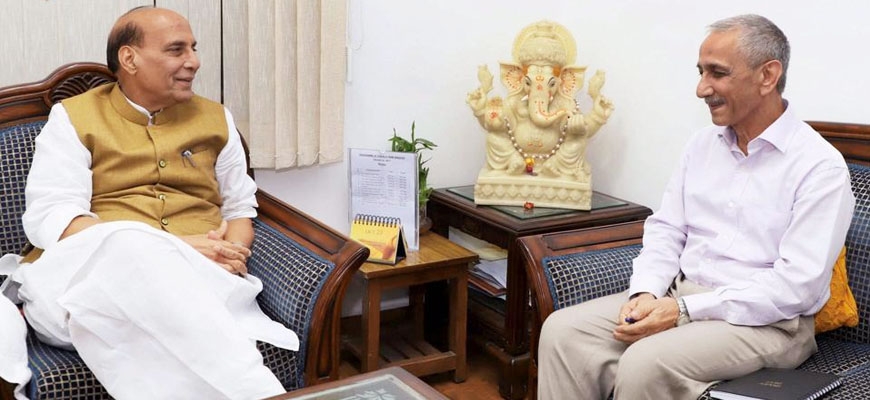
The interlocutor Shri Dineshwar Sharma is an apt choice. He has worked in J&K and has the necessary experience. Having been in the Intelligence department, he also possesses the required knowledge of the subject. Additionally, his police background would have also given him the necessary ability to interact with different sections of the civil society. He needs and deserves our collective goodwill for success in the difficult task assigned to him. The inputs provided by him would be crucial in framing the policy at the Centre.
A word of caution may be in order. The talks have been made possible by relentless pressure exerted by the Army. That tempo needs to be maintained without let-up. Our experience in the northeast had been that the insurgents used the lull to make up on the deficiency of arms, equipment and recruitment.
Secondly, Pakistan, obviously rattled by the prospects of peace, will try to send in more jehadis to keep the problem alive. Therefore, our surveillance at the LoC should continue and in fact, should be further bolstered to thwart attempts at infiltration. Lastly, there must be no softening up of the ongoing investigation by the NIA. Those against whom evidence of wrongdoing gets found must be dealt with sternly.