Taking oath of accelerating climate action, BASIC countries hold 29th ministerial meeting
Total Views |
Beijing, October 26: The 29th ministerial meeting of the BASIC (Brazil, South Africa, India, China) countries on Climate Change at Beijing, China on October 25 and 26 concluded today, in which, the ministers hailed the 10th anniversary of the BASIC Group and agreed to further strengthen the solidarity and cooperation among the four countries. Union Environment Minister Prakash Javadekar had participated in the meeting.
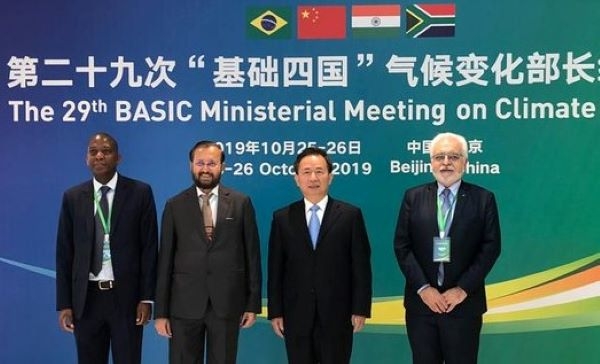
The meeting was chaired by LI Ganjie, Minister of Ecology and Environment of the People’s Republic of China.
BASIC Ministers expressed their concern for the global challenge of climate change and its adverse effects, and confirmed their commitments to multilateralism in order to address the issue and to foster climate resilience and promote greenhouse gas emissions reduction, low-carbon and sustainable development, with a view to collectively working towards preparedness of international community for the wellbeing of all.
Ministers underscored that all parties should jointly defend the international system underpinned by the United Nations, in accordance with the principles of equity, common but differentiated responsibilities and respective capabilities (CBDR-RC), in the light of different national circumstances.

BASIC Ministers emphasized the faithful and comprehensive implementation of the Paris Agreement, in particular of its goals and principles, and underlined the importance of a full, effective and sustained implementation of the United Nations Framework Convention on Climate Change (UNFCCC), its Kyoto Protocol and its Paris Agreement, in accordance with the principles of equity, common but differentiated responsibilities and respective capabilities (CBDR-RC), in the light of different national circumstances, as well as the nationally- determined nature of the Paris Agreement.
India has already achieved 21% reduction in emission intensity of GDP in 2014 compared to 2005 levels, thereby achieving its pre-2020 voluntary target. In 2015, Brazil had already achieved a 58% emission reduction in the business as usual scenario set for its NAMAs, thereby overachieving its target of 36%- 39% reductions set for 2020.
Ministers valued the 187 ratifications of the Paris Agreement to date, called on all remaining Parties to ratify, and welcomed the implementation of the Agreement in the post-2020 period. The Group also underscored Kyoto Protocol as the significant milestone in the multilateral climate process. Ministers also welcomed the 134 ratifications, to date, of the Doha Amendment to the Kyoto Protocol and recalled that only 10 acceptance instruments are outstanding for the amendment to enter into force. They urged the Parties that have not yet ratified the Doha Amendment to do so as soon as possible, striving for its prompt entry into force before COP25.
Ministers urged developed countries to propose the new collective quantified goal on finance as soon as possible, including detailed roadmap and timetable. The goal should be from a floor of USD 100 billion per year, significantly publicly funded and of greater transparency.
Ministers underscored the importance of concluding the discussions on Article 6 of the Paris Agreement, in accordance with the mandates and principles set out in the Agreement and the accompanying decision, including ensuring environmental integrity and avoiding double counting.
The Ministers restated that decisions on other subjects should not pre-empt discussions under Article 6, and the issues should be addressed in a balanced and inclusive manner. Ministers also welcomed the review of the Warsaw International Mechanism for Loss and Damage associated with Climate Change Impacts based on the mandates.