India Names Lonar Lake, Sur Sarovar As Wetlands Of International Importance
Total Views |


New Delhi, November 16: Minister of Environment, Forest and Climate Change Prakash Javadekar has named Lonar lake in Maharashtra, and Sur Sarovar in Agra as the international importance under the treaty of Ramsar Convention.
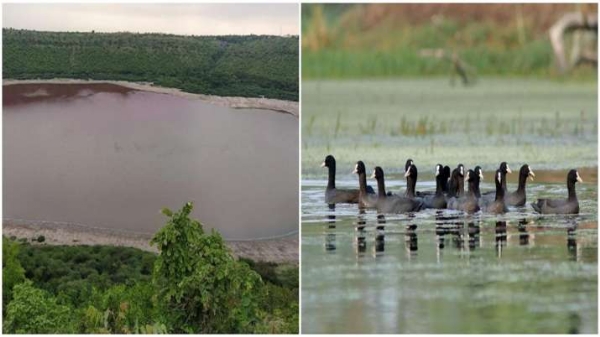
Announcing the news via Twitter Javadekar tweeted, “Happy to note that India has added two more Ramsar sites. Lonar lake in Maharashtra, the only crater lake of the country, and Sur Sarovar, also known as Cheetham lake in Agra. Wetlands are the world’s natural water filters and one of the most productive ecosystems on the planet.”
Happy to note that India has added two more Ramsar sites.
— Prakash Javadekar (@PrakashJavdekar) November 15, 2020
🔹Lonar lake in Maharashtra, the only crater lake of
Country.
🔹Sur Sarovar, also known as Keetham lake, in Agra.
Wetlands are the world's natural water filters &one of the most productive ecosystem on the planet. pic.twitter.com/SCSJypHusB
Sur Sarovar is also known as Keetham lake and is about 20 km from Agra. The entire lake is formed in a catchment area of 7.13 km². Keetham Lake is pentagonal in shape. There are artificially created islands for shelter and breeding grounds for the migratory birds. The best thing is that is placed on the way of Delhi and tourist can visit during their journey to Agra.
The Site is important for bird species that migrate on the Central Asian flyway, with over 30,000 waterbirds known to visit the reservoir annually. Over 1% of the South Asian regional population of the greylag goose (Anser anser) is present.
On other hand, Lonar Lake is a saltwater lake located at Lonar in Buldhana district, Maharashtra. It was created by an asteroid collision with the earth's impact during the Pleistocene Epoch. The Site includes the lake as well as escarpments, which form the crater walls, and forested zones. The lake is high in salinity and alkalinity, as the lack of an outflow leads to a concentration of minerals as the lake water evaporates. Specialized micro-organisms such as anaerobes, cyanobacteria, and phytoplankton survive in this harsh chemical environment.
This move is expected to lead to better conservation of Lonar Lake, as Ramsar Convention is for the conservation of wetlands. The importance of the lake's ecosystem and biodiversity is rising due to the algal population & other micro-organisms in the lake & flora-fauna around the lake.
The Ramsar Convention on Wetlands of International Importance Especially as Waterfowl Habitat is a treaty for the conservation and sustainable use of such sites. It is named after Ramsar, the Iranian city where the treaty was signed in 1971, and places are chosen for conservation under it are given the tag ''Ramsar site''.
The aim of the Ramsar list is to develop and maintain an international network of wetlands which are important for the conservation of global biological diversity and for sustaining human life through the maintenance of their ecosystem components, processes, and benefits. Wetlands declared as Ramsar sites are protected under strict guidelines of the convention.
Apart from these two India has 38 wetlands including Chilika Lake in Odisha, Keoladeo National Park in Rajasthan, Harike Lake in Punjab, Loktak Lake in Manipur, and Wular Lake in Jammu and Kashmir.
Wetlands provide a wide range of important resources and ecosystem services such as food, water, groundwater recharge, water purification, flood moderation, erosion control, and climate regulation. Over 170 countries are party to the Ramsar Convention and over 2,000 designated sites covering over 20 crore hectares have been recognised under it.