Kamala Harris Not Good News For India!
Total Views |


!As the US election going into full swing, Joe Biden picks Indian-American and an African-American Kamala Harris as his running mate in the November US Presidential election. Harris’ selection as the presidential nominee is being celebrated with much enthusiasm in India, bringing a lot of cheer amongst the Indians. From politicians to netizens, from newspaper headlines to tweets, people have expressed their pride and joy over an "Indian" origin woman who could be vice-president of the United States come January 2021. This move to name Kamala Harris is expected to give Biden votes from the large Indian diaspora in the United States. If Harris is elected she would be the first woman vice president ever for the country. But is she really good news for India?
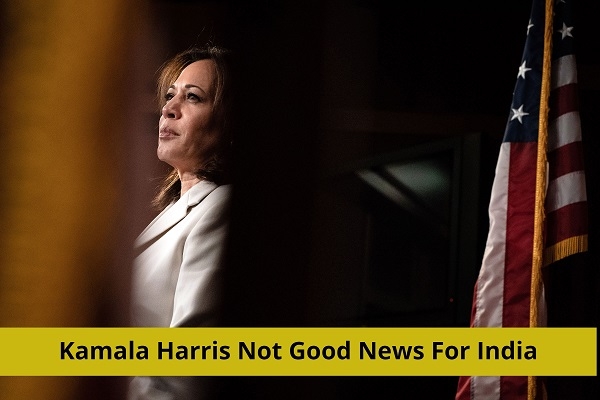
Calls herself as 'African-American'
Describing herself as African-American in the US census itself says a lot about her identity. Harris and her sister Maya were raised by their mother after her Indian-born mother and Jamaican-born father had divorced when she was seven years old. In her 2019 memoir, 'The Truths We Hold: An American Journey', she refers to her mother as "the reason for everything", and writes that "there is no title or honor on earth I’ll treasure more than to say I am Shyamala Gopalan Harris’s daughter". She credits her mother for many of her political beliefs. But, she grew up identifying more as an African American than Indian Americans and officially calls herself as 'African-American'.
Ha ha Indians are so predictable for whites, to attract Pakistani votes they didn’t hire a Pakistani American but an American of Indian origin who is Pro Pak, after studying LaxmiBai’s struggle I understood one thing, yeh desh dushmanon ne kum aur apnon ne zayada loota hai.. 🙂 https://t.co/crjR4FMDkQ
— Kangana Ranaut (@KanganaTeam) August 14, 2020
Critical about Abrogation of Article 370
After choosing a career in law, Harris has been known to take tough positions on law and order and has been a strong advocate of human rights. She leaves no opportunity to lecture India on human rights. One includes her stand against India's Kashmir decision. She has openly opposed the removal of 370 from the Kashmir and Citizenship Amendment Act (CAA). When last year she was running her campaign for the Democratic nomination she was asked about Kashmir’s "human rights abuses" and the clampdown on communication and other restrictions imposed in the region after the abrogation of article 370, She said that "We have to remind the Kashmiris that they are not alone in the world. We are keeping track of the situation. There is a need to intervene if the situation demands." She also backed the demand for intervention.
At the same event, she also said, "It comes under American values to raise the issue of human rights." If she will be elected as President, she will follow the same values. She took a dig at President Donald Trump for not having a full-time US ambassador in Pakistan at this time. She said that if the US wants to take any effective step on the Kashmir issue, then there is a need for deployment of an American ambassador in the region.
The Jaishankar-Jayapal incident
Moreover, Harris has also backed another Indian-American Congresswoman, Pramila Jayapal, who stood against the abrogation of Article 370 and introduced a Congressional resolution on Kashmir urging India to lift as swiftly as possible all restrictions on communications in Jammu and Kashmir which were imposed following the abrogation of Article 370 on 5 August. She lashed out at External Affairs Minister S Jaishankar for not meeting her colleague Pramila Jayapal. "It's wrong for any foreign government to tell Congress what members are allowed in meetings on Capitol Hill," on Twitter at that time.
It’s wrong for any foreign government to tell Congress what members are allowed in meetings on Capitol Hill. I stand with @RepJayapal, and I'm glad her colleagues in the House did too. https://t.co/PpbDoB0zKB
— Vice President Kamala Harris (@VP) December 20, 2019
Criticism from US Sikhs
In July 2019, Harris faced a lot of criticism as supported the discriminatory policy in 2011 that prohibited state prison guards from keeping beards for religious reasons, even though exceptions were given for medical reasons. A group of Sikh activists had launched an online petition asking her to apologize to the community.
Harris has remained a tough critic of India’s domestic policies under Prime Minister Narendra Modi. It worth to be noted that Harris is one of the leaders who had boycotted the ‘Howdy Modi’ event in Texas.
It not only Harris but Biden has also been critical of the CAA and also asked New Delhi to take all necessary steps to restore the rights of the people of Kashmir. “In Kashmir, the Indian government should take all necessary steps to restore rights for all the people of Kashmir. Restrictions on dissent, such as preventing peaceful protests or shutting or slowing down the Internet, weaken democracy,” he said.
Harris is not averse to the Indian vote bank in the US but she has a very different stance against India that unsettles policymakers in New Delhi. After all the Harris might not be as favorable to India as the current Republican government. She can become a real threat to India.