Who is Pradeep Kumar Rawat, India's new envoy to China?
Ambassador Rawat speaks fluent Mandarin and has served in Hong Kong and China between 1992 and 1997.
Total Views |


Beijing, Mar 14: India’s new envoy to China Pradeep Kumar Rawat assumed charge on Monday. Pradeep Rawat was appointed as the next Ambassador of India to China in December last year. Rawat earlier served as the envoy to the Netherlands. “H.E. Shri. Pradeep Kumar Rawat, Ambassador of India to the People’s Republic of China assumed charge @EOIBeijing today,” Indian Embassy in China said in a tweet.
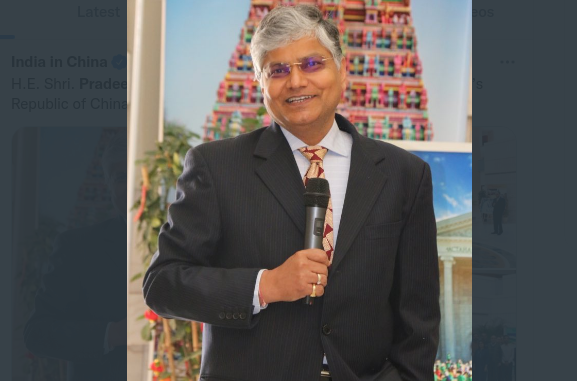
Ambassador Rawat succeeds Vikram Misri, who was appointed as the Deputy National Security Advisor. According to a Ministry of External Affairs (MEA) release, Rawat has spent the majority of his diplomatic career handling Beijing from Delhi and was the joint secretary (East Asia) from 2014 to 2017.
H.E. Shri. Pradeep Kumar Rawat, Ambassador of India to the People’s Republic of China assumed charge @EOIBeijing today. pic.twitter.com/8LA1qGsOgt
— India in China (@EOIBeijing) March 14, 2022
Ambassador Rawat speaks fluent Mandarin and has served in Hong Kong and China between 1992 and 1997. He returned to Delhi in 1997 and served in East Asia Division for over 3 years and went on to serve as First Secretary in Indian Mission in Mauritius. Notably, he was joint secretary (East Asia) in the MEA when the Doklam border stand-off took place in 2017. He was involved in the negotiations during the early days before moving to Indonesia as an ambassador.
Later on, Rawat served as India’s envoy to Indonesia and Timor-Leste from September 2017 to December 2020. In 2021, he was appointed as India's Ambassador to the Netherlands and was the Permanent Representative of India to the Organization for the Prohibition of Chemical Weapons from January 2021-February 2022.
His appointment came at a time when India and China have engaged in military conflict since June 2020 with no breakthrough coming even after 15 round of high-level military talks.
Also Read: Border disputes shouldn't impact interests of bilateral cooperation: Chinese Foreign Minister
The MEA said in its annual report that the two sides have agreed to manage their differences and not allow differences on any issue to become disputes. Further, India and China agreed that pending the final settlement of the boundary question, maintenance of peace and tranquility in the border areas is an essential basis for the overall development of the bilateral relationship.
However, since April-May 2020 the Chinese side undertook several attempts to unilaterally alter the status quo along the Line of Actual Control (LAC) in the Western Sector, which seriously disturbed the peace and tranquility along the LAC in the Western Sector.
“These attempts were invariably met with an appropriate response from Indian Armed Forces,” MEA said and added that the continued unilateral attempts by China to change the status quo have impacted the bilateral relationship since then.