Article 370 Was Never Permanent
The first public protest against Article 370 started in the year 1952. Dr Syama Prasad Mookerjee and other opposition leaders put pressure on the Government to abolish the Article.
Total Views |


Ajit Prasad Jain served as Minister with cabinet rank in charge of the Ministry of Rehabilitation in the first Lok Sabha. He has written a book titled, ‘Kashmir: What Really Happened’ which includes surprising information related to Article 370. He wrote, “The draft was approved by the Sheikh and his colleagues. The Congress party passed it (p.81).” It is clear that neither this Article went to the Drafting Committee nor any expert of the constitution was consulted. This was the single Article of the Indian Constitution that was drafted in Srinagar and approved behind the closed doors of the Indian National Congress office.
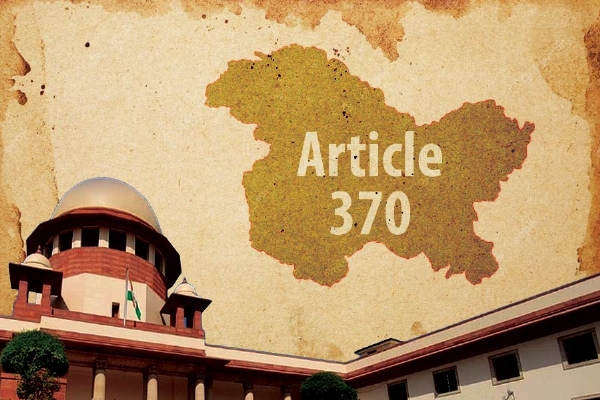
The first public protest against Article 370 started in the year 1952. Dr Syama Prasad Mookerjee and other opposition leaders put pressure on the Government to abolish the Article. Eventually, Prime Minister Nehru was forced to reply in this regard. Highlighting India’s relations with Kashmir in Lok Sabha on 7 August,
1952, he said, “Article 370 was transitional.” Further in the same debate, he described, “Article 370 is obviously like a transitional Article, but it lays down the process of change.”
Unfortunately, in the meantime, Dr. Mookerjee died untimely in Srinagar. Subsequently, no specific action was taken in Parliament against the Article. Attention towards Article 370 comes again when Deputy Minister of Law, R.M. Hajarnavis presented the Personal Laws (Extension) Bill on 17 November 1959. On this motion, the next speaker was Pratap Singh Daulta who represented Jhajjr
Rewari constituency from the Communist Party of India. He was the first communist to speak against Article 370, “This Parliament has members from Kashmir but, at the same time it has no power to legislate on matters relating to Kashmir.”
The statement of Daulta revived the issue once more time, whose reflection was visible at the beginning of the third Lok Sabha. During this tenure, Hari Vishnu Kamath asked a question on 8 June 1962 in Lok Sabha, “Whether the Government propose to amend the Constitution by repealing Article 370.” Minister of State in the Home Ministry, B.N. Datar responded, “The question will be considered at the appropriate time.” Kamath questioned again, “Because according to the Constitution, this Article 370 is temporary and transitional, is it going to
be indefinitely temporary and transitional, or has the Government set a date for its abrogation of is considering or thinking of setting a date of its abrogation.” Datar replied, “No such date has been but may I point out to the honourable member that after 1950 on four or five occasions changes or modifications have been made so far as the relations with Jammu and Kashmir State are concerned.” However, the Government has not fixed any date but they never said that Article 370 is permanent.
In this period many parties and their Members of Parliament started speaking against Article 370. For example, the Delimitation Commission Bill was moved on 30 November 1962 by Bibudhendra Mishra who represented Puri from Congress. Speaker of Lok Sabha fixed the next week for discussion or consideration on the
motion. Mishra himself, Kamath, P.K. Deo from Kalahandi (Swatantra Party) and some other members had suggested that Jammu and Kashmir should have been included within the scope of this Bill. All the members expressed concern over this and hoped to bring Jammu and Kashmir under this bill soon.
Prime Minister Nehru made his famous statement on 27 November 1963, “So we feel that this process of gradual erosion of Article 370 is going on.” Nowhere is it recorded in the Constitution that Article 370 will be abolished automatically with time? Article 370 has been in force for the last 13 years, thus, too much time has passed to abolish it. In this third Lok Sabha, many Members of Parliament including Congress had the same desire that it should be completely erased from the Constitution.
Eminent Congress leader M.C. Chagla was among those supporting such demand. He said on 24 February 1964, “I hope, the Prime Minister is here; he used the expression gradual erosion of Article 370, I hope that erosion will be accelerated. I hope and trust that very soon Article 370 will disappear from our constitution. Let us not forget that Article 370 is in a part which talks of transitional and temporary provisions. I think the transitional period has been too long.”
After this, these kinds of demands started happening continuously. U.M. Trivedi from Bharatiya Jana Sangh on 13 February 1964, “What prevents us from dropping out Article 370 now? A resolution can be passed. Those people are prepared to pass the resolution. The Assembly is prepared to pass the resolution. Let us say, we have committed a mistake and let us abide by the mistake.”
Surendranath Dwivedy was elected from Kendrapara (Praja Socialist Party) said on 14 April 1964, “Article 370 of the constitution should have been abrogated…… All democratic laws in this country should have been made applicable to Kashmir also.”
On 25 March, 1964 Hari Vishnu Kamath, Yashpal Singh and P.C. Barooah asked an oral question to the Minister of Home Affairs, “whether his attention has been drawn to the fact that the Chief Minister of Jammu and Kashmir has expressed himself in favour of full integration of that State with the rest of the Indian Union by the repeal or abrogation of Article 370 of the constitution.” Minister replied, “I have seen reports of the press statement made by Shri G.M. Sadiq. The matter is under consideration.”
Ghulam Mohammad Sadiq was the Chief Minister of Jammu and Kashmir from 1964 to 1965. He wrote an article in The Hindustan Times on 26 November 1963 under the heading, ‘Article 370 and What is Good for Kashmir’. He divided this article into three parts, in the first part Sadiq put forward the Government’s side, then reviewed the perception of those who want to remove the article.
In the end, he put his view, “The authors of the Article had envisaged raising the standard of administration in the State to bring it to the same level as in the other State. It is time now to modify this Article in such a manner as to make the rest of the provisions of the Constitution applicable to the State to enable the people to derive complete benefits from the welfare measures adopted in social, economic and educational fields. The legislation so far enacted by Parliament had taken due note of the interests of labour and the investing public against the machinations of unscrupulous elements in trade and industry, but the advantages of such laws will be available in the State only after the Constitution applies to the State in its entirely.”