NB Explains | Was G20 Foreign Ministerial meet in India, a failure?
For India to organize the G20 summit in such a conflicted time was a huge challenge and if anything, India should be praised was that it was instrumental in getting everyone together under the same roof.
Total Views |


The much-anticipated G20 foreign ministers meeting concluded in New Delhi on Thursday. Over 40 delegations, including the foreign ministers of almost all the G20 nations, travelled to India, which holds the G20 presidency this year. The meeting’s outcomes had mixed reactions. Newsbharati will explain it to you-
Notably, the G20 foreign ministers meeting was the second ministerial meeting of India’s G20 presidency after the finance ministers meeting, which concluded in Bengaluru in late February. The latest meeting saw the world’s top diplomats, including US Secretary of State Antony Blinken, Chinese Foreign Minister Qin Gang, and Russian Foreign Minister Sergei Lavrov descend on New Delhi.
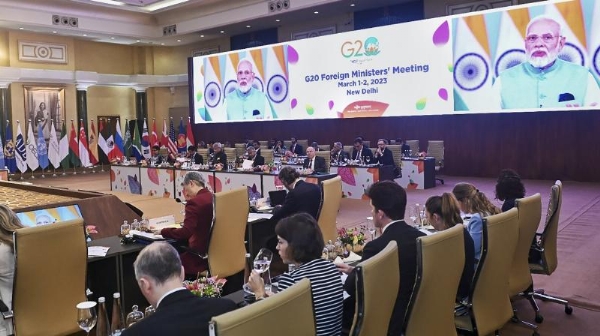
In his welcome remarks, Prime Minister Narendra Modi acknowledged the divisions among G20 members but urged nations to cooperate in the interests of the wider world.
After the conclusion of the foreign minister's meeting, they agreed on a range of challenges, including food security, reforming multilateralism, and protecting biodiversity except the Russia-Ukraine war. Against the backdrop of this setback, the G20 countries were unable to agree to a joint communique. Russia & China refused to include criticism of Russia over the conflict with Ukraine which the West insisted on.
No Joint Statement Released
No Joint Statement Released
This grabbed global headlines mainly focussing on the failure to release a joint statement, which India tried hard to secure. This showed that tensions between West vs Russia & China will continue no matter what. Now, such disagreements over Ukraine may obscure agreement on other issues & cast a shadow over India's G20 Presidency.
However, one should understand that a joint statement is not possible with the current issues prevailing because it has been a year since the Russian invasion of Ukraine, and in that time ideological divisions between both the sides have only become rigid as there seems to be no end in sight to the military conflict. So, the chances of reaching on an agreement were therefore low.
Apart from this, for India to organize the G20 summit in such a conflicted time was a huge challenge. If anything, India should be praised was that it was instrumental in getting everyone together under the same roof. For e.g. the significant milestone was US Secretary of State Antony Blinken and Russian Foreign Minister Sergey Lavrov meeting for the first time since the Ukraine invasion, even as initial reports suggested that they might not. Even though the face-to-face meeting lasted barely 10 minutes.
But a Summary was published.....
But a Summary was published.....
Further, the Chair’s Summary and Outcome Document issued at the end of the foreign ministers’ meeting was a rather innovative alternative to any watered-down joint statement, and perhaps a model to be followed in other multilateral groupings. The document stated that “All G20 Foreign Ministers agreed to paragraphs 1, 2 and paragraphs 5 to 24". So, it was only the those two paragraphs that were not agreed upon. So, India should take credit where it is due. But this also means expectations from the country will be high going forward.
Paragraph 3 of the Outcome Document "deplores in the strongest terms the aggression by the Russian Federation against Ukraine and demands its complete and unconditional withdrawal from the territory of Ukraine".
Paragraph 4 notes, "It is essential to uphold international law and the multilateral system that safeguards peace and stability" and also has reference to Prime Minister Narendra Modi’s declaration when he met Russian President Vladimir Putin last year, stating, “Today’s era must not be of war."
For a country that has traditionally preferred abstention to vote at the UN, India appears to have stated its preference clearly by siding with the majority on paragraphs 3 and 4. However, the G20 document is not legally binding. If anything, the only thing New Delhi is consistent about is its desire to balance between the West on the one side and the Russians and the Chinese on the other in its quest to have the best of all worlds and for national interests.
With so many positives in India's favor which striving to become a global power, it is a bit unfair to judge the meeting solely on one metric i.e. securing a joint statement.