Brisbane Khalistan Referendum Online voting hit by Massive cyber-attack leading to its Crash
Total Views |


The Khalistan Referendum voting was hit by a massive cyber security attack within 30 minutes after it began.
 The Ministry of External Affairs spokesperson Arindam Bagchi in his media talk confirmed that a group of Sikhs protestors had entered the consulate and work was halted. He added that India has taken up the issue with the Australian authorities.
The vote began at 9 a.m. sharp at the Brisbane Convention and Exhibition Centre, with Sikh holy prayers. It went nicely for the first 30 minutes, but suddenly the entire electronic voting system broke due to a cyber-attack.
The vote was organised by the pro-Khalistan secessionist organisation Sikhs For Justice (SFJ), which claims the attack was well-planned and well-coordinated. They went on to say that the cyber-attack was carried out by Indian government agencies.
They said that this was not the first time the Khalistan Referendum voting had been criticised.
On Sunday, while the system was disrupted, thousands of Khalistani terror supporters waited in lines outside for it to reopen. The internet portal designed specifically for secure voting on the topic of "Secession of India from Punjab" broke down, and the system displayed the message: "Your connection is not private." Attackers may attempt to steal your information from the website (such as passwords, messages, or cards)."
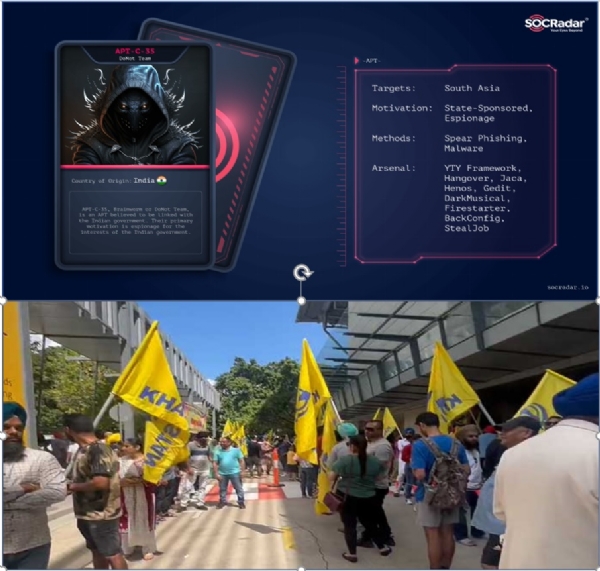
Qihoo360 Technology, a large software business located in Beijing, produced a cyber-security study claiming that in India, Sikhs with religious and political inclinations, Khalistan Referendum 2020 websites and mobile applications are under attack by an Indian cyber mercenary outfit known as "APT C-35."
APT C-35 cyber mercenaries have established many phishing websites and mobile applications connected to Referendum 2020 as bait to target pro-Khalistan Sikhs in India. According to the Qihoo 360 Core Security team, "there is an ongoing phishing and spyware distribution campaign targeting Sikhs in India." There are roughly 30 million Sikhs, adherents of a 15th-century monotheistic faith, the majority of whom (83%) live in Punjab, India."
Few days before the March 19, voting by pro-Khalistan secessionist group Sikhs For Justice (SFJ), Indian External Affairs Ministry spokesperson Arindam Bagchi stated that Prime Minister Narendra Modi discussed with his Australian counterpart Anthony Albanese recent alleged incidents of temple attacks in Australia as well as pro-Khalistani activities in that country.
According to reports, Indian Prime Minister Narendra Modi discussed the matter with the Australian government after over 50,000 Khalistanis Terror supporters voted in the first part of the Khalistan Referendum in Melbourne at the end of January this year. Clashes broke out on the streets outside the voting place between Khalistani supportive Sikhs and Hindu organisations, and several people were arrested.