Hindu Americans call for protection against rising Hinduphobia and Caste Bill, US lawmakers stand in support
Total Views |


The Coalition of Hindus of North America (CoHNA) emphasised the issues that Hindus confront in the United States, including increased religious violence, Hinduphobia, caste restrictions, and academic prejudice. The Coalition of Hindus of North America (CoHNA) organised the 'National Hindu Advocacy Day on the Hill' on US Capitol Hill. A number of congressmen, both Republicans and Democrats, attended the event, including Congressman Rich McCormick, Indian American entrepreneur turned politician Sri Thanedar, Buddy Carter of Georgia, Congressman Thomas Keane, and Hank Johnson.
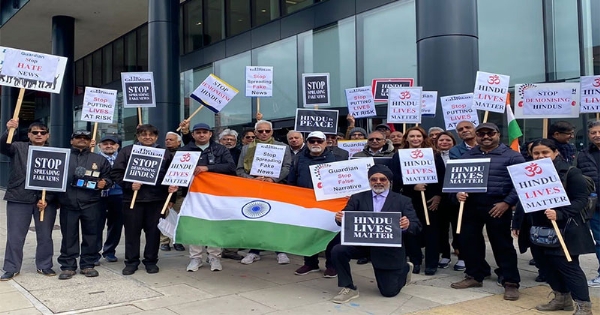
Congressman McCormick, a staunch supporter of the Indian American community, hailed the 'hard-working', harmonious, and peaceful US Hindu population of around three million people, who had made significant contributions to the nation and society, particularly in his area. On February 21, Seattle became the first city in the United States to prohibit caste-based discrimination by including it in its anti-discrimination statutes.
SB 403 aimed to include caste as a new category under the state's non-discrimination statute, but it currently enumerates caste as one of several protected classes under the wider umbrella of "ancestry." "I believe it is racist and divides people in a divisive way." I've also been public in my opposition to intimidation. We will confront them publicly or personally, if necessary, because they should not exist right here in America..." McCormick stated to ANI.
Hindus in America are a lively and diversified population that has made major contributions to American growth, well-being, and democracy, especially during the COVID-19 epidemic.
Indian-American Congressman Shri Thanedar was the sole Indian-American US legislator to attend the Hindu advocacy day on Capitol Hill on Tuesday. When asked about the event, Thanedar stated that he is there to support the Hindu community and thinks that everyone has the freedom to practise their faith without fear of hatred, intolerance, or physical harm.
"I am here to show them my support because I believe that everyone has the right to practise their religion without fear, bigotry, hatred, or any other type of attack or phobia." And I am a great believer in religious liberty. And I've come to help the Hindu community. In addition, I am a US Congressman who founded the Hindu caucus in the US Congress." Thanedar explained.
Hindu American students, employees, and community members may be found throughout the country and have been a part of the American fabric for decades. Despite this, records reveal that just one in every four Americans knows a Hindu, and according to 2020 FBI data, hate crimes against Indian Americans are risen 500%. Salvatore Bobonus, associate professor at the University of Sydney and executive director of the Indian Century Roundtable in Sydney, Australia, and one of the event's presenters, told ANI, "Indians may be surprised to learn that caste has arrived in America, and in a big way." That is not to say that there is any true caste prejudice.
I'm referring to the politicisation of caste. "Caste reservations and disputes over who is classified as a Scheduled Caste will be very familiar to Indians," Salvatore said. CoHNA has sponsored multiple legislative briefings on various topics affecting the Hindu American community over the years, and it is spearheading efforts to educate stakeholders about Hinduism and the mounting challenges it faces in the United States through events such as its Hindu Advocacy on the Hill event.
Notably, caste structures exist among the region's Sikh, Muslim, Buddhist, and Christian groups, but casteism among Hindu South Asians has received more attention, notably in the United States, which has 5.4 million individuals of South Asian heritage. According to Pew Research Centre data from 2015, there are currently 2.23 million Hindus in the United States, making them the country's fourth biggest religious community after Christians, Jews, and Muslims. Hinduism is a religion of the Indic or Dharmic faiths family. In the United States, Hinduism is the largest dharmic tradition. Sikhism, with over 500,000 devotees, and Jainism, with around 180,000 adherents, are two additional dharmic faiths with significant numbers in the United States.
In the United States, there are also significant communities of Muslims and Christians from the Indian subcontinent. South Asian Muslims account for around 16% of Muslims in the United States (600,000 individuals). There are also minor numbers of South Asian Buddhists and Zoroastrians (Parsis) in the United States.
"So, in California, we're actually getting close to passing a law that, for the first time, will allow us to profile, single out, and discriminate against people based on something we can't control: our birth." This isn't just for those like us who have immigrated from India.
It's something that will last forever for our children. So whether you're second, third, or tenth generation Hindu, there's no end to being attacked for your ethnicity if you happen to be Hindu...": Pushpita Prasad, Member (COHNA) hindus-of-north-america">Coalition of Hindus of North America on Hindus in America.
According to Pew research, Indian Americans of Hindu faith have the highest retention of any religion in the United States, with a whopping 80% of individuals reared Hindu remaining identifying with Hinduism as adults. This is not unexpected given the diversity of Hinduism's intellectual and cultural traditions, which include monism, pantheism, panentheism, henotheism, monotheism, polytheism, and atheism.