India and Afghanistan: A Timeless Bond Navigating a Shifting Geopolitical Landscape
Pakistan wants a compliant government in Kabul to protect its western border and keep India out of Afghanistan. An independent and stable Afghanistan is thus a natural strategic partner for India.
Total Views |


India-Afghanistan relations are not the result of contemporary diplomacy but a fabric unwoven over millennia of common history, culture, and strategic necessity. From the resonance of the Indus Valley Civilization to the high-drama "Great Game" of the 21st century, this alliance has weathered empires, conquests, and ideologies. Today, when the geopolitical sands of the region are changing in monumental ways due to the US departure and the re-emergence of the Taliban to governance, realizing this age-old bond is more important than ever to unlock the destiny of South and Central Asia. Their modern-day relationship rests upon the foundation of their historical interaction.
Ancient and Medieval Ties: The ties trace back to the Indus Valley
Civilization. Following Alexander the Great's short invasion, the area now known as Afghanistan was relinquished to the Mauryan Empire of Emperor Chandragupta Maurya in 305 BCE. The Mauryans brought Buddhism, which left an indelible religious and cultural imprint. For many centuries, empires born in Afghanistan, like the Ghaznavids, Khiljis, and Mughals, influenced the Indian subcontinent's political and cultural reality and resulted in a major people-to-people exchange, ideas, and traditions.
The Colonial Era and Beyond: During the British Raj period, Afghanistan was the focal point of the "Great Game" between the British and Russian Empires. Interestingly, Khan Abdul Ghaffar Khan, the "Frontier Gandhi," was a die-hard supporter of the Indian National Congress and embodied the common struggle against colonialism and intense ideological identification. This continuum of the past illustrates how much more than a neighboring state Afghanistan is for India, it is a partner of civilizations.
The Post-Independence Engagement: A Rollercoaster of Relations
After India's independence in 1947, it actively sought to build a strong relationship with Afghanistan. The 1950 "Friendship Treaty" solidified initial bonds. India enjoyed robust relations with King Zahir Shah and maintained diplomatic ties with successive Soviet-friendly governments in Kabul, even during the Soviet invasion of 1979. While India's role was limited during the anti-Soviet jihad, it continued developmental projects focused on infrastructure, irrigation, and hydroelectricity.
The Taliban Era and Strategic Support: The rise of the Pakistan-backed Taliban in the 1990s posed a severe challenge. India, viewing the Taliban as a proxy and a security threat, closed its embassy and threw its support behind the anti-Taliban Northern Alliance, in coordination with Russia, Iran, and
Tajikistan. This period was marked by security nightmares, including the hijacking of IC-814 to Kandahar, which underscored the direct threat posed by Taliban-sanctioned terrorism to India.
The Post- 9/11 Renaissance: The US-led ouster of the Taliban in 2001 opened a golden era for India-Afghan relations. India became a key partner in reconstruction and nation-building, investing over $3 billion in high-visibility, high-impact projects that won the hearts of the Afghan people. These included:
- The Salma Dam (Afghan-India Friendship Dam) in Herat.
- The new Afghan Parliament Building in Kabul, a symbol of democratic
- solidarity.
- The Zaranj-Delaram Highway, a critical infrastructure link providing
- Afghanistan an alternative route to the sea via Iran's Chabahar port.
This developmental approach, focused on "soft power," earned India immense goodwill and established it as a reliable and benevolent partner, in stark contrast to Pakistan's influence through coercion and support for militant groups.
Strategic Relevance in Today's Geopolitical Scenario
The US withdrawal and the Taliban's ascendance in 2021 have fundamentally altered the regional balance of power, thrusting the India-Afghan relationship into a period of intense uncertainty and strategic recalibration. The relevance of this partnership today can be analyzed through three core lenses:
1. Strategic and Security Imperatives:
Afghanistan has always been the focal point of the India-Pakistan security rivalry. Pakistan wants a compliant government in Kabul to protect its western border and keep India out of Afghanistan. An independent and stable Afghanistan is thus a natural strategic partner for India, debarred from being used by Pakistan as a launching pad for proxy wars against it. India's central security anxiety is that Afghanistan cannot become again a haven for anti-India terrorist organizations such as Lashkar-e-Taiba and Jaish-e-Mohammed. The 1990s are a stark reminder of the danger. The emergence of ISIS-Khorasan (ISIS-K) is an added dimension to regional security. Afghanistan is a chessboard once again for regional and international players. China is reaching out to the Taliban to shield its Pakistani and Xinjiang investments from militancy. Russia is seeking to develop relationships in order to battle drug
trafficking and increase its reach. Iran wants stability for its trade while trying to deal with a huge refugee crisis. India has to maneuver through this web to safeguard its interests.
2. Economic and Connectivity Aspirations:
Mineral Wealth: Afghanistan sits on untapped mineral resources estimated to be worth $1-3 trillion, including lithium, copper, iron ore, and rare earths. Indian investment and expertise could be crucial for their extraction, benefiting both nations.
Regional Connectivity: Afghanistan is the linchpin for India's connectivity ambitions with Central Asia. The Chabahar Port in Iran, developed with Indian investment, is a strategic masterstroke to bypass Pakistan and create a reliable trade route to Afghanistan and beyond. Initiatives like the International North-South Transport Corridor (INSTC) and the activation of the TIR convention further underscore India's intent to integrate Afghanistan into regional economic networks.
3. The Diplomatic Dilemma: Engaging with the Taliban
The most significant challenge for India today is its approach to the Taliban. For two decades, India backed the internationally recognized Afghan government and built its policy on constitutional democracy and republic values. The US-Taliban deal in Doha and the subsequent collapse of the Afghan government forced a reluctant regional recalibration. Global powers like the US, Russia, and China, eager to exit or engage, have accepted the Taliban as a central political reality, much to Pakistan's diplomatic advantage. India's immense soft power, built over 20 years of developmental work, is its greatest asset. However, as former US President Donald Trump's mocking of India's role revealed, soft power has its limitations in a war-torn region. There is a vigorous debate in India on whether to continue with a purely developmental approach or to more aggressively pursue strategic and security partnerships, though direct military involvement remains off the table.
Conclusion: Navigating an Uncertain Future
The historic India-Afghanistan relationship stands at a critical crossroads. The deep civilizational and people-to-people bonds provide a strong foundation, but the current political reality demands ruthless pragmatism.
India's path forward is fraught with challenges but not without options. It must:
1. Protect its Interests: Continue backchannel talks with all Afghan factions, including the Taliban, to ensure the security of its personnel, projects, and strategic assets.
2. Leverage Regional Partnerships: Intensify dialogue with key stakeholders like Russia and Iran, reminding them that a total capitulation to Taliban demands would be detrimental to their own long-term security, given the threat
of radiating extremism and drug trade.
3. Champion the Afghan People: Use its diplomatic heft to ensure that any final political settlement does not completely reverse the gains of the last 20 years, particularly concerning human rights, especially for women and
minorities.
4. Double Down on Connectivity: Aggressively operationalize the Chabahar port and other trade corridors to maintain economic leverage and demonstrate India's value as a reliable long-term partner.
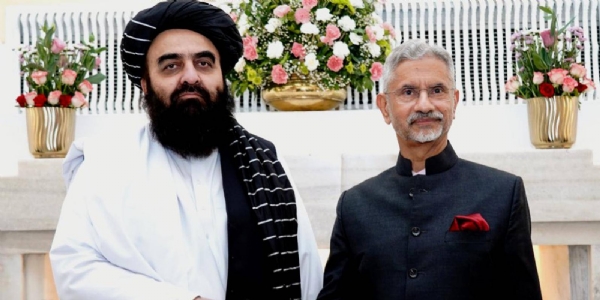
Indeed, the recent visit of Afghan Foreign Minister Muttaqi to India and his assurances that Afghan soil will not be used for anti-India activities mark a significant and pragmatic evolution in their historic engagement. This development represents a strategic masterstroke for New Delhi, allowing it to secure its core national security interests—primarily preventing Pakistan-backed terrorism from emanating from Afghan territory—while maintaining a principled distance from the Taliban's regressive ideology. By engaging directly with the de facto authorities, India is demonstrating a necessary realpolitik, ensuring it remains a relevant player in Kabul's political landscape and is not "out of the room" as Afghanistan's future is shaped. This calibrated engagement does not signify an endorsement but a crucial diplomatic channel to protect its substantial investments and regional standing.
Ultimately, it is a testament to India's mature statecraft, balancing its unwavering commitment to the Afghan people with the hard-nosed imperative of navigating a complex new geopolitical reality where the Taliban are an inescapable factor.
(Author Dr Alok Kumar Dwivedi holds a PhD in Philosophy from the University of Allahabad. He is currently working as an Assistant Professor at KSAS, Lucknow, which is the Indian research Centre of INADS, USA. Dr Alok's interests include philosophy, culture, society, and politics.)