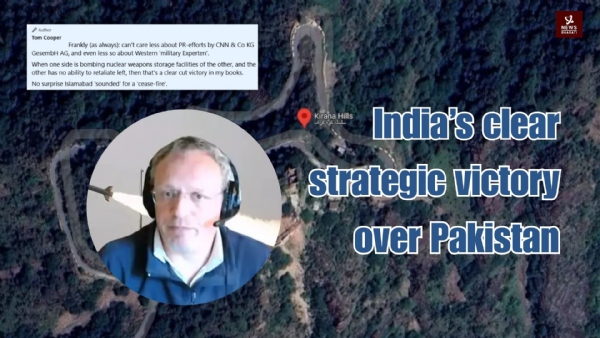
Austrian air warfare expert Tom Cooper recently gave a groundbreaking interview to journalist Navika Kumar on Times Now. What makes this moment remarkable is not just the expert insight, but the rare and bold endorsement by a foreign analyst of India’s clear strategic victory over Pakistan in their most recent confrontation. Cooper’s detailed breakdown highlights not only India’s operational precision but also a fundamental shift in its military doctrine.
A Voice of Credibility
Tom Cooper is no armchair commentator. Born in Vienna in 1970, Cooper is a respected military historian with more than 50 books and 1,000 articles on air warfare across the Middle East, Africa, and South Asia. His expertise particularly spans Cold War-era aircraft, Iran-Iraq conflicts, and now, South Asia’s volatile military dynamics. In his latest commentary, Cooper's deep dive into the 2025 India-Pakistan conflict offers not just validation of India's tactical brilliance, but recognition of its newfound strategic audacity.
A Precise Strike, A Clear Message
According to Cooper, the Indian Air Force (IAF) executed pinpoint strikes on critical Pakistani military infrastructure—most notably, its nuclear storage facilities. These strikes were not random acts of aggression but carefully calculated moves that rendered key Pakistani sites inoperable. The psychological and strategic signal was loud and clear: India has the means and the will to dismantle its adversary’s nuclear deterrence—if pushed.
India’s decision to neutralize the entry points of Pakistan’s nuclear bunkers was symbolic as much as it was tactical. Cooper emphasized that such action is only taken when the attacker is absolutely confident that the opponent lacks the capacity—or will—to respond effectively. Pakistan's muted response and subsequent outreach for ceasefire, Cooper asserted, was nothing short of an admission of defeat.
India’s Defensive Supremacy
Cooper lauded India’s integrated air defence, particularly the indigenous Akash system and the Russian-made S-400 missile shields, for neutralizing Pakistan's retaliatory attempts. Despite the deployment of Turkish drones and artillery reminiscent of the Russia-Ukraine war, Pakistan failed to breach Indian airspace or cause significant damage. This failure highlighted the growing technological and strategic gap between the two nations.
In another significant operation, India destroyed a Pakistani C-130 transport aircraft stationed at the Nur Khan Airbase and inflicted casualties on a key hangar strike—proof of India’s capacity to strike deep and with accuracy.
Strategic Clarity Under Modi Doctrine
Cooper pointed to what he calls a "fundamental shift" in India’s military posture under Prime Minister Narendra Modi. The long-held doctrine of "strategic restraint" has been replaced with decisive, preemptive action. This includes:
- Direct retaliation against terrorism.
- Rejection of nuclear blackmail.
- Equal treatment of state and non-state aggressors.
Cooper summarised this change with chilling precision: "India is no longer playing defense. It now hits where it hurts the most."
Challenging Western Bias
A notable part of Cooper’s analysis was his critique of Western media’s skewed narrative, which often downplays Pakistan’s terror ties and portrays India’s assertiveness in a negative light. He advised India to shed its hesitation in countering these narratives and embrace a firmer, unapologetic global posture.
The Endgame: Pakistan Cornered
Perhaps the most defining moment in Cooper’s assessment was his unequivocal statement that India had won; militarily, strategically, and psychologically. The erosion of Pakistan’s nuclear deterrence capability, coupled with its failure to retaliate effectively, marked the end of any real balance of power. With no cards left to play, Pakistan was forced to seek a ceasefire.
Tom Cooper’s frank and authoritative analysis marks a turning point in international recognition of India’s military capabilities. It validates India’s evolving doctrine and showcases a new geopolitical reality—where India no longer waits to respond, but leads the narrative, reshapes the battlefield, and asserts its strategic dominance.
The article is based on research provided by Vayuveg
--