Pakistan-China nexus
China has emerged as the single largest exporter of military hardware to Pakistan as far as the details of weapon systems used by Pakistan during our Operation Sindoor are concerned.


In the aftermath of the 4 days war between Bharat and Pakistan, we, in Bharat, have to sit down and very carefully analyse the adversary's strengths, weaknesses, its supporters and collaborators in future conflicts and roles which possibly will be played by major international powers.
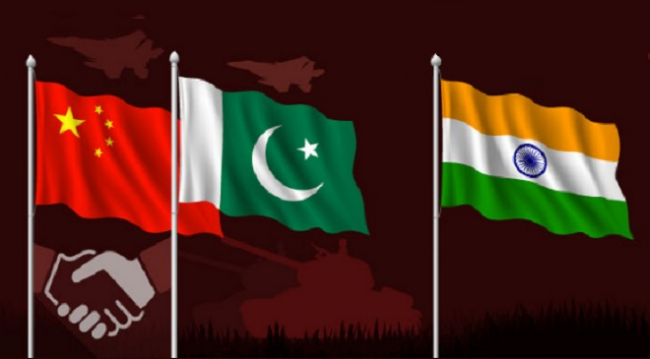
From China’s point of view, Pakistan’s geographical location and its ideological moorings, are a boon for it in respect of its sinister designs of cutting Bharat down to size, are concerned. China perceives Bharat as its formidable rival on the global stage; this perception is not the outcome of Bharat’s recent emergence as one of the global powers; this phenomenon was always a part of Mao’s imperialistic designs. Mao Tse Tung, first chairman of People’s Republic of China wanted to recapture the areas which once were held by Qing rulers; Xinjiang, inner Mongolia and Manchuria were incorporated in a span of 2-3 years and finally Tibet was invaded in the year 1950. Bharat’s indecisive leadership remained mute spectators and we lost a buffer state which separated us from the dragon.
After consolidating its geographical gains, China set its eyes on Bharat whom it considered as a big stumbling block on its way of realisation of westward expansion. In 1962 it stabbed Bharat in the back, blasted the Panchsheel Agreement signed by the then PM Nehru and Chinese premier Zhou Enlai, ridiculed the slogan “ Hindi Chini bhai bhai” and mounted an invasion on us. Yes, we were caught napping. Subsequent to that, camaraderie between China and Pakistan began. First thing Pakistan did was ceding 5180 square kilometers of Shaksgam Valley, a part of the Indian state of Jammu & Kashmir, illegally occupied by the former to China in the year 1963.
Pakistan wanted China to intervene in its favour in the two wars namely of 1965 and 1971 fought between the former and Bharat; however, due to the prevailing geo-political reasons China dragged its feet. In the year 1965, in the post Nehruvian era, both USSR and USA wanted to consolidate their respective presence in Bharat. Both of them wanted China not to intervene militarily in the war. However, by the time 1971 came, the USSR had already solidified its relations with Bharat and in retrospect, Smt Gandhi took a wise decision of signing the Treaty of Peace, Friendship and Cooperation with the Soviets before going into war with Pakistan. Not only did the USSR thwart American attempts to prevent surrender by the Pak forces, the former initiated troop movement also with its border with China to discourage it from poking its nose in the ongoing war between Bharat and Pakistan.
The beginning of the decade of seventies had an everlasting impact on global political alignments in general and for Bharat in particular. The then Pakistani foreign minister Z. A Bhutto facilitated the secret visit of his American counterpart Henry Kissinger to China in August 1971; it paved the way for the subsequent visit of the American president Richard Nixon to Beijing in the year 1972. Time only will tell how much the USA will repent for that visit; the plan which was conceived to contain the USSR, resulted in creation of an economic and military behemoth China which will keep on tormenting the west till when, nobody knows.
The US wanted to kill many birds with one stone; firstly it wanted to catapult its own workforce from manufacturing to technology driven sectors like IT and Biotech and was in search of a country to which it could outsource cheap manufacturing activity, China fitted immaculately in the scheme of things; secondly it needed the said country to be used as a counterweight against USSR and thirdly it thought that while pursuing its economic goals, China will divert from Communism to the Capitalist model. That thought was the biggest blunder committed by the USA in the twentieth century. China had its cake and ate it too; it progressed to the point that it has been challenging the USA by adopting a capitalistic economic model but its political power remains with the all powerful Chinese Communist Party.
Actually, Hua Guofeng inherited power after the death of Mao in the year 1976, but, due to the model forwarded by the USA, and being its supporter, Deng Xiaoping assumed reins of control and should be considered as the father of the post 1980 growth model of the said country. He famously said whether the cat is white or black, it does not matter so long as it catches the mice; it was to buttress his argument in favour of a capitalist model for economic growth. Another of his famous dictums which is diligently followed by the CCP is, Hide your power and bide your time.
In the context of Bharat, China does not recognise McMahon line as the international border between the two countries. It has illegally occupied our 38,000 square kilometers territory of Aksai Chin in the UT of Ladakh. It lays its claim on our NE state of Arunachal Pradesh too. In its scheme of things of containing and countering Bharat, it has found more than a willing partner in Pakistan. On the Cost-benefit perspective, China is incurring negligible costs but benefitting immensely by pitting Pakistan against us.
Today, Pakistan’s military complex predominantly consists of Chinese hardware and technology. It has ceded control, to China, of its Gwadar port, which connects it to the CPEC (China Pakistan Economic Corridor) which starts from Kashgar area of the Chinese province of Xinjiang. It is noteworthy that not only Gwadar has given China an opportunity to enter warm waters of the Arabian Sea, it has enabled it to encircle Bharat from the western direction too. During Operation Sindoor, notwithstanding, TRP boosting reportage by the news channels and subscriber hunting YouTubers, it has been amply established that the Chineses military hardware and technology used by Pakistan, if not better than the western equipment, is not inferior also to it.
Pakistan’s nuclear programme too, clandestinely, has been supported by China. Though Pakistan officially became a nuclear power in the year 1998 but actually it had tested its device way back in the year 1983 in China. AQ Khan, the nuclear architect of Pakistan, who had stolen centrifuge blueprints from a Dutch lab and had surreptitiously collected required material from the global black markets, told the then military dictator General Zia-ul-Haq that he was ready with the device and wanted to test. Fearing an international backlash, General Zia did not want
to test it in Pakistan and instead requested China to do the needful and cold start test was conducted there. There are ample proofs that Pakistan had developed atomic bomb in the early eighties because when Bharat launched Operation Brasstacks in the year 1987 to counter former’s involvement in promoting terrorism in Punjab, General Zia had conveyed to Rajiv Gandhi that owing to the conventional superiority of Bharat, his country will launch a nuclear attack.
All the missiles, ballistic as well cruise, of Pakistan either have been supplied by China or have been facilitated by it. Benazir Bhutto has said this on record that she swapped nuclear technology of Pakistan with missile blueprints from North Korea, the protege state of China. Today, in the aftermath of Operation Sindoor, both China and Pakistan are sitting together and assessing and evaluating the successes and the failures of the Chinese weapon systems deployed by Pakistan. It can very safely be hypothesised that the entire gamut of weapon systems, developed by China to establish itself as a superpower, will be given to Pakistan. After all, on cost-benefit analysis it is less costly and hugely beneficial for China to make Pakistan fight with Bharat instead of engaging with the latter directly. Soon its stealth fighter J-35 and Jiutian SS-UAV which can simultaneously eject 100 drones, will become part of Pakistani arsenal; nobody should be surprised if tomorrow news breaks out that China has supplied nuclear powered submarines also to complete the nuclear attack triad of Pakistan.
Rajan Khanna
Born in Amritsar on NOv 17, 1960, Rajan Khanna had his education at Amritsar and Srinagar. He settled in Mumbai and is engaged in his business of construction of play courts and fields. He is associated with RSS since his childhood and presently he is the NationalSecretary of Rashtriya Sikh Sangat, an RSS-sponsored organization.
He has been writing on various contemporary issues. He used to write a column called 'Interesting People" for Organiser Weekly.