Why is NOBODY talking about? India’s Growing Democratic Confidence in a World of Discontent
Total Views |


Democracy is not new to India; it is deeply embedded in its civilisational ethos. Ancient scriptures such as the Rigveda and Atharvaveda mention deliberative bodies such as Sabha and Samiti, and epics like the Mahabharata reflect traditions of participatory governance and rule by merit. These early principles valuing public consensus, merit-based leadership, and individual dignity continue to influence India’s democratic structure today.
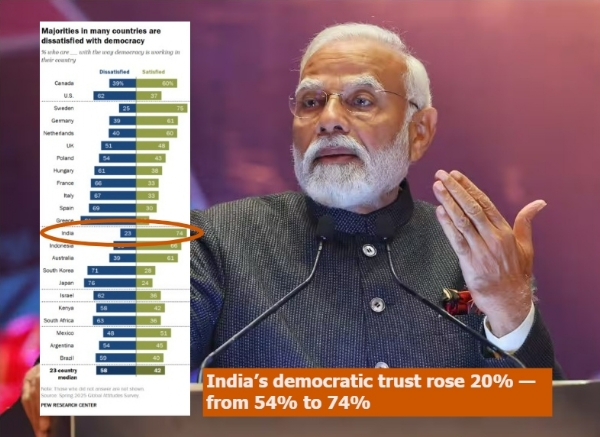
Since gaining independence in 1947, India’s democratic journey has witnessed historic achievements and formidable challenges. Among the latter was the Emergency in the 1970s, a moment when democratic institutions were seriously tested. Yet, through every high and low, the Indian people have remained steadfast in their belief in democracy. In recent years, this faith has only deepened, especially under the leadership of Prime Minister Narendra Modi, whose governance model has expanded citizen participation, transparency, and delivery-focused welfare, making democracy not just a process but an experience.
Amid rising global concerns about the health of democratic systems, particularly in high-income Western countries, India offers a compelling counter-narrative. The 2025 Pew Research Centre survey reveals that 74% of Indians are satisfied with the way democracy functions in the country, up significantly from 54% in 2019. In contrast, countries like Greece (81% dissatisfied), Japan (76%), and South Korea (71%) face a crisis of democratic trust. This InfoPack unpacks the reasons behind India’s rising democratic confidence, how a blend of cultural values and effective governance is contributing to this trend, and what this means for global discussions on democracy.
Global Democratic Fatigue vs. India’s Optimism
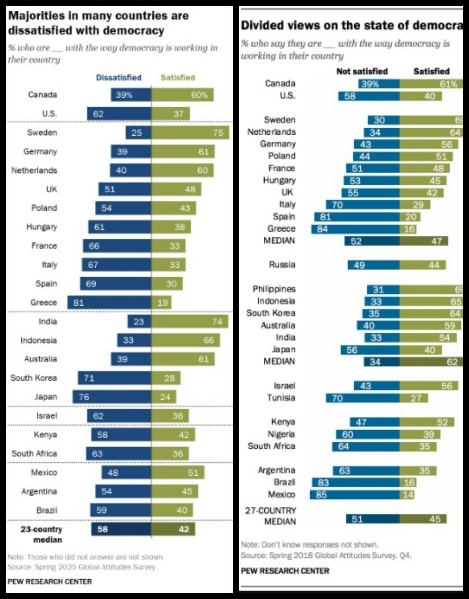
Across much of the developed world, democratic satisfaction is eroding. Public trust in institutions is falling, and citizens increasingly feel alienated from political decision-making. The Pew Research Center’s latest survey underscores this trend: across 12 advanced economies tracked since 2017—including the United States, Germany, Japan, and the United Kingdom—there has been a consistent slide in satisfaction with democratic functioning. Back in 2017, opinion was split evenly—49% satisfied and 49% dissatisfied. In 2025, the median dissatisfaction has climbed to 64%.
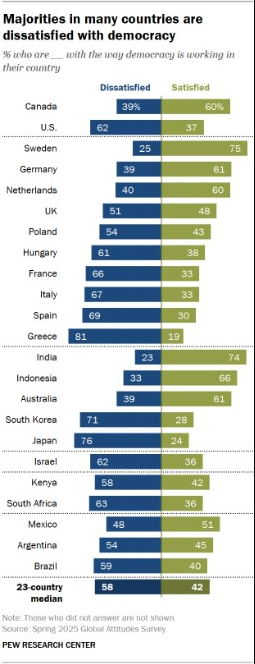
This erosion is not necessarily a rejection of democratic ideals but a response to disillusionment. Citizens feel unrepresented, distanced from the political elite, and cynical about promises of change. In Japan, for instance, only 24% express satisfaction with democracy. South Korea fares only slightly better at 26%. In the US, only 37% are content, while 48% in the UK express dissatisfaction with their democratic systems.
India, however, tells a very different story.
India’s Surge in Democratic Satisfaction
India’s 20-point jump in democratic satisfaction—from 54% in 2019 to 74% in 2025—is one of the most significant positive shifts recorded across the 23 countries covered in the Pew survey. This is not just a statistical anomaly but a reflection of something deeper: a growing public perception that democracy in India delivers real, tangible outcomes.
Narendra Modi’s Governance Model: Democracy in Action
The rising satisfaction with Indian democracy cannot be understood without recognising the influence of Prime Minister Narendra Modi’s governance approach. Rooted in the philosophy of Antyodaya, the upliftment of the last person, Modi’s model is less about rhetoric and more about result-driven administration.
Whether it’s the Jan Dhan Yojana that connected millions to the banking system, or the Ujjwala Yojana that delivered clean cooking fuel to rural households, the message is clear: democracy must deliver. Similarly, schemes like PM Awas Yojana (housing), Jal Jeevan Mission (water supply), and DBT (Direct Benefit Transfers) have improved living standards and enhanced trust in public systems.
Beyond service delivery, platforms like Mann Ki Baat and MyGov have created a direct communication channel between the government and the people, fostering inclusion and engagement. In this model, democracy is more than periodic elections—it becomes a continuous dialogue and delivery mechanism.
Economic Confidence Drives Political Faith
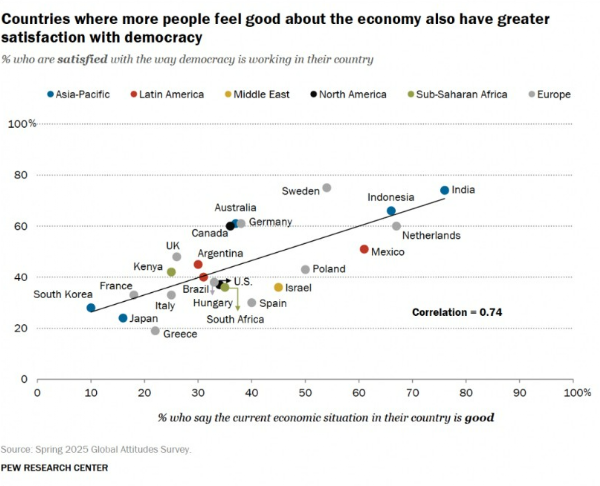
One of the key insights from the Pew Research Center’s findings is the strong link between public satisfaction with democracy and perceptions of economic well-being. Simply put, when people believe the economy is working for them, they tend to have more faith in democratic systems.
India ranks among a handful of countries—along with Sweden, Indonesia, Mexico, and the Netherlands—where citizens express both democratic and economic confidence. In contrast, in countries like France, Greece, Japan, and South Korea, dissatisfaction runs high across both parameters.
India’s economic performance, marked by rising infrastructure spending, job creation, growing digital inclusion, and robust GDP growth, has contributed significantly to this positive sentiment. The government’s emphasis on last-mile delivery, social protection, and stable macroeconomic management has helped build public trust.
Global Elections and Their Impact on Democratic Sentiment
The Pew report also examines how recent elections affect public sentiment toward democracy. In countries such as Germany, the United States, and the United Kingdom, democratic satisfaction rose post-elections, but primarily among supporters of the winning parties. CDU/CSU voters in Germany, Labour supporters in the UK, and Republicans in the US reported higher satisfaction, whereas opposition supporters remained more critical.
On the flip side, in nations like South Korea and Poland, satisfaction fell after contentious election outcomes. South Korea, for instance, reported a 74% dissatisfaction rate following political turbulence, while Poland recorded a 54% dissatisfaction rate in the wake of divisive presidential elections.
India, by contrast, has seen broad-based democratic satisfaction across electoral cycles. The upward trajectory in public approval from 2019 to 2025 suggests that Indians are seeing long-term gains in governance that go beyond electoral outcomes and partisanship.
Countering the “Democratic Backsliding” Claim
Critics, especially in Western media and academia, have long pushed the narrative that India’s democracy is in decline. Claims of authoritarianism, institutional erosion, and shrinking freedoms have been made repeatedly since the Modi government came to power.
Yet, these claims are increasingly contradicted by data from independent global sources like the Pew Research Center. The 2025 survey shows that Indians feel more satisfied with their democracy than ever before. With 74% approval and only 23% dissatisfaction, India ranks among the most optimistic democracies in the world.
The real story of Indian democracy is not one of erosion, but evolution—towards a system that works better, reaches farther, and includes more voices. It is a form of democracy that embraces technology, prioritises efficiency, and values results over rhetoric.
As global democratic systems grapple with declining trust and rising disillusionment, India stands as a rare example of resilience and progress. Its democracy is not without flaws, but it is dynamic, participatory, and increasingly effective.
The Pew Research Centre’s findings reinforce this transformation. In India, democracy means not just casting a vote, but seeing that vote translate into better roads, clean water, financial access, and opportunities for one’s children. It is a democracy rooted in cultural traditions, but updated through technology and reform.
In a world questioning the future of democratic systems, India’s model—anchored in delivery, dialogue, and dignity—offers hope and inspiration.
Since gaining independence in 1947, India’s democratic journey has witnessed historic achievements and formidable challenges. Among the latter was the Emergency in the 1970s, a moment when democratic institutions were seriously tested. Yet, through every high and low, the Indian people have remained steadfast in their belief in democracy. In recent years, this faith has only deepened, especially under the leadership of Prime Minister Narendra Modi, whose governance model has expanded citizen participation, transparency, and delivery-focused welfare, making democracy not just a process but an experience.
Amid rising global concerns about the health of democratic systems, particularly in high-income Western countries, India offers a compelling counter-narrative. The 2025 Pew Research Centre survey reveals that 74% of Indians are satisfied with the way democracy functions in the country, up significantly from 54% in 2019. In contrast, countries like Greece (81% dissatisfied), Japan (76%), and South Korea (71%) face a crisis of democratic trust. This InfoPack unpacks the reasons behind India’s rising democratic confidence, how a blend of cultural values and effective governance is contributing to this trend, and what this means for global discussions on democracy.
Global Democratic Fatigue vs. India’s Optimism
Across much of the developed world, democratic satisfaction is eroding. Public trust in institutions is falling, and citizens increasingly feel alienated from political decision-making. The Pew Research Center’s latest survey underscores this trend: across 12 advanced economies tracked since 2017—including the United States, Germany, Japan, and the United Kingdom—there has been a consistent slide in satisfaction with democratic functioning. Back in 2017, opinion was split evenly—49% satisfied and 49% dissatisfied. In 2025, the median dissatisfaction has climbed to 64%.
This erosion is not necessarily a rejection of democratic ideals but a response to disillusionment. Citizens feel unrepresented, distanced from the political elite, and cynical about promises of change. In Japan, for instance, only 24% express satisfaction with democracy. South Korea fares only slightly better at 26%. In the US, only 37% are content, while 48% in the UK express dissatisfaction with their democratic systems.
India, however, tells a very different story.
India’s Surge in Democratic Satisfaction
India’s 20-point jump in democratic satisfaction—from 54% in 2019 to 74% in 2025—is one of the most significant positive shifts recorded across the 23 countries covered in the Pew survey. This is not just a statistical anomaly but a reflection of something deeper: a growing public perception that democracy in India delivers real, tangible outcomes.
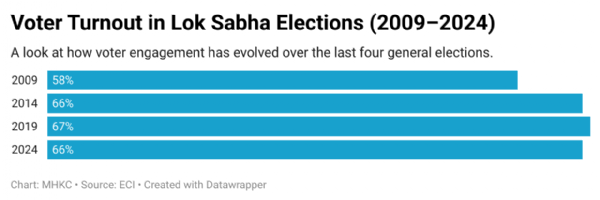
Take voter turnout as one example. Between 2009 and 2024, participation in Indian elections has consistently increased, from 58% in 2009 to 66% in 2024, with a peak of 67% in 2019. High voter engagement is a signal that Indian citizens not only value democracy but believe their participation can influence governance.
What reinforces this belief is the delivery of governance. Over the past decade, India’s welfare architecture has undergone a dramatic transformation. From rural electrification to digital transfers of subsidies, governance has become citizen-centric. Schemes now reach beneficiaries with minimal delay, ensuring that democracy is felt where it matters the most—on the ground.
The rising satisfaction with Indian democracy cannot be understood without recognising the influence of Prime Minister Narendra Modi’s governance approach. Rooted in the philosophy of Antyodaya, the upliftment of the last person, Modi’s model is less about rhetoric and more about result-driven administration.
Whether it’s the Jan Dhan Yojana that connected millions to the banking system, or the Ujjwala Yojana that delivered clean cooking fuel to rural households, the message is clear: democracy must deliver. Similarly, schemes like PM Awas Yojana (housing), Jal Jeevan Mission (water supply), and DBT (Direct Benefit Transfers) have improved living standards and enhanced trust in public systems.
Beyond service delivery, platforms like Mann Ki Baat and MyGov have created a direct communication channel between the government and the people, fostering inclusion and engagement. In this model, democracy is more than periodic elections—it becomes a continuous dialogue and delivery mechanism.
Economic Confidence Drives Political Faith
One of the key insights from the Pew Research Center’s findings is the strong link between public satisfaction with democracy and perceptions of economic well-being. Simply put, when people believe the economy is working for them, they tend to have more faith in democratic systems.
India ranks among a handful of countries—along with Sweden, Indonesia, Mexico, and the Netherlands—where citizens express both democratic and economic confidence. In contrast, in countries like France, Greece, Japan, and South Korea, dissatisfaction runs high across both parameters.
India’s economic performance, marked by rising infrastructure spending, job creation, growing digital inclusion, and robust GDP growth, has contributed significantly to this positive sentiment. The government’s emphasis on last-mile delivery, social protection, and stable macroeconomic management has helped build public trust.
Global Elections and Their Impact on Democratic Sentiment
The Pew report also examines how recent elections affect public sentiment toward democracy. In countries such as Germany, the United States, and the United Kingdom, democratic satisfaction rose post-elections, but primarily among supporters of the winning parties. CDU/CSU voters in Germany, Labour supporters in the UK, and Republicans in the US reported higher satisfaction, whereas opposition supporters remained more critical.
On the flip side, in nations like South Korea and Poland, satisfaction fell after contentious election outcomes. South Korea, for instance, reported a 74% dissatisfaction rate following political turbulence, while Poland recorded a 54% dissatisfaction rate in the wake of divisive presidential elections.
India, by contrast, has seen broad-based democratic satisfaction across electoral cycles. The upward trajectory in public approval from 2019 to 2025 suggests that Indians are seeing long-term gains in governance that go beyond electoral outcomes and partisanship.
Countering the “Democratic Backsliding” Claim
Critics, especially in Western media and academia, have long pushed the narrative that India’s democracy is in decline. Claims of authoritarianism, institutional erosion, and shrinking freedoms have been made repeatedly since the Modi government came to power.
Yet, these claims are increasingly contradicted by data from independent global sources like the Pew Research Center. The 2025 survey shows that Indians feel more satisfied with their democracy than ever before. With 74% approval and only 23% dissatisfaction, India ranks among the most optimistic democracies in the world.
The real story of Indian democracy is not one of erosion, but evolution—towards a system that works better, reaches farther, and includes more voices. It is a form of democracy that embraces technology, prioritises efficiency, and values results over rhetoric.
As global democratic systems grapple with declining trust and rising disillusionment, India stands as a rare example of resilience and progress. Its democracy is not without flaws, but it is dynamic, participatory, and increasingly effective.
The Pew Research Centre’s findings reinforce this transformation. In India, democracy means not just casting a vote, but seeing that vote translate into better roads, clean water, financial access, and opportunities for one’s children. It is a democracy rooted in cultural traditions, but updated through technology and reform.
In a world questioning the future of democratic systems, India’s model—anchored in delivery, dialogue, and dignity—offers hope and inspiration.