‘Chor Machaye Shor’: Rahul Gandhi’s theatre of double standards
It is not merely ironic; it is a cruel joke against democracy that Rahul Gandhi, whose political lineage is deeply entwined with some of the most infamous episodes of electoral malpractice in India’s history, should lecture the nation on electoral purity.
NewsBharati 18-Aug-2025 13:13:49 PM
Total Views |


Rahul Gandhi’s repeated outbursts over alleged “vote chori” (vote theft) bring to mind that old Hindi film song — “Chor machaye shor”. The parallel is irresistible. His sister, Priyanka Gandhi, was even seen clapping and jumping outside Parliament in a protest scene that looked more like a college picnic than a serious political demonstration. This is the state of the Congress party’s leadership — political theatrics in place of substance, spectacle in place of evidence, and slogan-shouting instead of hard facts.
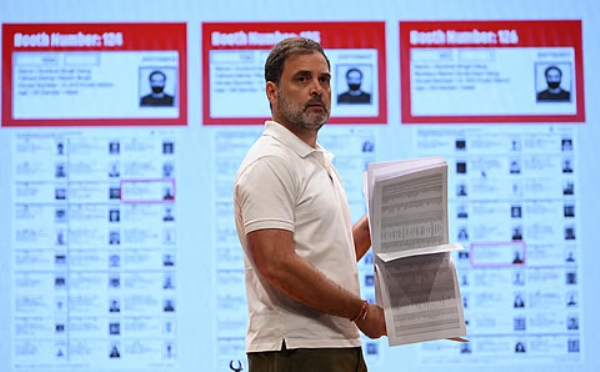
But beneath the drama lies a more serious concern, the deliberate undermining of India’s democratic process by those who have themselves been the greatest beneficiaries, and manipulators, of it. It is not merely ironic; it is a cruel joke against democracy that Rahul Gandhi, whose political lineage is deeply entwined with some of the most infamous episodes of electoral malpractice in India’s history, should lecture the nation on electoral purity.
Questions Rahul Gandhi must answer before casting stones
If Rahul Gandhi truly wishes to be taken seriously, there are several questions he must answer — questions rooted in undeniable historical fact.
First: How did his mother, Sonia Gandhi, become a registered voter before she was even a citizen of India?
Second: How was Dr. B.R. Ambedkar, the principal architect of our Constitution, declared defeated in an election where his victory had initially been announced?
Third: Why did his father, Rajiv Gandhi, push for the introduction of Electronic Voting Machines (EVMs) after his humiliating defeat in 1989, replacing the very ballot paper system Rahul now demands?
Fourth: Why did the judiciary find his grandmother, Indira Gandhi, guilty of large-scale electoral malpractice — an event that directly led to the imposition of the Emergency, perhaps the darkest period in India’s democratic history?
Fifth: Why is Congress opposing the Special Intensive Revision (SIR) of Bihar’s voter list, a process designed to weed out infiltrators and bogus votes? Does this opposition stem from a genuine concern for democracy, or from the compulsions of appeasement politics?
Until Rahul Gandhi can answer these questions honestly, his moral authority to accuse others of electoral misconduct is non-existent.
The Congress record: from the first election to to the present day
Rahul Gandhi’s accusations lose all credibility when viewed against the historical record. In fact, the Congress party laid the foundation of electoral malpractice in the very first general election of independent India in 1952.
The most glaring example was the defeat of Dr. Ambedkar in the Bombay North Central constituency. Congress, in active collusion with the Communist Party of India (CPI), worked to ensure Ambedkar’s loss. A staggering 74,333 votes were declared invalid, while Ambedkar lost by a mere 14,561 votes. Such statistical anomalies are not accidental — they are engineered.
The Congress also perfected the art of booth capturing, aided by hired musclemen, in subsequent decades. In fact, it was precisely because of Congress’s repeated abuse of the ballot paper system that EVMs were introduced in the first place. The irony could not be richer: the very machines Rahul now seeks to abolish were brought in by his father’s government to prevent the kind of fraud the Congress had mastered.
And let’s not forget the pre-independence precedent: Jawaharlal Nehru was declared Congress President even though Sardar Patel had actually won the internal election. The manipulation of democratic processes is a Congress tradition.
Rahul Gandhi’s ‘lose–blame–repeat’ formula
The pattern is painfully familiar.
Rahul Gandhi loses an election → He blames the EVMs → He demands the return of ballot papers → He loses again → He alleges hacking → He demands 100% VVPAT verification → He loses yet again → He invents a new conspiracy.
This cycle has repeated itself across Maharashtra, Haryana, Delhi, and multiple national elections. In fact, Rahul Gandhi has now led the Congress through 90 electoral defeats, including three consecutive Lok Sabha losses. Yet, not once has he or his party shown the courage for introspection. Not once has the Congress filed a formal complaint with the Election Commission or provided credible evidence. Instead, the tactic has been to cast suspicion on constitutional institutions, undermine public faith in the electoral process, and sow doubt in the minds of ordinary voters. It is politics by slander — and it is corrosive to democracy.
Evasion instead of evidence
When summoned by the Election Commission to substantiate his claims about the voter roll, Rahul Gandhi simply didn’t show up. Despite repeated requests, no evidence was ever produced. Section 80 of the Representation of the People Act clearly allows for election petitions, but neither Rahul Gandhi nor any Congress candidate has used this legal route.
Why? Because the allegations are not meant to be proven — they are meant to be headlines. They are designed to create an atmosphere of suspicion and grievance without the burden of truth.
Misleading statistics and manufactured outrage
Rahul Gandhi’s latest charges are as flawed as his earlier ones. He claimed that Maharashtra saw suspiciously high voter additions. But the facts tell a different story:
2004 (UPA rule): Voter growth rate was 4.7%
2009 (UPA rule): 4.1%
2014: 3.4%
2019: 1.3%
2024: 4%
If 4% voter growth in 2024 is “evidence” of fraud, then what was 4.7% in 2004 and 4.1% in 2009? Were those Congress victories also the result of “vote chori”? Similarly, Rahul alleged a suspicious jump in votes after 5 p.m. on polling day. The truth:
Before 5 p.m.: Average 5.8 million votes per hour
After 5 p.m.: Average 3.25 million votes per hour
The numbers don’t just fail to prove his case — they demolish it.
Appeasement politics and the infiltrator vote bank
Rahul Gandhi’s selective outrage becomes even more questionable when viewed through the lens of vote-bank politics. Take the example of Dhule Lok Sabha constituency in Maharashtra. The Malegaon Central Assembly segment, with a high minority population, recorded 1,94,000 votes — enough to overturn BJP’s 1,90,000 lead in the other four segments.
This is not about communal profiling; it is about a consistent political pattern — the courting of votes from illegal infiltrators, even at the cost of undermining the integrity of the voter list. The Congress’s opposition to the SIR process in Bihar — aimed precisely at removing such bogus votes — makes perfect political sense if your strategy is appeasement. It makes zero sense if your goal is clean democracy.
Protecting bogus votes, insulting genuine voters
The question Rahul Gandhi must answer is simple: Why does he want to protect illegal votes? Why does his party oppose measures designed to ensure that only Indian citizens decide India’s future? Every bogus vote dilutes the power of a genuine voter. By defending the former, the Congress insults the latter. The voters of India have understood this — which is why they have repeatedly rejected Congress. The party’s once formidable base has shrunk, not because of EVMs, but because the electorate has seen through its cynical politics.
Fear-mongering as a political strategy
Frustrated by repeated defeats, Rahul Gandhi’s strategy now boils down to a three-step formula:
1. Before elections: Spread fear in the name of the Constitution, stoke rumours, and run targeted propaganda.
2. During elections: Manufacture allegations of malpractice to delegitimize the process in advance.
3. After losing: Disappear on a foreign trip while party workers lick their wounds.
Despite the noise, Narendra Modi has secured a third consecutive term as Prime Minister — something Rahul and the INDI alliance find intolerable. Unable to digest the verdict, they have chosen the path of undemocratic disruption, even if it risks chaos and instability.
Conclusion: Democracy deserves better
India’s democracy is robust, but it is not indestructible. Its strength lies in the trust citizens place in its institutions. By relentlessly attacking these institutions without evidence, Rahul Gandhi and the Congress are playing a dangerous game. Criticism is healthy in a democracy. Falsehoods are not. Allegations should be proven in courts, not shouted in street protests. Leaders should strengthen faith in elections, not erode it for personal or partisan gain.
Rahul Gandhi has made himself the face of political denialism in India. Until he chooses truth over theatrics, substance over slogans, and evidence over evasion, his cries of “vote chori” will remain what they are — political noise, unworthy of the serious business of safeguarding democracy.
--
Satyajit Shriram Joshi
Satyajit Shriram Joshi is Pune based senior journalist.