“If you were a true Indian…”: Supreme Court lashes out at Rahul Gandhi for his remarks against Indian Army
Total Views |


Recent observations by the Supreme Court of India have left Congress “leader” Rahul Gandhi visibly embarrassed. The apex court came down heavily on him for once again crossing the line and attempting to demoralise key institutions such as the Indian Army under the guise of freedom of speech. In a not-shocking situation, this has not gone down well with the leftist-liberal ecosystem, as they pointed fingers at the apex court of India, stating it suggests a threat to democratic norms, where political speech may now face legal consequences or be curtailed, even if it was previously protected.
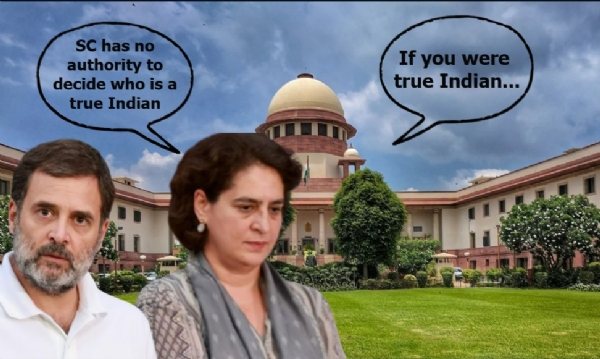
“If you were a true Indian…”
The observations were made in the context of Gandhi’s controversial statement during his Bharat Jodo Yatra, where he claimed that China had occupied 2,000 square kilometres of Indian territory and that the Indian Army was being “thrashed” in Arunachal Pradesh. These remarks were against national morale and military dignity. The bench comprising Justices Dipankar Datta and Augustine Masih did not mince words. “If you were a true Indian, you would not say all this,” Justice Datta told Singhvi during the hearing. This sent a powerful message: the criticism, too, must be rooted in fact and national interest.
"If Rahul Gandhi truly believed that the Indian Army had lost territory or suffered a setback, he could have raised the issue in Parliament, where discussions are recorded, deliberated, and often defended. The Supreme Court asked the same question: “Why don’t you say this in Parliament? Why say this in social media posts?”
Though he is a national leader, his remarks on matters of territorial integrity and military performance amount to an affront to both democracy and patriotism. While the court granted interim relief by staying the proceedings, this judicial stance delivered a sharp rebuke to the underlying ethos of Rahul Gandhi’s brand of politics.
A habitual pattern
This is not the first time Rahul Gandhi has been in trouble for his statements. What is alarming is the pattern: a long-standing tendency to make unverified claims, often without concern for either national interest or legal consequences.
Whether it was his infamous “chowkidar chor hai” jibe directed at Prime Minister Narendra Modi during the Rafale controversy (which also invited the Supreme Court’s rebuke) or his repeated allegations regarding crony capitalism without submitting credible evidence, Rahul Gandhi’s political messaging often relies on innuendo, exaggeration, and conspiracy theory.
It is pertinent to mention that before the matter reached the Supreme Court, the Allahabad High Court had rightly pointed out that freedom of speech and expression does not extend to making defamatory statements against the Indian Army. This is a crucial legal principle and a democratic one.
In any other country, defaming the armed forces — especially during times of heightened tensions or border conflicts — would be considered a grave offence. India, despite its democratic tolerance, cannot afford to allow its national discourse to be dragged into the realm of malicious fiction, especially when such statements can demoralise soldiers and their families.
The complaint filed by Uday Shankar Srivastava, a retired Border Road Organisation official, rightly flagged Gandhi’s remarks as both defamatory and demoralising. His concern spoke highly of Indians who see the army as an institution above politics. Something to be respected, not ridiculed for political mileage.
Judicial relief on technical grounds, not on merit
It must be noted that the Supreme Court while staying the proceedings in the lower court, did so purely on technical grounds. Senior counsel Singhvi argued that under Section 223 of the Bhartiya Nyaya Suraksha Samhita, Gandhi was entitled to be heard before the summons was issued. The Court agreed, but its remarks during the hearing made it abundantly clear that its displeasure had little to do with procedure and everything to do with the content of Gandhi’s statements.
Even Singhvi eventually had to concede that Rahul Gandhi could have “worded the statement better.”
The relief given, therefore, should not be mistaken for vindication. On the contrary, the Supreme Court has held a mirror to Gandhi’s political behaviour, and what reflects back is not a leader of depth, caution, or statesmanship, but one of political immaturity.
Left-liberal ecosystem has meltdown
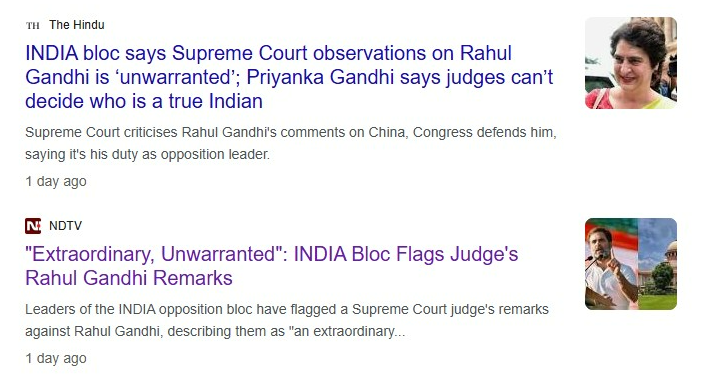
After the Supreme Court questioned Rahul Gandhi, sharp political reactions have emerged from the Congress party and other INDIA bloc constituents, denouncing the judicial comments as misplaced and inappropriate. In a joint statement, members of the INDIA alliance, including the Congress party, said they “respectfully disagreed” with the Court’s observation, describing it as “extraordinary and unwarranted” and an “attack on the democratic right of political leaders to question the government on matters of national interest.”
They emphasised that “questioning government failures on border security does not equate to disrespecting the armed forces,” and noted that it is the “constitutional role and moral responsibility of the opposition, especially the Leader of the Opposition, to seek accountability.”
Congress General Secretary Priyanka Gandhi Vadra issued a pointed response: “With all due respect, no judge of the Supreme Court has the authority to decide who is a true Indian.” She defended her brother, stating that he has “always shown utmost respect for the armed forces and never spoken against them. This is a misrepresentation. Raising questions is the duty of the opposition. That is how democracy functions,” she added.
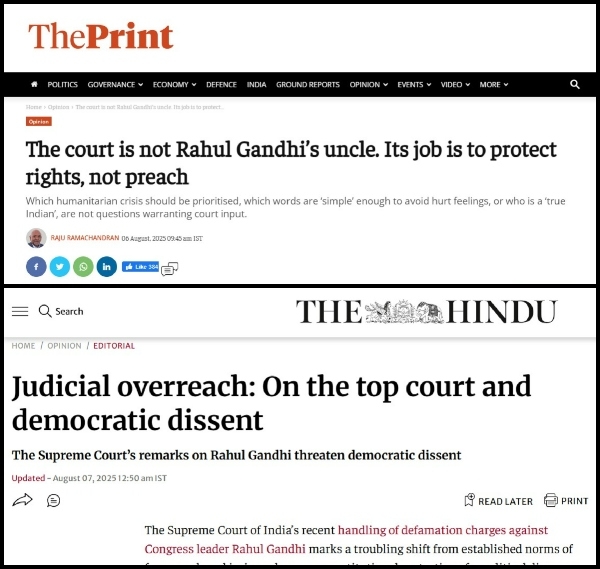
It is not the political parties but the media that have also questioned its observations.
“If you were a true Indian…”
The observations were made in the context of Gandhi’s controversial statement during his Bharat Jodo Yatra, where he claimed that China had occupied 2,000 square kilometres of Indian territory and that the Indian Army was being “thrashed” in Arunachal Pradesh. These remarks were against national morale and military dignity. The bench comprising Justices Dipankar Datta and Augustine Masih did not mince words. “If you were a true Indian, you would not say all this,” Justice Datta told Singhvi during the hearing. This sent a powerful message: the criticism, too, must be rooted in fact and national interest.
"If Rahul Gandhi truly believed that the Indian Army had lost territory or suffered a setback, he could have raised the issue in Parliament, where discussions are recorded, deliberated, and often defended. The Supreme Court asked the same question: “Why don’t you say this in Parliament? Why say this in social media posts?”
Though he is a national leader, his remarks on matters of territorial integrity and military performance amount to an affront to both democracy and patriotism. While the court granted interim relief by staying the proceedings, this judicial stance delivered a sharp rebuke to the underlying ethos of Rahul Gandhi’s brand of politics.
A habitual pattern
This is not the first time Rahul Gandhi has been in trouble for his statements. What is alarming is the pattern: a long-standing tendency to make unverified claims, often without concern for either national interest or legal consequences.
Whether it was his infamous “chowkidar chor hai” jibe directed at Prime Minister Narendra Modi during the Rafale controversy (which also invited the Supreme Court’s rebuke) or his repeated allegations regarding crony capitalism without submitting credible evidence, Rahul Gandhi’s political messaging often relies on innuendo, exaggeration, and conspiracy theory.
It is pertinent to mention that before the matter reached the Supreme Court, the Allahabad High Court had rightly pointed out that freedom of speech and expression does not extend to making defamatory statements against the Indian Army. This is a crucial legal principle and a democratic one.
In any other country, defaming the armed forces — especially during times of heightened tensions or border conflicts — would be considered a grave offence. India, despite its democratic tolerance, cannot afford to allow its national discourse to be dragged into the realm of malicious fiction, especially when such statements can demoralise soldiers and their families.
The complaint filed by Uday Shankar Srivastava, a retired Border Road Organisation official, rightly flagged Gandhi’s remarks as both defamatory and demoralising. His concern spoke highly of Indians who see the army as an institution above politics. Something to be respected, not ridiculed for political mileage.
Judicial relief on technical grounds, not on merit
It must be noted that the Supreme Court while staying the proceedings in the lower court, did so purely on technical grounds. Senior counsel Singhvi argued that under Section 223 of the Bhartiya Nyaya Suraksha Samhita, Gandhi was entitled to be heard before the summons was issued. The Court agreed, but its remarks during the hearing made it abundantly clear that its displeasure had little to do with procedure and everything to do with the content of Gandhi’s statements.
Even Singhvi eventually had to concede that Rahul Gandhi could have “worded the statement better.”
The relief given, therefore, should not be mistaken for vindication. On the contrary, the Supreme Court has held a mirror to Gandhi’s political behaviour, and what reflects back is not a leader of depth, caution, or statesmanship, but one of political immaturity.
Left-liberal ecosystem has meltdown
After the Supreme Court questioned Rahul Gandhi, sharp political reactions have emerged from the Congress party and other INDIA bloc constituents, denouncing the judicial comments as misplaced and inappropriate. In a joint statement, members of the INDIA alliance, including the Congress party, said they “respectfully disagreed” with the Court’s observation, describing it as “extraordinary and unwarranted” and an “attack on the democratic right of political leaders to question the government on matters of national interest.”
They emphasised that “questioning government failures on border security does not equate to disrespecting the armed forces,” and noted that it is the “constitutional role and moral responsibility of the opposition, especially the Leader of the Opposition, to seek accountability.”
Congress General Secretary Priyanka Gandhi Vadra issued a pointed response: “With all due respect, no judge of the Supreme Court has the authority to decide who is a true Indian.” She defended her brother, stating that he has “always shown utmost respect for the armed forces and never spoken against them. This is a misrepresentation. Raising questions is the duty of the opposition. That is how democracy functions,” she added.
It is not the political parties but the media that have also questioned its observations.