Bharat Mata: The Sacred Idea of Nation as Mother
Total Views |


In Indian culture, the Earth has always been revered as Bhūmātā - the Mother Earth.
The Atharva Veda declares:
From this ancient belief flows a deeper truth: for us, Bharat is not merely a stretch of land, but the embodiment of a living mother. Just as a mother nurtures her children with love and protection, Bharat Mata shelters her people through her rivers, mountains, soil, and resources.
 Thus, patriotism in our tradition is not a cold duty—it is sanctified love, akin to devotion towards one’s mother. In this seamless merging, mātru-bhakti (love for the mother) and rāṣṭra-bhakti (love for the nation) become one.
The philosophical foundation of “Bharat Mata” owes much to Bankimchandra Chattopadhyay. In the 1870s, he composed the immortal hymn Vande Mātaram, later included in his 1882 novel Anandamath. Here, the Motherland is not described as mere soil, but as Durga, the ten-armed protector; Kamala, the radiant Lakshmi; and Vani, the goddess of wisdom. The song became a patriotic verse and a hymn of worship, where the Motherland was revered as divine.
Anandamath was based on the 1773 Sannyasi rebellion in Bengal. Ascetic warriors cry “Vande Mātaram” in its pages while sacrificing everything for their Mother’s freedom. Bankim’s metaphor was powerful: the Mother is shackled under foreign rule, and her children must rise to liberate her. This imagery ignited generations of revolutionaries and transformed Bharat Mata into the moral centre of national consciousness.
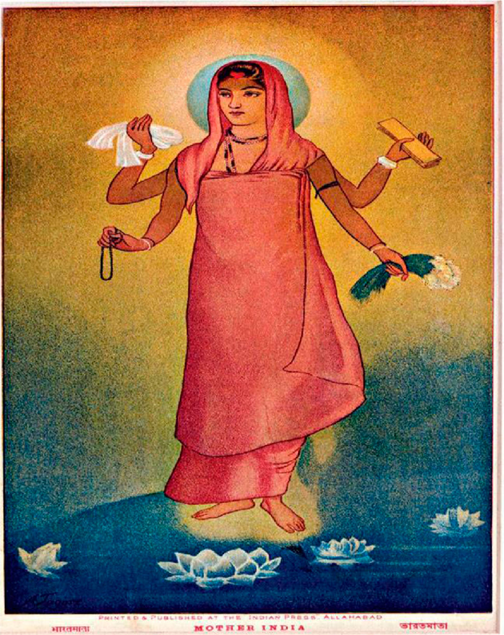
In 1905, Abanindranath Tagore’s painting of Bharat Mata became an icon of the Swadeshi movement. Depicted as a serene ascetic woman in saffron robes, she holds in her four hands:
This imagery arose during the partition of Bengal (1905), becoming a symbol of unity and resistance. Initially conceived as “Banga Mata,” it soon transcended Bengal to be embraced as “Bharat Mata” by the entire nation.
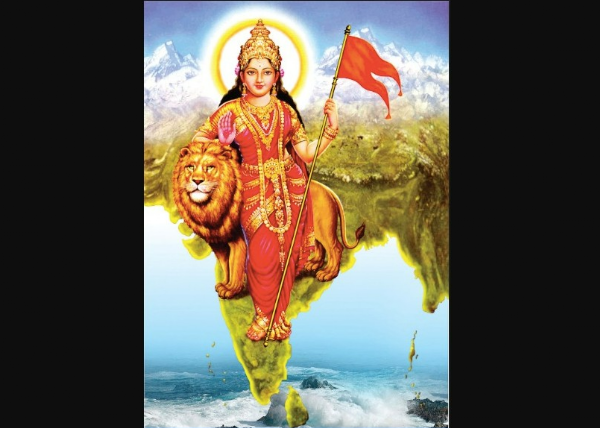
Later, Shripad Damodar Satwalekar’s painting depicted Bharat Mata as a mother with a child, draped in a sari forming India’s map, standing beside the Indian Ocean. Such images reinforced the idea of the nation as a living mother.
Durga, Mahishasura, and Collective Strength
Just as Maa Durga was born from the combined energies of the gods to defeat Mahishasura, India’s freedom too came from the unity of diverse castes, creeds, and regions. The Mahishasura myth became an allegory: only collective strength, not isolated effort, can overcome oppressive forces.
Swami Vivekananda elevated Bharat Mata to a spiritual plane. In 1897, he urged Indians: “For the next fifty years, let this Motherland be your sole deity.” Exactly fifty years later, in 1947, India attained independence, seeming to fulfil his prophetic vision.
His disciple, Sister Nivedita, gave visual identity to the concept, popularising Abanindranath’s painting and ensuring its spread as a national symbol.
Sri Aurobindo advanced the idea of “spiritual nationalism.” For him, Bharat was not geography but a living spiritual power. He equated nationalism with Sanatana Dharma and saw the freedom struggle as a sacred yoga for the upliftment of humanity itself.
RSS and Institutionalisation
While thinkers like Vivekananda and Aurobindo gave the idea depth, the Rashtriya Swayamsevak Sangh (RSS) made “Bharat Mata ki Jai” a living ritual. Through its daily prayers and discipline, the RSS wove the symbol of Bharat Mata into the very habit of national devotion.
Bharat Mata Mandirs
The most striking embodiment of this concept is the Bharat Mata Mandir in Varanasi (1936), inaugurated by Mahatma Gandhi. Here, instead of idols, lies a massive marble map of undivided India, revered as sacred.
Similarly, the Bharat Mata Mandir in Haridwar (1983) and the shrine at Daulatabad Fort near Aurangabad continue this tradition—sanctifying the nation itself as divine.
Eternal Symbol
From Bankim’s poetry to Abanindranath’s brush, from Vivekananda’s call to Aurobindo’s vision, from Nivedita’s popularisation to RSS’s institutionalisation, Bharat Mata has remained at the heart of India’s nationalism.
She is not a mere metaphor but a living emblem of unity, sacrifice, and spiritual nationhood. Even today, the cry of “Vande Mātaram” evokes the same timeless truth—that love for the Motherland is as sacred as a child’s devotion to its mother.
Source: Vayuveg
The Atharva Veda declares:
“Mātā bhūmiḥ putro’ham pṛthivyāḥ”
“The Earth is my mother, and I am her son.”
From this ancient belief flows a deeper truth: for us, Bharat is not merely a stretch of land, but the embodiment of a living mother. Just as a mother nurtures her children with love and protection, Bharat Mata shelters her people through her rivers, mountains, soil, and resources.
Bankimchandra and Vande Mātaram
The philosophical foundation of “Bharat Mata” owes much to Bankimchandra Chattopadhyay. In the 1870s, he composed the immortal hymn Vande Mātaram, later included in his 1882 novel Anandamath. Here, the Motherland is not described as mere soil, but as Durga, the ten-armed protector; Kamala, the radiant Lakshmi; and Vani, the goddess of wisdom. The song became a patriotic verse and a hymn of worship, where the Motherland was revered as divine.
Anandamath was based on the 1773 Sannyasi rebellion in Bengal. Ascetic warriors cry “Vande Mātaram” in its pages while sacrificing everything for their Mother’s freedom. Bankim’s metaphor was powerful: the Mother is shackled under foreign rule, and her children must rise to liberate her. This imagery ignited generations of revolutionaries and transformed Bharat Mata into the moral centre of national consciousness.
Painters and the Visual Form of Bharat Mata
In 1905, Abanindranath Tagore’s painting of Bharat Mata became an icon of the Swadeshi movement. Depicted as a serene ascetic woman in saffron robes, she holds in her four hands:
- White cloth – industry and self-reliance,
- A book – knowledge,
- Sheaves of grain – food and prosperity,
- A rosary – spirituality.
This imagery arose during the partition of Bengal (1905), becoming a symbol of unity and resistance. Initially conceived as “Banga Mata,” it soon transcended Bengal to be embraced as “Bharat Mata” by the entire nation.
Later, Shripad Damodar Satwalekar’s painting depicted Bharat Mata as a mother with a child, draped in a sari forming India’s map, standing beside the Indian Ocean. Such images reinforced the idea of the nation as a living mother.
Durga, Mahishasura, and Collective Strength
Just as Maa Durga was born from the combined energies of the gods to defeat Mahishasura, India’s freedom too came from the unity of diverse castes, creeds, and regions. The Mahishasura myth became an allegory: only collective strength, not isolated effort, can overcome oppressive forces.
| Element | Metaphorical Meaning |
|---|---|
| Arrogant Mahishasura | The oppressive, arrogant, and cruel British rule. |
| Defeated Gods | The weakened and fragmented Indian people under foreign domination. |
| Combined Radiance of All Gods | The collective, organised, and united strength required for India’s freedom struggle. |
| Goddess Durga | The embodiment of Bharat Mata, s ymbolizing united power and ultimate victory. |
| Weapons bestowed by the Gods | The essential tools for independence: knowledge, sacrifice, courage, and unwavering devotion. |
Vivekananda, Sister Nivedita, and Aurobindo
Swami Vivekananda elevated Bharat Mata to a spiritual plane. In 1897, he urged Indians: “For the next fifty years, let this Motherland be your sole deity.” Exactly fifty years later, in 1947, India attained independence, seeming to fulfil his prophetic vision.
His disciple, Sister Nivedita, gave visual identity to the concept, popularising Abanindranath’s painting and ensuring its spread as a national symbol.
Sri Aurobindo advanced the idea of “spiritual nationalism.” For him, Bharat was not geography but a living spiritual power. He equated nationalism with Sanatana Dharma and saw the freedom struggle as a sacred yoga for the upliftment of humanity itself.
RSS and Institutionalisation
While thinkers like Vivekananda and Aurobindo gave the idea depth, the Rashtriya Swayamsevak Sangh (RSS) made “Bharat Mata ki Jai” a living ritual. Through its daily prayers and discipline, the RSS wove the symbol of Bharat Mata into the very habit of national devotion.
Bharat Mata Mandirs
The most striking embodiment of this concept is the Bharat Mata Mandir in Varanasi (1936), inaugurated by Mahatma Gandhi. Here, instead of idols, lies a massive marble map of undivided India, revered as sacred.
Similarly, the Bharat Mata Mandir in Haridwar (1983) and the shrine at Daulatabad Fort near Aurangabad continue this tradition—sanctifying the nation itself as divine.
Eternal Symbol
From Bankim’s poetry to Abanindranath’s brush, from Vivekananda’s call to Aurobindo’s vision, from Nivedita’s popularisation to RSS’s institutionalisation, Bharat Mata has remained at the heart of India’s nationalism.
She is not a mere metaphor but a living emblem of unity, sacrifice, and spiritual nationhood. Even today, the cry of “Vande Mātaram” evokes the same timeless truth—that love for the Motherland is as sacred as a child’s devotion to its mother.
Source: Vayuveg