Digging for the Future: India’s Rare Earth Mission
NewsBharati 25-Sep-2025 19:48:15 PM
Total Views |


From the scooter on our roads to the smartphone in our hands, an invisible thread links daily life to the world’s cutting-edge technologies. That thread is made of rare earth elements (REEs) — a family of 17 metals with extraordinary magnetic, optical, and chemical traits.
They may not be household names, but neodymium, praseodymium, cerium, and lanthanum are the quiet enablers of our high-tech age. These elements make devices faster, lighter, and more durable. Without them, electric cars would struggle, wind turbines would shrink in efficiency, and our screens would lose their brilliance.
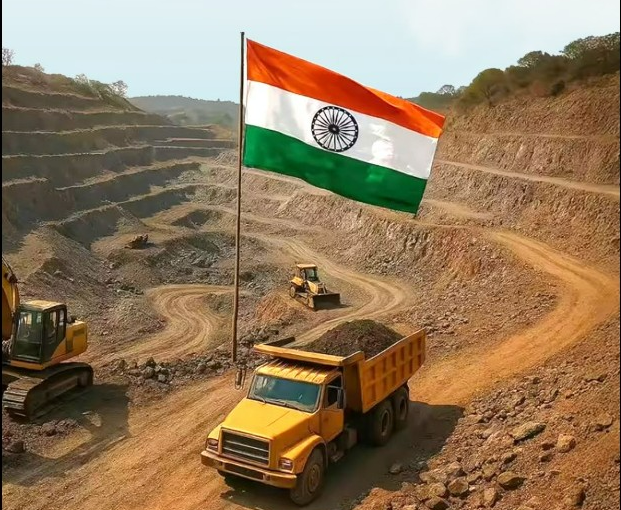
Now the story takes an Indian turn. Beneath the country’s sands and soils lie 8.52 million tonnes of rare earth reserves, one of the world’s largest stockpiles, much of it barely touched. In January 2025, the government unveiled the ₹34,300-crore National Critical Mineral Mission (NCMM), a plan to tap this buried potential, cut dependence on imports, and make India a serious player in the global race for advanced technology.
The Metals That Power Modernity
Though used in tiny amounts, rare earths are indispensable. Much like vitamins in the human body, their absence disrupts the entire system.
• Clean energy: Neodymium (Nd) and praseodymium (Pr) create super-strong magnets that run electric vehicle motors and make wind turbine generators compact yet powerful.
• Electronics: Lanthanum (La) improves camera lenses, cerium (Ce) is vital for polishing glass and optical fibres, while europium (Eu), terbium (Tb), and yttrium (Y) give life to the vibrant colours of LED and LCD screens.
• Defence: Samarium (Sm) produces magnets that endure extreme heat, critical for missile guidance systems and aircraft engines. Rare-earth-based lasers support both industrial and military applications.
• Industry: Catalysts using cerium and lanthanum help refine cleaner fuels, while rare-earth phosphors brighten lamps and medical imaging devices.
In short, these metals are the building blocks of the so-called “Rare Earth Age.”
India’s Untapped Wealth
India’s reserves are concentrated in monazite-rich beach sands in Kerala, Tamil Nadu, Odisha, Andhra Pradesh, and Maharashtra, with additional inland deposits in Rajasthan and Gujarat. Pick up a handful of reddish coastal sand, and you could be holding the raw material for an EV motor or a satellite component.
Yet despite such abundance, India has mostly been a minor player in the rare earth value chain. Our exports are dominated by mixed concentrates, semi-processed forms that fetch low value. The real wealth lies in separating and refining each element — a technically demanding job involving complex chemical processes like solvent extraction and ion exchange. This requires specialised facilities, high-level expertise, and heavy capital investment, areas where India has lagged.
The result: we export the cheap stuff and import expensive finished products like magnets and alloys — an imbalance that drains value from our own resources.
China’s Tight Grip
The rare earth story globally has been one of concentration and control, with China as the undisputed leader. Over the last three decades, Beijing has built a stranglehold over the sector, accounting for over 90% of global processing capacity. By investing heavily in refining and manufacturing, it turned a geological advantage into geopolitical leverage.
India, like most nations, remains dependent on Chinese exports for critical rare-earth products. While some supplies also come from Japan, Russia, Vietnam, Malaysia, and the US, China’s dominance looms large. Any disruption — whether trade restrictions, price hikes, or geopolitical tension — can ripple through industries worldwide. For India, this dependence threatens not just economic growth but also energy transition targets and defence preparedness.
The National Critical Mineral Mission
Against this backdrop, the NCMM marks a decisive shift. With ₹34,300 crore in funding, it seeks to move India from the margins to the centre of the rare earth race. The Mission’s blueprint is ambitious and multi-layered:
1. Exploration: Expanding surveys to discover fresh reserves in coastal and inland belts.
2. Processing at home: Building modern facilities to refine raw minerals into high-purity products.
3. Recycling: Extracting rare earths from discarded electronics and industrial waste, turning today’s e-waste crisis into tomorrow’s supply source.
4. Global sourcing: Partnering with like-minded countries to secure diversified supply lines.
5. Innovation drive: Investing in R&D with a target of 1,000 new patents in rare earth technologies over the next decade.
Together, these steps form a “mine-to-market” chain, allowing India not just to dig but to design, manufacture, and export finished high-tech products.
Why It Matters
The stakes could not be higher. Rare earths sit at the intersection of clean energy, digital economy, and national security.
• For EVs: Without rare-earth magnets, India’s electric mobility plans could stall.
• For renewables: Wind and solar projects require reliable access to these metals.
• For defence: Fighter jets, radars, and missile systems depend on rare-earth components.
In other words, control over rare earths is not just about industry; it is about strategic sovereignty. Dependence on imports, especially from adversarial sources, leaves India vulnerable. The NCMM seeks to close that gap.
Challenges Ahead
Ambition, however, must be matched with realism. Rare earth extraction and processing come with hurdles:
• Environmental costs: Mining beach sands and managing radioactive by-products demand strong safeguards. India will need to ensure that ecological damage does not accompany industrial growth.
• Technology gap: Separating and refining requires advanced chemical engineering. India must invest in training, R&D, and international partnerships to close this gap.
• Global competition: With China entrenched and other players like the US and Australia scaling up, India must act fast to carve a niche.
Academic and Policy Perspectives
Experts often describe rare earths as a “paradox resource.” They are relatively abundant in nature, yet difficult and costly to harness. The challenge is not geology but technology and economics.
For India, success will mean building an entire ecosystem — mining, refining, research labs, start-ups, and skilled manpower. Universities and national institutes will play a pivotal role, as will collaborations with global leaders in the field. Recycling technologies, in particular, could give India a leap forward, allowing it to recover valuable metals from discarded gadgets and batteries.
The Public Conversation
Since the Mission’s launch, reactions have been diverse. Industry groups welcomed it as India’s overdue “moonshot” in critical minerals. Young professionals saw new career avenues in metallurgy and materials science. Environmental groups, however, issued caution, urging strict protections for fragile coastal ecosystems and greater transparency in mining operations.
This debate is healthy, reminding policymakers that growth and sustainability must move together.
The Road Ahead
If the NCMM succeeds, India could transform its role in the global supply chain. Instead of shipping low-value mineral sands abroad, it could export finished magnets, advanced turbines, and satellites. The ripple effects would include job creation, export growth, and a stronger bargaining position in international trade.
The initiative also aligns with national priorities: Make in India, Atmanirbhar Bharat, and the green energy transition. For a young nation with both natural wealth and human talent, the rare earth sector could become the bedrock of future prosperity.
Rare earth elements may be invisible to the naked eye, but they shape the visible future of technology. They drive our transition to clean energy, enable national security, and sustain the digital economy. For India, the challenge is to turn its vast reserves from a latent resource into a strategic advantage.
The National Critical Mineral Mission is not just a policy programme; it is a statement of intent — to rise beyond dependency, to secure critical supply chains, and to claim a place in the commanding heights of global technology.
What was once dismissed as mere sand on our beaches could soon become the cornerstone of satellites in orbit and vehicles on the road. If India plays wisely, the world may soon look to our shores for the rare metals that power tomorrow.
Source: Vayuveg
They may not be household names, but neodymium, praseodymium, cerium, and lanthanum are the quiet enablers of our high-tech age. These elements make devices faster, lighter, and more durable. Without them, electric cars would struggle, wind turbines would shrink in efficiency, and our screens would lose their brilliance.
Now the story takes an Indian turn. Beneath the country’s sands and soils lie 8.52 million tonnes of rare earth reserves, one of the world’s largest stockpiles, much of it barely touched. In January 2025, the government unveiled the ₹34,300-crore National Critical Mineral Mission (NCMM), a plan to tap this buried potential, cut dependence on imports, and make India a serious player in the global race for advanced technology.
The Metals That Power Modernity
Though used in tiny amounts, rare earths are indispensable. Much like vitamins in the human body, their absence disrupts the entire system.
• Clean energy: Neodymium (Nd) and praseodymium (Pr) create super-strong magnets that run electric vehicle motors and make wind turbine generators compact yet powerful.
• Electronics: Lanthanum (La) improves camera lenses, cerium (Ce) is vital for polishing glass and optical fibres, while europium (Eu), terbium (Tb), and yttrium (Y) give life to the vibrant colours of LED and LCD screens.
• Defence: Samarium (Sm) produces magnets that endure extreme heat, critical for missile guidance systems and aircraft engines. Rare-earth-based lasers support both industrial and military applications.
• Industry: Catalysts using cerium and lanthanum help refine cleaner fuels, while rare-earth phosphors brighten lamps and medical imaging devices.
In short, these metals are the building blocks of the so-called “Rare Earth Age.”
India’s Untapped Wealth
India’s reserves are concentrated in monazite-rich beach sands in Kerala, Tamil Nadu, Odisha, Andhra Pradesh, and Maharashtra, with additional inland deposits in Rajasthan and Gujarat. Pick up a handful of reddish coastal sand, and you could be holding the raw material for an EV motor or a satellite component.
Yet despite such abundance, India has mostly been a minor player in the rare earth value chain. Our exports are dominated by mixed concentrates, semi-processed forms that fetch low value. The real wealth lies in separating and refining each element — a technically demanding job involving complex chemical processes like solvent extraction and ion exchange. This requires specialised facilities, high-level expertise, and heavy capital investment, areas where India has lagged.
The result: we export the cheap stuff and import expensive finished products like magnets and alloys — an imbalance that drains value from our own resources.
China’s Tight Grip
The rare earth story globally has been one of concentration and control, with China as the undisputed leader. Over the last three decades, Beijing has built a stranglehold over the sector, accounting for over 90% of global processing capacity. By investing heavily in refining and manufacturing, it turned a geological advantage into geopolitical leverage.
India, like most nations, remains dependent on Chinese exports for critical rare-earth products. While some supplies also come from Japan, Russia, Vietnam, Malaysia, and the US, China’s dominance looms large. Any disruption — whether trade restrictions, price hikes, or geopolitical tension — can ripple through industries worldwide. For India, this dependence threatens not just economic growth but also energy transition targets and defence preparedness.
The National Critical Mineral Mission
Against this backdrop, the NCMM marks a decisive shift. With ₹34,300 crore in funding, it seeks to move India from the margins to the centre of the rare earth race. The Mission’s blueprint is ambitious and multi-layered:
1. Exploration: Expanding surveys to discover fresh reserves in coastal and inland belts.
2. Processing at home: Building modern facilities to refine raw minerals into high-purity products.
3. Recycling: Extracting rare earths from discarded electronics and industrial waste, turning today’s e-waste crisis into tomorrow’s supply source.
4. Global sourcing: Partnering with like-minded countries to secure diversified supply lines.
5. Innovation drive: Investing in R&D with a target of 1,000 new patents in rare earth technologies over the next decade.
Together, these steps form a “mine-to-market” chain, allowing India not just to dig but to design, manufacture, and export finished high-tech products.
Why It Matters
The stakes could not be higher. Rare earths sit at the intersection of clean energy, digital economy, and national security.
• For EVs: Without rare-earth magnets, India’s electric mobility plans could stall.
• For renewables: Wind and solar projects require reliable access to these metals.
• For defence: Fighter jets, radars, and missile systems depend on rare-earth components.
In other words, control over rare earths is not just about industry; it is about strategic sovereignty. Dependence on imports, especially from adversarial sources, leaves India vulnerable. The NCMM seeks to close that gap.
Challenges Ahead
Ambition, however, must be matched with realism. Rare earth extraction and processing come with hurdles:
• Environmental costs: Mining beach sands and managing radioactive by-products demand strong safeguards. India will need to ensure that ecological damage does not accompany industrial growth.
• Technology gap: Separating and refining requires advanced chemical engineering. India must invest in training, R&D, and international partnerships to close this gap.
• Global competition: With China entrenched and other players like the US and Australia scaling up, India must act fast to carve a niche.
Academic and Policy Perspectives
Experts often describe rare earths as a “paradox resource.” They are relatively abundant in nature, yet difficult and costly to harness. The challenge is not geology but technology and economics.
For India, success will mean building an entire ecosystem — mining, refining, research labs, start-ups, and skilled manpower. Universities and national institutes will play a pivotal role, as will collaborations with global leaders in the field. Recycling technologies, in particular, could give India a leap forward, allowing it to recover valuable metals from discarded gadgets and batteries.
The Public Conversation
Since the Mission’s launch, reactions have been diverse. Industry groups welcomed it as India’s overdue “moonshot” in critical minerals. Young professionals saw new career avenues in metallurgy and materials science. Environmental groups, however, issued caution, urging strict protections for fragile coastal ecosystems and greater transparency in mining operations.
This debate is healthy, reminding policymakers that growth and sustainability must move together.
The Road Ahead
If the NCMM succeeds, India could transform its role in the global supply chain. Instead of shipping low-value mineral sands abroad, it could export finished magnets, advanced turbines, and satellites. The ripple effects would include job creation, export growth, and a stronger bargaining position in international trade.
The initiative also aligns with national priorities: Make in India, Atmanirbhar Bharat, and the green energy transition. For a young nation with both natural wealth and human talent, the rare earth sector could become the bedrock of future prosperity.
Rare earth elements may be invisible to the naked eye, but they shape the visible future of technology. They drive our transition to clean energy, enable national security, and sustain the digital economy. For India, the challenge is to turn its vast reserves from a latent resource into a strategic advantage.
The National Critical Mineral Mission is not just a policy programme; it is a statement of intent — to rise beyond dependency, to secure critical supply chains, and to claim a place in the commanding heights of global technology.
What was once dismissed as mere sand on our beaches could soon become the cornerstone of satellites in orbit and vehicles on the road. If India plays wisely, the world may soon look to our shores for the rare metals that power tomorrow.
Source: Vayuveg

Lexiconistbug
Lexiconistbug is the pen name of the author who wishes to remain anonymous. The author is a science researcher and academic, working to understand the connections between the mind, society, and the universe through scientific inquiry and reflective thought. Passionate about philosophy and ancient knowledge systems, with a drive to make complex ideas accessible through engaging science communication. A lifelong learner fueled by curiosity, committed to bridging academia with society and highlighting the cultural and human dimensions of science.