Thiruparankundram Deepam Row: How DMK Defied Court Orders and Hurt Hindu Sentiment
Total Views |


The controversy surrounding the prominent Thiruparankundram Deepam issue in Tamil Nadu’s Madurai continues even after the Madras High Court’s decision. It has become one of the most intense political controversies in the state this year. Several Hindu organisations, including Hindu Munnan, have accused the DMK government of deliberately creating a controversy and attempting to weaken ancient Hindu traditions.
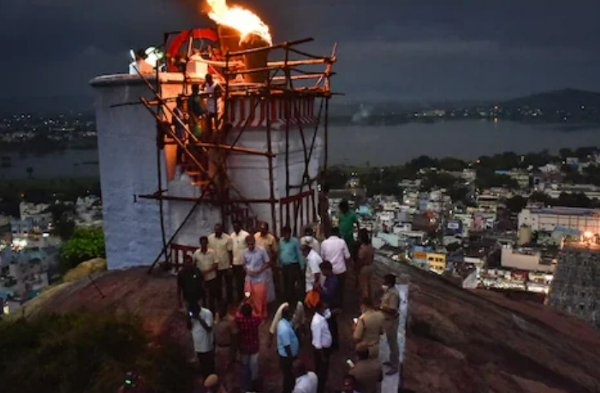
Thiruparankundram Hill, located in Madurai district, holds deep historical, cultural and spiritual significance in Tamil tradition. The belief that "wherever there is a hill, there is Lord Murugan" finds one of its strongest expressions here. For centuries, devotees have worshipped Bhagwan Shri Murugan at this site and observed the Karthigai Deepam festival with devotion.
High Court Order and Government Response
Ahead of the Karthigai Deepam festival, the Madurai Bench of the Madras High Court directed that the Thiruparankundram Deepam be lit on the Deepa Thoon, the lamp pillar situated at the hilltop. Justice G.R. Swaminathan noted in his order that the pillar is located about 50 metres from the Sikandar Badusha Dargah and that lighting the Deepam would not affect the dargah or the Muslim community in any manner.
The judge dismissed objections raised by the Hindu Religious and Charitable Endowments Department and other parties, observing that the temple administration had failed to sufficiently protect its rights over vacant land on the hill. He also referred to a 1923 judgment that established ownership rights and noted that it did not justify alleged encroachments on temple land.
Justice Swaminathan emphasised that temple authorities must remain vigilant against encroachment attempts and stated that there was no legal or moral issue in lighting the Deepam at the designated location.
DMK, an anti-Hindu party
Despite the court's directive, the DMK-led state government did not permit the Thiruparankundram Deepam to be lit at the hilltop. Barricade were put up near the temple to stop the ritual. The Dravidian party created an unnecessary dispute under the banner of secularism while ignoring Hindu sentiments and questioning a long-established religious practice.
The state later filed an appeal citing administrative and law-and-order concerns. However, even after judicial permission was granted, police and officials reportedly stopped devotees from performing the ritual, referring to the pending appeal.
The controversy deepened when DMK-affiliated leaders sought the removal of Justice G.R. Swaminathan over his order. The move drew widespread criticism, with legal observers warning that targeting a judge for delivering a lawful verdict sets a dangerous precedent and undermines judicial independence. Political pressure on the judiciary in religious matters risks weakening democratic institutions.
The Hindu belief system, its holy places and practices, is sacrificed at this twisted altar without a second thought. This is evident in Tamil Nadu, as it is in every part of the country, time and again, with Hindus repeatedly bearing the burden of minority appeasement and vote bank politics perpetrated by these parties.
Nonetheless, DMK or “secular parties” would never have the audacity to behave in this manner towards Muslims or followers of other faiths, which reveals much about their true intentions and motivations.
Thiruparankundram Hill, located in Madurai district, holds deep historical, cultural and spiritual significance in Tamil tradition. The belief that "wherever there is a hill, there is Lord Murugan" finds one of its strongest expressions here. For centuries, devotees have worshipped Bhagwan Shri Murugan at this site and observed the Karthigai Deepam festival with devotion.
High Court Order and Government Response
Ahead of the Karthigai Deepam festival, the Madurai Bench of the Madras High Court directed that the Thiruparankundram Deepam be lit on the Deepa Thoon, the lamp pillar situated at the hilltop. Justice G.R. Swaminathan noted in his order that the pillar is located about 50 metres from the Sikandar Badusha Dargah and that lighting the Deepam would not affect the dargah or the Muslim community in any manner.
The judge dismissed objections raised by the Hindu Religious and Charitable Endowments Department and other parties, observing that the temple administration had failed to sufficiently protect its rights over vacant land on the hill. He also referred to a 1923 judgment that established ownership rights and noted that it did not justify alleged encroachments on temple land.
Justice Swaminathan emphasised that temple authorities must remain vigilant against encroachment attempts and stated that there was no legal or moral issue in lighting the Deepam at the designated location.
DMK, an anti-Hindu party
Despite the court's directive, the DMK-led state government did not permit the Thiruparankundram Deepam to be lit at the hilltop. Barricade were put up near the temple to stop the ritual. The Dravidian party created an unnecessary dispute under the banner of secularism while ignoring Hindu sentiments and questioning a long-established religious practice.
The state later filed an appeal citing administrative and law-and-order concerns. However, even after judicial permission was granted, police and officials reportedly stopped devotees from performing the ritual, referring to the pending appeal.
The controversy deepened when DMK-affiliated leaders sought the removal of Justice G.R. Swaminathan over his order. The move drew widespread criticism, with legal observers warning that targeting a judge for delivering a lawful verdict sets a dangerous precedent and undermines judicial independence. Political pressure on the judiciary in religious matters risks weakening democratic institutions.
The Hindu belief system, its holy places and practices, is sacrificed at this twisted altar without a second thought. This is evident in Tamil Nadu, as it is in every part of the country, time and again, with Hindus repeatedly bearing the burden of minority appeasement and vote bank politics perpetrated by these parties.
Nonetheless, DMK or “secular parties” would never have the audacity to behave in this manner towards Muslims or followers of other faiths, which reveals much about their true intentions and motivations.