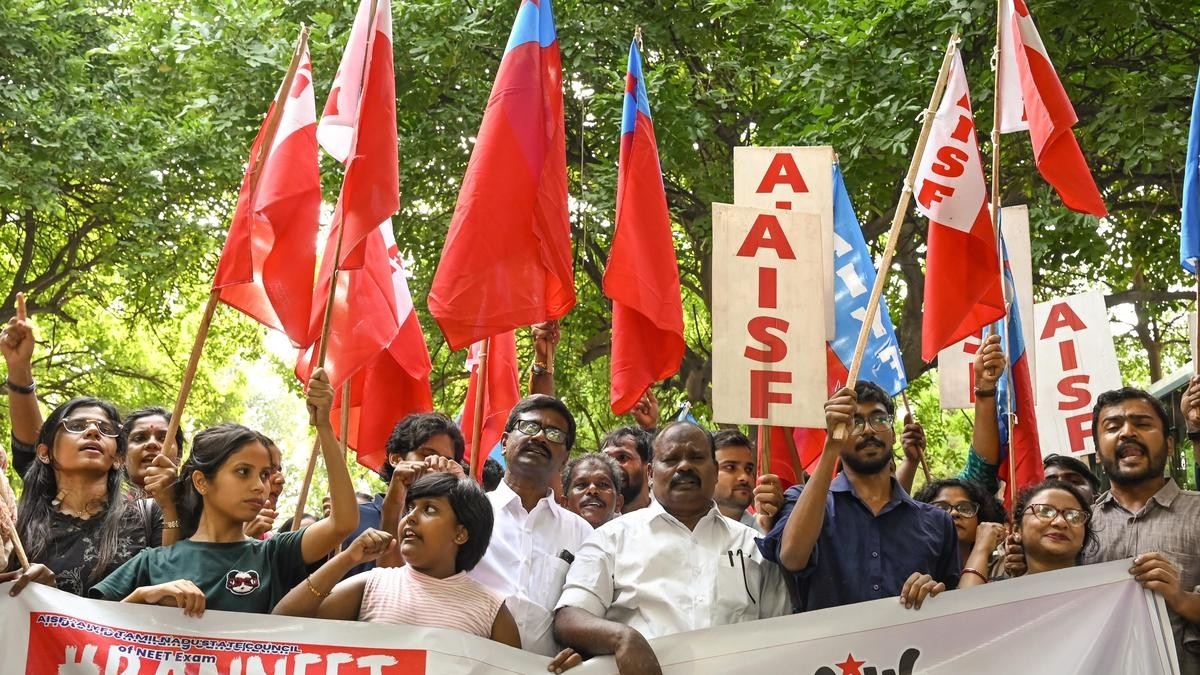
The mobilisation also involved AISF members travelling from outside Delhi. A video shared online claimed that around 22 female students affiliated with AISF, travelling from Pune to Delhi for the Jantar Mantar protest, were detained by Madhya Pradesh Police at Itarsi and taken to a hotel. If confirmed, the incident would add another dimension to the October 10 mobilisation, raising questions about the authorities’ handling of students travelling to participate in the protest.
Left groups behind the CJP protest
A video of CJP spokesperson Saurav Das thanking Left-affiliated student organisations AISF and SFI for helping organise the protest has put the role of these groups under the spotlight. Speaking at the CPI headquarters, Das openly acknowledged the contribution of AISF, SFI and others, saying that the protest would not have been as organised or significant without their support.
The protest was initially built around the controversy over alleged irregularities in the NEET examination and the demand for the resignation of then Union Education Minister Dharmendra Pradhan. CJP projected itself as a youth-led movement, with its “Gen Z” identity becoming a major part of its public image.
Das’s remarks, however, show that established Left student organisations played an important role in organising the mobilisation. AISF and SFI brought years of experience in student politics, protests and cadre-based mobilisation to a movement that was being presented largely as a spontaneous youth uprising.
Their involvement does not by itself invalidate the grievances raised by students over the NEET controversy. But it does add an important political layer to the movement. The CJP campaign was not operating entirely outside established political networks; it had support from organisations with a clear ideological and organisational history.
AISF’s role is particularly relevant because the organisation has repeatedly taken positions against the BJP government on education and other political issues. Its participation in the CJP campaign therefore needs to be viewed not only as student activism but also in the context of its wider political opposition to the government.
The Jharkhand question
The same question becomes important when AISF’s response to BJP-ruled governments is compared with its approach towards governments run by other parties.
Jharkhand saw weeks of protests by students and job aspirants over irregularities and delays in recruitment examinations. The Hemant Soren government eventually agreed to cancel 22 examinations and order investigations into 23 others. The agitation was suspended after 26 days.
This raises an obvious question for AISF. If examination failures are serious enough to demand the resignation of a Union minister, why should the same issue be treated differently when it occurs under a non-BJP government?
AISF’s Communist politics
AISF is a communist student organisation and its politics are openly ideological. Its positions are influenced by the wider communist movement and cover issues such as education, privatisation, secularism, economic policy and the role of the state.
There is nothing unusual about a student organisation having an ideology. But that ideology does not put it beyond criticism.
AISF can oppose the BJP. It can join protests with other organisations. It can demand resignations and challenge government policies. At the same time, it has to answer questions about whether it applies the same standards to governments across the political spectrum.
The October 10 protest brings that question back into focus.
Protest and violence
AISF has been involved in student protests and political agitations across India for decades. But its record should be judged by more than the causes it claims to support. The methods used during protests, its role in campus clashes and its response to violence also deserve scrutiny.
In February 2026, tensions at Andhra University in Visakhapatnam escalated after clashes involving the Akhil Bharatiya Vidyarthi Parishad (ABVP) and communist-affiliated student groups, including AISF and the Students’ Federation of India (SFI). The dispute followed opposition to an RSS-related programme on campus. Protests continued over the next few days, forcing the university administration to restrict political and religious gatherings on campus. The incident showed how political rivalries between student organisations can spill into campus life and disrupt normal academic activities. However, the reported clashes involved several groups, and the available account does not establish that AISF alone was responsible for the violence.
AISF’s participation in the October 10 CJP protest has also brought the organisation into the spotlight. Fourteen women affiliated with AISF were detained at Itarsi while travelling from Pune to Delhi for the demonstration. The reported reason for their detention was their planned participation in the protest. Their detention, by itself, is not evidence of violent conduct.
The question is what role AISF plays when student protests become confrontational. Does it work to keep demonstrations peaceful, or does its political rivalry with opposing groups sometimes deepen tensions?
The same standard should apply to claims that former AISF members have engaged in anti-national activities and how AISF treated them, how they make heroes out of them.
CISF’s history of clashes with police
In Kerala, July 2025: AISF and DYFI organised protests over the appointment of the Kerala University registrar. Tensions rose when protesters tried to enter university buildings and cross police barricades. Police used water cannons and lathi charges to control the situation. Reports also recorded clashes, attacks on police personnel and damage to vehicles. The protests continued after some AISF members were detained.
In Patna, October 2001: AISF and AIYF members attempted to break through police barricades at R-Block while protesting against the Muzaffarpur police firing on students. The protesters were trying to gherao the Bihar Chief Minister. Police first used tear gas and water cannons and later resorted to a lathi charge when protesters pushed against the cordon. Around two dozen protesters were injured.
In Telangana: AISF and SFI have also taken part in “Chalo Assembly” protests over scholarships, pending fee payments, education funding and the National Education Policy. Several such demonstrations resulted in confrontations with police, detentions and the use of water cannons when protesters tried to move beyond barricades.
There have also been clashes during Left-led marches on issues such as NEET, PM SHRI and other education-related demands. In some demonstrations, protesters tried to cross police barricades, leading to physical confrontations and the use of water cannons. In related Left student protests, including AISA-led demonstrations, barricades were broken and police vehicles were damaged, with some officers suffering injuries.
The Larger Political Game
AISF’s role in the CJP campaign exposes a wider political convergence. AISF is linked to the Communist Party of India (CPI), while CJP is clearly the B-team of AAP. Two formations that come from very different political traditions have nevertheless found common ground in one objective: opposing the BJP at every available front.
The irony is difficult to miss. The Left has spent decades attacking the politics of the AAP, while AAP has built its own political identity around challenging the traditional parties. Yet when the target is the BJP, these differences appear to disappear. AISF brings its established student network and protest machinery, while CJP brings the language and image of a new-age youth movement.
The result is a familiar political strategy in a new package. A protest is presented as a spontaneous youth uprising, but established political organisations are involved in organising it, mobilising participants and giving it political direction. CJP’s own spokesperson publicly acknowledging the contribution of AISF and SFI makes it difficult to dismiss the organisational role of these groups.
The political convergence becomes even more revealing when the history of the campaign is considered. What began with the NEET controversy and demands for the resignation of Dharmendra Pradhan has now expanded into a wider confrontation with the Election Commission and the BJP government. The issue may have changed, but the political target remains the same.
For AISF, this is no longer simply student politics. It is part of a broader political campaign. For CJP, the association with established Left organisations also raises questions about how independent its much-publicised youth identity really is.
That question becomes even more important when the same organisations demand accountability from the BJP while their scrutiny of non-BJP governments appears far less aggressive. Political opposition is legitimate. But selective outrage, shifting alliances and the presentation of organised political mobilisation as a purely spontaneous youth movement deserve to be called out.