Decolonizing History: Book Launch Exposes British Lie of 'Educating' Indian Women
English lacks a word for "woman intellectual" because Western history denied them that role. Colonizers couldn"t export an educational framework their own culture never possessed.
Total Views |


For generations, the story of Indian women’s education has often been told through the lens of colonial rule. The British brought modern education, the argument goes, and Indian women gradually emerged from a world confined to the kitchen and the upbringing of children. But what if this story leaves out a much older intellectual tradition? What if the Indian woman was not merely a homemaker, but a philosopher, poet, scholar and teacher long before colonial institutions took shape?
These questions took centre stage in Pune on Thursday at the release of Bharatiya Vidushi Ani Lekhika: San 1 te 1857 (Indian Women Scholars and Writers: 1 CE to 1857). Published in Marathi, Hindi and English, the book seeks to recover the lives and works of women whose contributions to India’s intellectual history have received limited attention. The launch was organised by Drishti Stree Adhyayan Prabodhan Kendra at the Maharashtra Sahitya Parishad’s Madhavrao Patwardhan Hall.
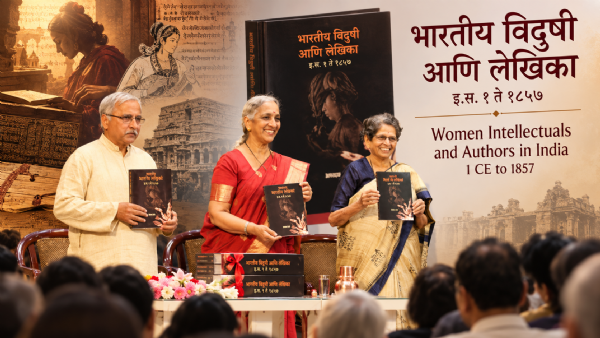
Dr Gauri Mahulikar, Dean of Chinmaya Vishwavidyapeeth, who was the chief guest, drew a sharp contrast between the domestic roles prescribed for women in certain European educational traditions and the scholarly pursuits of Indian women. The familiar idea of Chul Ani Mool (the kitchen and children) was not, she argued, an adequate description of India’s historical experience. Indian women had studied poetry, literature and Vedanta, while participating in intellectual traditions that extended across centuries.
“Our history teaches us about kings, battles and learned men, but the women who studied literature and Vedanta in depth have largely been forgotten,” Mahulikar observed. She pointed to gurukuls, mathas and temples as centres of learning, and to inscriptions, copper plates and manuscripts as sources that can help establish the place of women in India’s intellectual past.
Women associated with Vedic, Jain, Buddhist, Tantric and Bhakti traditions, she noted, made substantial contributions to literature and learning. They were not simply literate; some attained the standing of acharyas and literary figures. The problem, she suggested, is not merely that their stories are missing from textbooks, but that an entire intellectual inheritance has slipped from public memory.
No synonym for a woman intellectual?
Milind Oak raised a sharper question: What does a language reveal about the civilisation that speaks it?
Milind Oak raised a sharper question: What does a language reveal about the civilisation that speaks it?
Vidushi, Pandita, Brahmavadini, Acharyani and Kavayitri are among the words used in Indian intellectual and literary traditions to describe learned women, women engaged in philosophical inquiry, female teachers and women poets. For Oak, this vocabulary itself offers a point of reflection. A society’s language grows around ideas, practices and distinctions that matter to its people.
Yet, when one searches for a synonym for “woman intellectual” in English, there is no single, direct equivalent that captures the same range of meanings.If a culture has no native vocabulary for an intellectual woman, it is because that culture had no historical framework for female intellectual leadership. In the West, women were systematically excluded from formal intellectual spaces for centuries relegated strictly to domesticity.
So, when British colonizers walked into India claiming they were "bringing education" to a land of illiterate women, it was not just revisionist history it was outright audacity. How can a civilization whose own language lacked the basic vocabulary for female intellect claim to have introduced scholarship to a society whose indigenous languages were overflowing with it? You cannot export what you never possessed in the first place.
Sixty-four arts, literary puzzles and women scholars
Oak cited Maharshi Vatsyayana's account of the 64 arts, which included intellectual exercises such as Prahelika, or riddles and puzzles, and Samsya Purti, the completion of poetic compositions. These examples, he argued, point to a conception of learning that extended beyond domestic skills and included literary ability, memory and intellectual agility.
He also highlighted Avantisundari, the wife of the Sanskrit poet Rajasekhara, who was renowned for her knowledge of Prakrit. Oak referred to her standing as a literary authority in the context of Acharya Hemachandra's Desinamamala, a work associated with the study of regional vocabulary. Her example challenges the assumption that women in earlier centuries were absent from serious literary and linguistic scholarship.
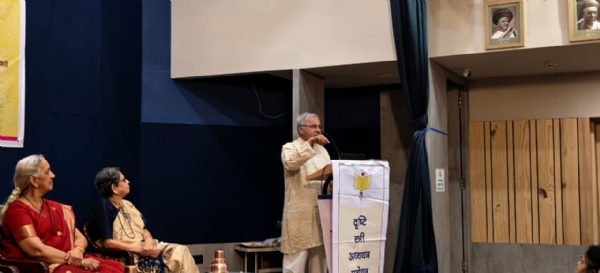
In Tanjavur, women associated with courtly and literary circles were proficient in multiple languages and participated in the preservation, copying and translation of texts. Oak also referred to Ashtavadhanam and Shatavadhanam, demanding intellectual exercises involving sustained concentration and the management of multiple tasks.
The influence of women's literary contributions, he argued, can also be traced into modern culture. Oak cited Queen Bhattarika's Sanskrit poetry as an inspiration for the celebrated Marathi song Toch Chandrama Nabhat, associated with poet and lyricist Shanta Shelke.
Did women's education begin with the British?
The discussion also turned to colonial-era reports and records of indigenous education. Oak argued that accounts of girls receiving instruction in household schools and other local educational settings complicate the claim that Indian women had no access to learning before British intervention.
He also revisited the work of Mahatma Jyotirao Phule and Savitribai Phule, whose pioneering efforts to educate girls faced opposition. Oak referred to the participation of more than 250 girls in examinations in 1853, presenting it as evidence of the growing reach of girls' education within Indian society.
The significance of these examples lies in the distinction between the expansion of modern institutional education and the existence of earlier educational traditions. The speakers argued that the former should not be mistaken for the beginning of the latter.
The forgotten names of Indian scholarship
The problem is not simply that women's contributions are missing from textbooks. It is also that many of their works have disappeared from public memory. Manuscripts have been lost, literary works have fallen out of circulation, and the contributions of those who copied or translated texts have not always been adequately acknowledged. In some cases, the speakers argued, women’s intellectual contributions have been obscured or their credit appropriated by others.
The answer, they said, lies in recovering manuscripts, identifying forgotten scholars, translating and reprinting their works, and incorporating their contributions into educational curricula. Without that effort, generations of students will continue to encounter an incomplete account of India's intellectual history.
For a country that has produced the words Vidushi, Brahmavadini and Acharyani, the question remains: how did so many women who embodied these words disappear from the history taught to their own descendants?