Police move to cancel Sharjeel Imam’s bail amid CJP's leadrs detentions
Sarjeel Imam"s latest development has raised questions over his role in the CJP protest. Is this merely a coincidence of timing, or is there a deeper nexus at play?
Total Views |


As Delhi Police detained Cockroach Janta Party (CJP) leader Abhijeet Dipke and others at Delhi Airport on Saturday, October 10, 2026, a major legal update emerged regarding the 2020 Northeast Delhi riots case. Delhi Police have petitioned a local court to revoke the interim bail granted to key accused Sharjeel Imam, alleging that he violated his bail conditions by speaking to the media.
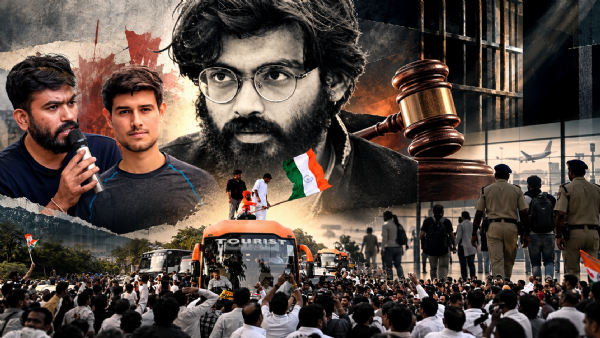
According to the authorities, he engaged with the media and broke the terms of his bail. Imam is prohibited from using social media and from interacting with members of the media during the period, pursuant to the stated condition.
He was given temporary relief by Karkardooma Court’s Additional Sessions Judge Sameer Bajpai to attend his cousin’s wedding from 4th to 10th October.
#Breaking
— Bar and Bench (@barandbench) October 10, 2026
Delhi Police moves Delhi court seeking cancellation of interim bail granted to Sharjeel Imam in the Delhi riots conspiracy case.
Police say that as a condition for granting bail, Imam was restrained from talking to the media. However, there is a video of him… pic.twitter.com/eZDtUhnIJx
The CJP and Left organisations like AISA and SFI have called for a protest at Jantar Mantar on the 10th of October 2026, demanding the resignation of CEC Gyanesh Kumar. The Delhi Police denied permission for the protest and enforced heavy police security. However despite the denial of permission, Abhijit Dipke, Ashutosh Ranka and Saurav Das were planning to create a ruckus at Jantar Mantar. Following which Delhi police arrested them.
#WATCH | Delhi Police personnel enter the aircraft that was carrying Cockroach Janta Party (CJP) Founder Abhijeet Dipke to Delhi. The flight landed at IGI Airport a few minutes ago.
— ANI (@ANI) October 10, 2026
"...I have come here to be arrested; arrest me," Abhijeet Dipke tells Delhi Police
"No, this is… pic.twitter.com/wz9jSXgNH2
Earlier, in the morning, the Delhi Police detained notorious youtuber and AAP supporter Dhruv Rathee and CJP’s legal cell head Ratna Singh at their respective residences. CJP’s policy head Mehr was also detained by the Delhi Police. Hundreds of suspected protesters were also detained by the police overnight from various parts of Delhi.
Sarjeel Imam's latest development has raised questions over his role in the CJP protest. Is this merely a coincidence of timing, or is there a deeper nexus at play?