Golden harvest drowns in AAP’s neglect: Rs 20 crore paddy submerged as Mann govt fails to prepare mandis in Punjab
Heavy overnight rain on October 11 exposed serious preparedness and infrastructure failures in Punjab’s paddy procurement system, with Fazilka’s main grain mandi submerged under three to four feet of water and freshly harvested paddy left floating.
Total Views |


Fazilka’s grain mandi, meant to be a centre of Punjab’s paddy procurement operation, turned into a waterlogged disaster zone on October 11 after heavy overnight rain.
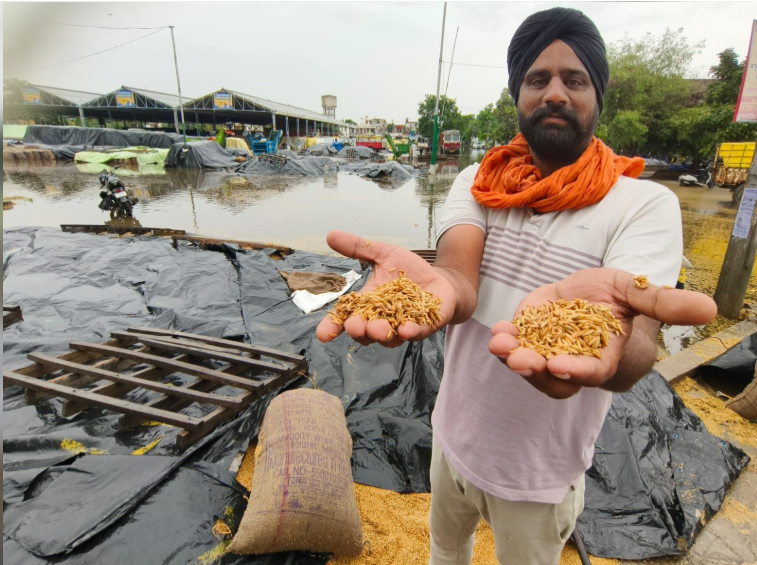
A farmer displays paddy grains amid waterlogging at a grain market following heavy rain in Patiala, (Image Source: The Tribune)
Three to four feet of water accumulated at several parts of the mandi, submerging freshly harvested paddy. Farmers and commission agents were forced to wade through knee-deep water, while a boat was brought into the mandi as surrounding roads and sections of the market became inaccessible.
The scenes exposed the apparent failure of basic arrangements to protect farmers’ produce during the procurement season.
Fazilka, located in Punjab’s Malwa region, was among the worst-affected areas. Farmers and arthiyas estimated that paddy worth Rs 15–20 crore was damaged in the mandi alone.
‘For the first time, we had to bring a boat’
Sanjeev Sachdeva (Goldy), president of the local Arhtiya Association, said the situation had become so severe that a kishti had to be brought into the mandi.
The mandi, spread across roughly 90-100 acres and established in 1971, has reportedly seen limited infrastructure modernisation despite the growing demands of agricultural procurement and increasingly erratic rainfall.
Farmers questioned why large quantities of paddy were lying exposed when procurement had already begun and the arrival of rain during the harvesting season was hardly an unforeseeable risk.
The problem was not simply the rainfall. It was the inability of the mandi infrastructure to drain the water quickly and protect the crop already brought into the market.
Similar waterlogging was reported in Malout in Sri Muktsar Sahib and other parts of the region.
At Malout, farmers reported that stocks remained exposed for days. One farmer said around 600 sacks of his paddy were submerged after he had already waited eight days for procurement.
Farmers blame Mann government for poor preparedness
The flooding triggered protests by arthiyas and farmer organisations, including BKU (Lakhowal) and BKU Dakonda.
Their criticism focused on two basic failures: inadequate drainage and inadequate protection for paddy arriving at the mandis.
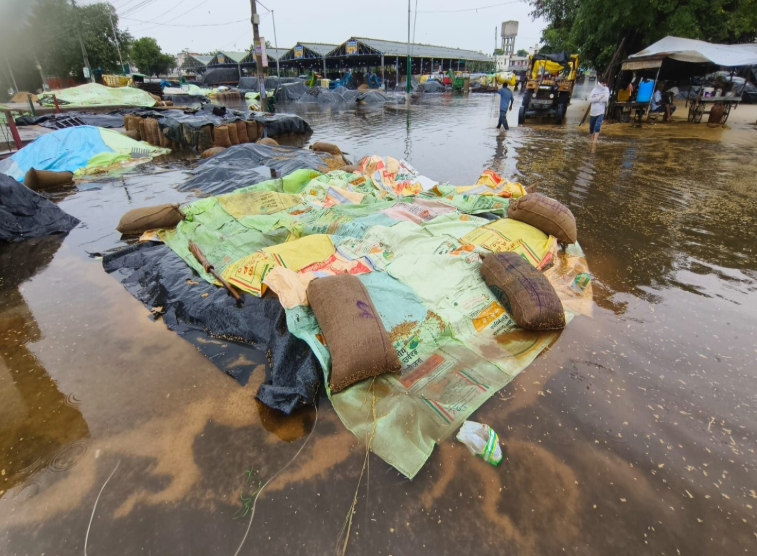
Visuals from the Mandi, (Image: The Tribune)
Farmers and commission agents argued that sufficient covered storage, elevated platforms, tarpaulins and functional drainage should have been arranged before procurement began.
The Centre provides procurement financing through the Cash Credit Limit mechanism, while the state administration is responsible for critical ground-level arrangements, including mandi infrastructure, gunny bags, storage arrangements, lifting and related procurement operations.
The Fazilka episode has therefore raised an uncomfortable question for the Bhagwant Mann government: if the state knew that millions of tonnes of paddy would enter mandis during the monsoon and post-monsoon period, why was basic drainage and protection not ready?
AAP MLA faces angry protesters
AAP MLA Narinder Pal Singh Sawna eventually reached the flooded mandi, where protesters confronted him and demanded answers.
Farmers sought an explanation for the scale of waterlogging and demanded compensation for their damaged crop.
The protest was called off after Sawna gave a written assurance that the infrastructure would be upgraded and that losses would be compensated by the state government.
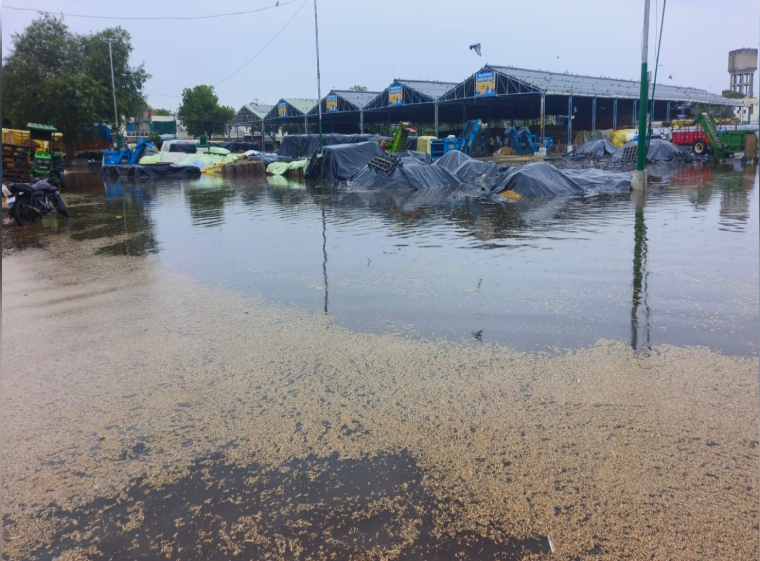
Visuals from the Mandi, (Image: The Tribune)
The assurance may have calmed the immediate protest, but it also underlined the larger problem: infrastructure upgrades were being promised after farmers' produce had already been destroyed.
‘Unexpected Rain’ defence fails to convince farmers
The Deputy Commissioner attributed the situation to an unexpected downpour and said pumps had been deployed to remove the accumulated water.
The administration also maintained that the mandi had a sewage and drainage system that became overwhelmed by the rainfall.
But the explanation did little to satisfy angry farmers.
For farmers, the question is not whether the rainfall was unusually intense. The question is why a major procurement centre lacked sufficient resilience to protect agricultural produce during a season when rain-related disruption is a known risk.
Calling the rainfall “unexpected” also does little to explain why paddy was left exposed in low-lying areas without adequate temporary protection.
BJP, SAD attack Mann Government
The opposition quickly seized on the flooded mandis to attack the AAP government.
Former Punjab BJP president Sunil Jakhar argued that procurement funds had already been made available by the Centre and accused the state government of failing to ensure proper arrangements on the ground.
Punjab BJP president Kewal Singh Dhillon said the incident exposed deficiencies in drainage, tarpaulins and procurement infrastructure. He also attacked Chief Minister Bhagwant Mann, accusing him of being more interested in political appearances than addressing farmers’ problems.
SAD president Sukhbir Singh Badal demanded immediate compensation and a special girdawari to assess crop damage across affected areas.
Badal also demanded advance relief of Rs 50,000 per acre and questioned why farmers had allegedly not received full compensation for crop losses caused by floods and hailstorms during the previous two years.
A procurement crisis waiting to spread?
Punjab is targeting procurement of around 180 lakh metric tonnes of paddy this season, while only a portion of the crop has reached the mandis.
That makes the Fazilka episode more than a localised incident.
If drainage, storage and temporary protection remain inadequate across other procurement centres, further spells of heavy rainfall could produce similar losses.
The problem becomes more serious mandis operate with infrastructure that was designed decades ago. It was the responsibility of the government to rebuild the mandi as per the needs of the farmers, which the AAP government has failed miserably.
Golden harvest submerged
The Fazilka disaster has exposed the gap between political claims of being a farmer-friendly government and the basic conditions confronting farmers on the ground.
For months, farmers invest money, labour and time in producing the paddy crop. Once the harvest reaches the mandi, the government and procurement agencies assume responsibility for ensuring that it is protected, lifted and purchased.
In Fazilka, that system visibly broke down.
The sight of golden paddy floating in several feet of water is more than an unfortunate consequence of heavy rain. It is a warning about the cost of poor preparedness.