Rahul Gandhi Leads INDIA Bloc March to Supreme Court, Files Plea Against CEC
Total Views |


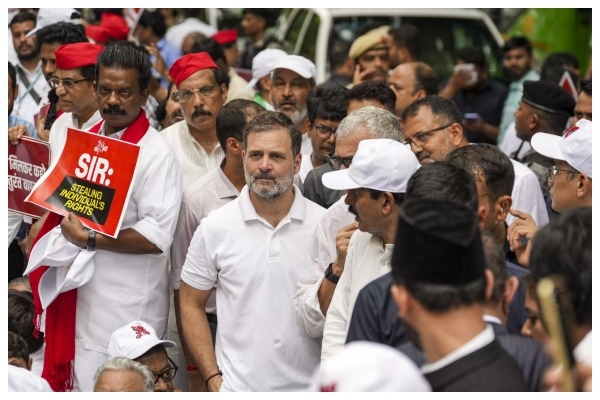
New Delhi, October 12: Leader of Opposition Rahul Gandhi led the INDIA bloc’s march towards the Supreme Court on Monday, following Chief Justice of India Surya Kant’s refusal to meet opposition leaders over their allegations of irregularities in electoral rolls and demands for action against Chief Election Commissioner Gyanesh Kumar. The march was halted by Delhi Police at Bhagwan Dass Road, while Gandhi’s lawyers filed a petition in the Supreme Court challenging the CEC’s role.
The sequence of events has raised questions about the opposition’s approach to constitutional institutions. The CJI had declined a request by Rahul Gandhi and Congress president Mallikarjun Kharge to meet him and submit a memorandum. In his communication, the CJI stated that the issues raised were already pending before the Supreme Court and that discussing them in a meeting would be incompatible with judicial propriety and the constitutional principle of separation of powers. He advised the leaders to approach the Court through the established judicial process.
The INDIA bloc nevertheless proceeded with its planned march, turning its confrontation with the Election Commission into a public demonstration outside the country’s highest judicial institution. The opposition sought to highlight what it describes as “vote chori” and irregularities in the Special Intensive Revision (SIR) of electoral rolls.
The opposition’s principal demands include the resignation of Gyanesh Kumar, a halt to the SIR exercise and a return to ballot-paper voting. Opposition parties have alleged that electoral procedures are being used to undermine the fairness of elections. The Election Commission’s functioning and the process of revising voter lists have consequently become the focus of an intensifying political dispute.
The march followed protests in Delhi over the SIR exercise and police action against demonstrators. Security arrangements were strengthened in the capital, with restrictions affecting traffic and metro services in parts of the city.
राहुल गांधी हवाहवाई नेता हैं और इनकी राजनीति का पैटर्न पूरी तरह हवाहवाई है।
— Anurag Thakur (@ianuragthakur) October 12, 2026
हवाहवाई नेता राहुल गांधी की..
हवाहवाई बातें,
हवाहवाई आरोप
हवाहवाई हरकतें
हवाहवाई प्रदर्शन
हवाहवाई तथ्य
हवाहवाई तर्क
हवाहवाई आंकड़े
इनका सब कुछ हवाहवाई ही है, धरातल और असलियत में शून्य बटे सन्नाटा। pic.twitter.com/2qQYDWywdF
The development has brought into focus the distinction between political protest and judicial proceedings. Opposition parties are entitled to challenge electoral decisions and seek legal remedies. However, the CJI’s refusal to receive a political memorandum reflected the principle that pending legal matters must be addressed through judicial procedures rather than administrative meetings with political representatives.
The filing of the petition now places the dispute within the judicial process. The Supreme Court will have to consider the matter in accordance with law, independently of the political mobilisation surrounding it.
The episode has also renewed debate over the relationship between the Election Commission and the judiciary. While opposition parties have demanded accountability from the CEC, the constitutional framework requires allegations to be examined through evidence and prescribed legal procedures.
The immediate question is whether the legal challenge will substantiate the opposition’s allegations and what course the Supreme Court will take. The broader issue is whether political parties can maintain public confidence in electoral institutions while pursuing their grievances through constitutional means.