‘Will Rahul Gandhi act or protect his friend?’ BJP Mahila Morcha in Assam demands action against MP Akoijam over JNU sexual assault case
BJP Mahila Morcha workers staged protests in Guwahati on October 10, demanding action against Congress MP Angomcha Bimol Akoijam following his dismissal from Jawaharlal Nehru University (JNU) over sexual harassment complaints by 11 female students. The protesters questioned Rahul Gandhi’s commitment to women’s safety and accused the Congress leadership of failing to hold its own MP accountable.
Total Views |


The Assam unit of the Bharatiya Janata Party’s Mahila Morcha staged a protest rally on October 10, marching towards the Assam Pradesh Congress Committee headquarters, Rajiv Bhawan, in Guwahati.
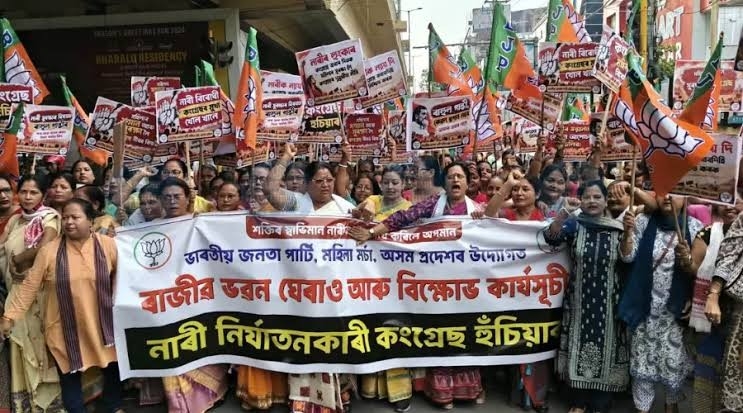
Visuals from the site of the protest, (Image source: The Assam Tribune)
Led by state president and Cabinet minister Nilima Devi, the protesters demanded the expulsion of Inner Manipur Congress MP Angomcha Bimol Akoijam following his dismissal from JNU over sexual harassment complaints involving 11 female students.
The demonstrators also targeted Congress leader and Leader of the Opposition in the Lok Sabha Rahul Gandhi, questioning his silence and demanding that the party take disciplinary action against Akoijam.
Police barricades stopped the march near the Congress office. Some protesters, including Devi, were briefly detained after attempting to cross the barricades. They were subsequently released.
Addressing the gathering, Devi accused the Congress of failing to practise the principles it publicly advocates.
She questioned whether Rahul Gandhi would act against Akoijam or protect him because of their political association.
She also challenged the Congress leadership to explain why it had not taken decisive action against the MP.
#WATCH | Assam: The State BJP Mahila Morcha took out a protest rally in Guwahati against Lok Sabha LoP Rahul Gandhi, demanding the expulsion of Congress MP from Inner Manipur, Angomcha Bimol Akoijam, following his dismissal from Jawaharlal Nehru University (JNU) over allegations… pic.twitter.com/WBDIIKsBjT
— ANI (@ANI) October 10, 2026
The protest put the spotlight on an uncomfortable question for the Congress: can a party that frequently speaks about women's safety and gender equality avoid scrutiny when serious allegations involve one of its own elected representatives?
JNU dismissal and police FIR Put Akoijam under scrutiny
JNU dismissed Akoijam from service with immediate effect on October 9 following an inquiry by its Internal Committee into complaints filed by 11 female students in May 2026.
Akoijam was a professor at the university's Centre for the Study of Social Systems under the School of Social Sciences.
The complaints included allegations of sexually suggestive remarks, intrusive questions about students' personal relationships, unwelcome physical contact and inappropriate conduct during academic interactions. Other allegations concerned late-night assessments at the professor's residence and the screening of explicit material without adequate warning.
The university's decision followed the committee's findings and recommendation for major disciplinary punishment under the applicable service rules.
Delhi Police subsequently registered an FIR on October 11 at Vasant Kunj North police station following a complaint by JNU's Chief Security Officer. The case invokes provisions of the Bharatiya Nyaya Sanhita relating to sexual harassment, sexually coloured remarks and insulting a woman's modesty.
The police investigation is ongoing.
Akoijam has rejected the allegations and described his dismissal as a political witch-hunt. He has also questioned the inquiry's procedures and alleged that his North-Eastern identity played a role in the action against him.
Rahul Gandhi's women’s rights campaign faces a test
The BJP has used the controversy to question the credibility of Rahul Gandhi's public positions on patriarchy, gender discrimination and women's rights.
BJP leaders have argued that the Congress cannot demand accountability from political opponents while remaining reluctant to act when allegations involve its own MP.
If women's dignity is a principle rather than a political slogan, the party must demonstrate that the standard applies regardless of the accused person's political position.
🚨 HUGE: BJP hits the streets in Delhi 🔥
— Megh Updates 🚨™ (@MeghUpdates) October 12, 2026
A MASSIVE protest march is UNDERWAY towards Congress HQ, demanding the IMMEDIATE SUSPENSION of MP Angomcha Bimol Akoijam over SEXUAL HARASSMENT complaints by 11 female JNU students.
Protesters also BURN an effigy of Rahul Gandhi. pic.twitter.com/x6uuA8tdXX
The demand for action is not simply about the fate of one MP; it concerns whether political parties are prepared to enforce internal accountability when doing so carries a political cost.
The BJP has demanded Akoijam's suspension and expulsion from the Congress. Protesters have also called for his resignation from the Lok Sabha and an apology to the students.
Nationwide BJP campaign intensifies pressure on Congress
Protests were organised or announced outside Congress offices in several locations, with party workers demanding action against Akoijam. In Delhi, BJP workers marched towards the Congress headquarters and burned effigies of Rahul Gandhi.
BJP leaders, including national president Nitin Nabin and former Union minister Smriti Irani, criticised the Congress over the controversy and questioned the gap between its public messaging on women's rights and its response to the case involving Akoijam.
The BJP has presented the campaign as a demand for accountability rather than a dispute limited to party politics.
Selective activism raises questions
The controversy has also prompted questions about the consistency of political activism and public scrutiny.
During the same period, the Cockroach Janta Party (CJP), a youth-led political movement, mobilised supporters in Delhi against Chief Election Commissioner Gyanesh Kumar over the Special Intensive Revision of electoral rolls. The movement and opposition groups alleged irregularities in the process, while the Election Commission and the BJP disputed accusations of deliberate wrongdoing.
Against this backdrop, the response of student organisations, civil-society groups and activists who regularly campaign on gender justice has become a subject of debate.
Many argue that organisations that mobilise rapidly over political and institutional controversies should apply comparable scrutiny when serious allegations involve a politician from the opposition. They contend that women's safety must not become a partisan issue, invoked against political rivals but treated cautiously when the accused belongs to a preferred political camp.