UN’s Double Standards: India Will Not Accept Foreign Tutelage
The United Nations Human Rights Office has received a firm and deserved response from India for its comments on the detention of protesters in Delhi.
NewsBharati 12-Oct-2026 13:24:47 PM
Total Views |


An unelected international office cannot lecture the world’s largest democracy selectively while its own credibility and consistency remain open to question.
 This is the heart of the controversy. The UN cannot demand unquestioning respect for its pronouncements while refusing to answer questions about the consistency of its own conduct. It cannot invoke human rights against one country, remain conspicuously silent about comparable incidents elsewhere and then expect its intervention to be treated as politically neutral.
India must not retreat from its position. Sovereignty is not a privilege granted by the UN, and India does not require international certification of its democratic legitimacy.
The OHCHR expressed concern over the detention of protesters, civil-society members, lawyers and journalists during the demonstrations in Delhi. But who authorised this office to assume the role of a judge in a developing domestic confrontation? India’s Constitution guarantees peaceful assembly. It also recognises the need for lawful restrictions in the interests of public order and safety. The question is not whether human rights matter. The question is whether the UN applies its principles impartially or deploys them selectively. Human rights cannot become a convenient instrument for exerting pressure on governments whose domestic policies or political orientation attract international criticism.
The UN intervention must also be seen against the political confrontation surrounding Chief Election Commissioner Gyanesh Kumar and the Special Intensive Revision of electoral rolls. Opposition parties have alleged irregularities and questioned whether the revision could disadvantage sections of voters. The Election Commission and the BJP dispute allegations of political manipulation. The claims must be assessed on evidence, electoral records and the remedies available under Indian law.
Instead, the demand for the CEC’s resignation has become part of a broader political campaign challenging the credibility of a constitutional institution. The UN’s intervention over the handling of the resulting protests now provides another international platform on which the controversy can be discussed.
The danger is obvious. When opposition parties accuse a constitutional institution of wrongdoing and an international office subsequently criticises the government’s response to protests, the latter statement can be presented as external validation of the former allegations. A contested domestic dispute is thereby elevated into an international narrative about democratic decline.
This does expose a political consequence that India cannot afford to ignore: external interventions can amplify allegations against the Modi government before those allegations have been conclusively established. The Election Commission must answer legitimate questions through the appropriate institutional processes. It should not be declared guilty by political accusation, nor should its credibility be undermined through the cumulative repetition of unverified claims at home and abroad.
The controversy over the proposed Foreign Contribution (Regulation) Amendment Bill offers another clear example of external pressure on India’s domestic decision-making. In August 2026, US Congressman Riley Moore criticised the proposed amendments, claiming that they threatened Christian institutions and religious charities. India rejected his intervention. The Ministry of External Affairs stated that legislative matters concerning India were for Parliament to decide and pointed out that the United States itself regulates foreign funding.
The same principle applies to the UN Human Rights Office. External institutions may express opinions, but those opinions do not confer supervisory authority over India’s Parliament, police or courts. The CEC controversy and the FCRA debate involve different issues. Their common thread is the question of external intervention in matters that India has established constitutional mechanisms to address. The government is entitled to challenge such interventions, particularly when external criticism risks becoming a political weapon against its domestic decisions.
The pattern deserves scrutiny. Allegations against the Election Commission, criticism of India’s foreign-funding legislation and the UN’s intervention over domestic protests have all contributed to international debate about the Modi government’s policies and democratic credentials. These episodes prove a coordinated international conspiracy. Different actors may have different motivations, and evidence of deliberate coordination must not be invented. It would be equally mistaken to ignore the cumulative political effect of repeated interventions.
When domestic allegations are amplified internationally, when Indian legislation is portrayed abroad in the most damaging terms, and when international bodies issue public pronouncements on politically charged developments, the combined effect can strengthen a narrative intended to undermine the government’s legitimacy.
The opposition may use international criticism to reinforce its domestic campaign. Foreign political figures may seek to influence debate over India’s policies. International officials may believe they are fulfilling their institutional mandates. Whatever their stated intentions, the consequences deserve examination.
India need not prove the existence of a central command coordinating every intervention before questioning their propriety, selectivity or impact. The country has every right to defend its institutions and to reject external pressure that exceeds legitimate international engagement.
The United Nations Human Rights Office must understand that India is not under its tutelage. India has a constitution, an elected Parliament, an independent judiciary and a free media. Its democratic institutions are accountable under the country’s legal framework; they do not require the approval of an international office to establish their legitimacy.
India should honour its international commitments and remain engaged with multilateral institutions. But cooperation must never be confused with submission. The UN’s credibility depends on its willingness to apply consistent standards, acknowledge legitimate criticism and respect the constitutional authority of sovereign democracies.
The message to the OHCHR must be unequivocal- stop the selective sermons, abandon the double standards and respect India’s sovereignty. India will not accept the presumption that an external pronouncement settles a domestic political dispute.
India welcomes principled international engagement. It rejects selective interference. Its Parliament is not answerable to foreign legislators, its constitutional institutions cannot be legitimized by unsubstantiated allegations, and its sovereignty is not negotiable. The authority to govern India belongs to the Indian people—not to the UN Human Rights Office.
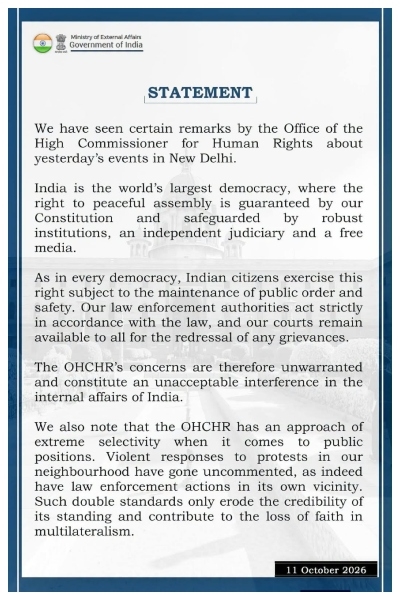
The United Nations Human Rights Office has received a firm and deserved response from India for its comments on the detention of protesters in Delhi. On October 11, the Ministry of External Affairs described the OHCHR’s concerns as “unwarranted” and an “unacceptable interference” in India’s internal affairs. More significantly, India exposed the organisation’s “extreme selectivity”, pointing to violent responses to protests in neighbouring countries and law-enforcement actions in the UN office’s own vicinity that had gone uncommented upon. India warned that such double standards erode the credibility of the institution and weaken faith in multilateralism.
India must not retreat from its position. Sovereignty is not a privilege granted by the UN, and India does not require international certification of its democratic legitimacy.
The OHCHR expressed concern over the detention of protesters, civil-society members, lawyers and journalists during the demonstrations in Delhi. But who authorised this office to assume the role of a judge in a developing domestic confrontation? India’s Constitution guarantees peaceful assembly. It also recognises the need for lawful restrictions in the interests of public order and safety. The question is not whether human rights matter. The question is whether the UN applies its principles impartially or deploys them selectively. Human rights cannot become a convenient instrument for exerting pressure on governments whose domestic policies or political orientation attract international criticism.
The UN intervention must also be seen against the political confrontation surrounding Chief Election Commissioner Gyanesh Kumar and the Special Intensive Revision of electoral rolls. Opposition parties have alleged irregularities and questioned whether the revision could disadvantage sections of voters. The Election Commission and the BJP dispute allegations of political manipulation. The claims must be assessed on evidence, electoral records and the remedies available under Indian law.
Instead, the demand for the CEC’s resignation has become part of a broader political campaign challenging the credibility of a constitutional institution. The UN’s intervention over the handling of the resulting protests now provides another international platform on which the controversy can be discussed.
The danger is obvious. When opposition parties accuse a constitutional institution of wrongdoing and an international office subsequently criticises the government’s response to protests, the latter statement can be presented as external validation of the former allegations. A contested domestic dispute is thereby elevated into an international narrative about democratic decline.
This does expose a political consequence that India cannot afford to ignore: external interventions can amplify allegations against the Modi government before those allegations have been conclusively established. The Election Commission must answer legitimate questions through the appropriate institutional processes. It should not be declared guilty by political accusation, nor should its credibility be undermined through the cumulative repetition of unverified claims at home and abroad.
The controversy over the proposed Foreign Contribution (Regulation) Amendment Bill offers another clear example of external pressure on India’s domestic decision-making. In August 2026, US Congressman Riley Moore criticised the proposed amendments, claiming that they threatened Christian institutions and religious charities. India rejected his intervention. The Ministry of External Affairs stated that legislative matters concerning India were for Parliament to decide and pointed out that the United States itself regulates foreign funding.
India’s FCRA framework concerns the regulation of foreign contributions, financial accountability and the protection of national interests. The proposed amendments can be debated, scrutinised and challenged through India’s democratic and judicial processes. But a US legislator has no authority to dictate the outcome of India’s parliamentary deliberations.
The same principle applies to the UN Human Rights Office. External institutions may express opinions, but those opinions do not confer supervisory authority over India’s Parliament, police or courts. The CEC controversy and the FCRA debate involve different issues. Their common thread is the question of external intervention in matters that India has established constitutional mechanisms to address. The government is entitled to challenge such interventions, particularly when external criticism risks becoming a political weapon against its domestic decisions.
The pattern deserves scrutiny. Allegations against the Election Commission, criticism of India’s foreign-funding legislation and the UN’s intervention over domestic protests have all contributed to international debate about the Modi government’s policies and democratic credentials. These episodes prove a coordinated international conspiracy. Different actors may have different motivations, and evidence of deliberate coordination must not be invented. It would be equally mistaken to ignore the cumulative political effect of repeated interventions.
When domestic allegations are amplified internationally, when Indian legislation is portrayed abroad in the most damaging terms, and when international bodies issue public pronouncements on politically charged developments, the combined effect can strengthen a narrative intended to undermine the government’s legitimacy.
The opposition may use international criticism to reinforce its domestic campaign. Foreign political figures may seek to influence debate over India’s policies. International officials may believe they are fulfilling their institutional mandates. Whatever their stated intentions, the consequences deserve examination.
India need not prove the existence of a central command coordinating every intervention before questioning their propriety, selectivity or impact. The country has every right to defend its institutions and to reject external pressure that exceeds legitimate international engagement.
The United Nations Human Rights Office must understand that India is not under its tutelage. India has a constitution, an elected Parliament, an independent judiciary and a free media. Its democratic institutions are accountable under the country’s legal framework; they do not require the approval of an international office to establish their legitimacy.
India should honour its international commitments and remain engaged with multilateral institutions. But cooperation must never be confused with submission. The UN’s credibility depends on its willingness to apply consistent standards, acknowledge legitimate criticism and respect the constitutional authority of sovereign democracies.
The message to the OHCHR must be unequivocal- stop the selective sermons, abandon the double standards and respect India’s sovereignty. India will not accept the presumption that an external pronouncement settles a domestic political dispute.
India welcomes principled international engagement. It rejects selective interference. Its Parliament is not answerable to foreign legislators, its constitutional institutions cannot be legitimized by unsubstantiated allegations, and its sovereignty is not negotiable. The authority to govern India belongs to the Indian people—not to the UN Human Rights Office.

Editor's Desk
Editor's Desk