Missionary institution under scanner in MP: 105 children linked to one Samagra ID, conversion and trafficking allegations under probe
Damoh police have arrested Mission Hospital manager Sanjeev Lambert in a case involving manipulation of Samagra IDs, with records of 105 children reportedly linked to a single ID. The investigation is examining suspected religious conversion, possible child trafficking and document forgery, while five other accused remain absconding.
Total Views |


Allegations of religious conversion and large-scale document fraud have emerged in Madhya Pradesh’s Damoh district after investigators found irregularities involving the Samagra IDs of 105 children. Police have arrested Sanjeev Lambert, manager of Damoh Mission Hospital, in connection with the case.

(An AI Generated Representative Image)
The investigation began after the Child Welfare Committee (CWC) raised concerns that the names of several children had been linked to a single Samagra ID associated with an institution. Authorities are examining whether documents were manipulated to alter the children’s family details and whether the fraud was connected to suspected religious conversion or child trafficking.
Police have registered a case against six people, including Lambert. The other five accused are reportedly absconding. Lambert was produced before a court and sent to jail, according to the report.
CWC complaint triggers investigation
The case came to light after CWC chairman Deepak Tiwari submitted a complaint to Damoh Dehat police station. He claimed that the names of multiple children had been entered under a Samagra ID created in the name of an institution.
Following the complaint, the district administration constituted a four-member inquiry team on the Collector’s orders. The team reportedly found irregularities in the records, following which an FIR was registered on September 25.
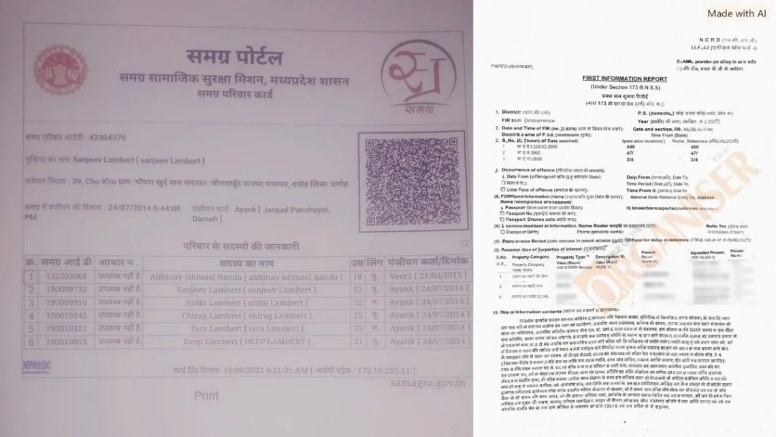
Copy of the FIR and Samagra details, (Image: Organiser)
Damoh Dehat police station in-charge Dharmendra Upadhyay said investigators had found discrepancies in the records of 105 children. He added that the inquiry was continuing and that the records were still being examined.
According to the complaint, the children’s biological parents were different from the family details reflected in the records. Investigators are now examining how the entries were made and who was responsible for the manipulation.
Religious conversion and child trafficking angles under probe
The case has raised concerns about possible religious conversion and child trafficking. However, these allegations remain under investigation and have not yet been established in court.
According to the CWC chairman, the institution entered children's names in official records by presenting them as one another’s parents. He also claimed that the records were used to obtain scholarships and ration benefits.
Tiwari further claimed that some children had been brought to Damoh from other states and that forged documents may have been prepared for them. He called for a detailed investigation into the children's identities, family backgrounds and institutional records.
Investigators are also examining whether the children’s names were subsequently linked to other families. The police have not yet established the full extent of the network or confirmed that all 105 children were subjected to religious conversion.
Child’s name added to family ID in 2016
During the investigation, police reportedly found that the name of one child had been added to Lambert’s family Samagra ID in 2016.
The child is suspected to have been subjected to religious conversion, although this allegation remains to be verified. During questioning, Lambert reportedly told investigators that the child was currently living in Chhattisgarh.
According to the police, a team will visit the address provided and conduct further inquiries into the child’s identity, family background and circumstances.
The investigation is also seeking to establish whether the irregularities were isolated incidents or part of a wider pattern involving multiple children.
Lambert was previously arrested in another case
Lambert had reportedly been arrested around eight months earlier in connection with a separate case involving deaths linked to treatment by a person accused of practising medicine fraudulently. A reward of Rs 30,000 had been announced for him in that case, according to the report. He was later released on bail.
His latest arrest is in connection with the Samagra ID manipulation. Police are examining whether the two cases have any connection, but no such link has been established so far.
The current case has been registered under Sections 467, 468 and 471 of the Indian Penal Code, which deal with forgery of valuable documents, forgery for the purpose of cheating, and using forged documents as genuine.
Earlier allegations against another children’s institution
The report also refers to previous allegations involving Aadhaarshila, a children’s institution associated with Christian missionary Dr Ajay Lal. The institution had faced allegations of religious conversion and sexual misconduct, and its children’s home was reportedly subject to regulatory action.
Earlier complaints had also prompted inquiries by the Madhya Pradesh Child Rights Protection Commission and the National Commission for Protection of Child Rights (NCPCR).
The allegations included claims that Hindu children were being taught Christian religious practices and made to read the Bible. Separate complaints concerned sexual misconduct involving an employee of the institution.
These allegations concern a separate set of claims and should not be treated as proof of wrongdoing in the current Samagra ID case.
Police probe continues
The immediate focus of the Damoh investigation is to establish how the records of 105 children came to be linked to one Samagra ID, who authorised the entries and whether forged documents were used to obtain government benefits.
Investigators are also examining the children's family details, the institutions involved and the suspected conversion and trafficking angles. The role of any officials or employees who may have facilitated the manipulation remains to be established.
With five accused still absconding, further details may emerge as the investigation progresses. The central questions remain whether the irregularities were deliberate, whether the children were unlawfully moved or subjected to coercion, and whether the offences can be substantiated through documentary and witness evidence.