Rahul Baba, Supreme Court Is Not Your Political Gym
This tension has roots in the Congress’s longer political history.
NewsBharati 13-Oct-2026 13:09:43 PM
Total Views |


The march to the Supreme Court by Rahul Gandhi and leaders of the INDIA bloc marks a serious troubling escalation in the confrontation between the Congress and India’s constitutional institutions. The issue is not whether opposition parties have the right to criticise the Election Commission and question electoral procedures. The fundamental question is whether political mobilisation can be used to bring constitutional authorities under pressure and whether the country’s highest court should be drawn into a political confrontation by a party dissatisfied with the continuous rejection by the people.
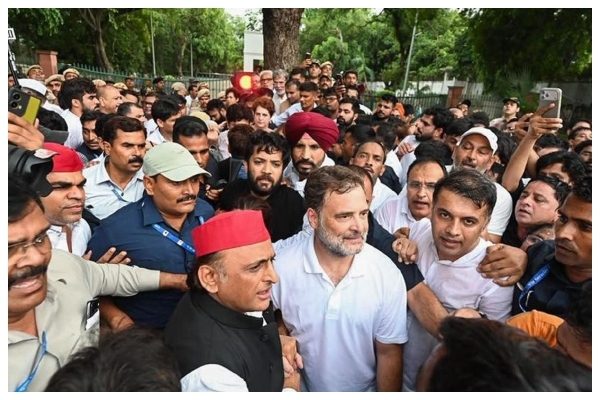
The Chief Justice of India, Surya Kant, declined to meet Rahul Gandhi invoking constitutional propriety and the separation of powers. He made it clear that the issues raised by the opposition should be pursued through judicial proceedings, particularly since related matters were already pending before the Supreme Court. This was a distinction of fundamental importance. A court is not a political delegation’s grievance-redressal office. Its authority rests on procedure, evidence, law and impartial adjudication not on the political stature of those demanding an audience.
But the opposition proceeded with its march. The spectacle of political leaders mobilising supporters towards the Supreme Court after the Chief Justice had declined their request for a meeting raises serious questions about political judgement and respect for institutional boundaries. A march to a political office and a march directed at the country’s highest judicial institution are not identical exercises. The latter carries an unmistakable risk of creating public pressure around an institution whose independence depends on freedom from political coercion.
The Supreme Court must never appear to be responding to the pressure of a street mobilisation. Nor should political leaders create the impression that judicial intervention can be accelerated, influenced or shaped through demonstrations outside the institution. The right to protest is an essential democratic freedom but it does not confer a right to influence the course of judicial proceedings.
The distinction also applies to the Court itself. The Supreme Court must remain accessible to legitimate grievances and dispose of urgent matters according to law. But any immediate consideration of a politically charged petition must be governed by established judicial criteria, not by the timing, scale or intensity of a march. The appearance of institutional independence matters as much as its substance. The Court must not be seen as yielding to political urgency manufactured outside its doors.
The episode also brings into focus a longstanding criticism of the Gandhi family’s relationship with India’s constitutional institutions. For decades, the Congress has been associated with a political culture in which the family’s influence has often appeared to transcend the ordinary limits of party leadership. The criticism is particularly relevant to Rahul Gandhi and Sonia Gandhi, whose political positions have frequently been accompanied by demands for deference from institutions they publicly accuse of failing their constitutional responsibilities.
The question is not whether a member of the Gandhi family is entitled to seek justice. The question is whether political prominence is being treated as a reason for special access, special consideration or an institutional response unavailable through ordinary procedures.
Rahul Gandhi is the Leader of the Opposition in the Lok Sabha. That position carries constitutional significance, but it does not place him above the Constitution. Indeed, it imposes a greater responsibility to demonstrate respect for the institutions whose independence sustains parliamentary democracy. He also has a responsibility to accept institutional boundaries when they do not suit his political objectives.
This tension has roots in the Congress’s longer political history. The party’s record cannot be separated from its repeated use of constitutional amendments during its extended periods in power. India has enacted 106 constitutional amendments. A figure of 77 amendments during 55 years of Congress rule was cited in a parliamentary debate in December 2024. The number of amendments alone does not establish that every amendment was improper; constitutional change is a legitimate democratic process. But the record invites scrutiny of how successive Congress governments have used their parliamentary power and whether constitutional institutions have always been treated with the restraint that their independence requires.
The contradiction is striking when a party with such a record presents itself as the exclusive guardian of the Constitution while questioning the legitimacy of institutions whose decisions it dislikes. Constitutional commitment is not established by repeatedly invoking the Constitution. It is demonstrated by accepting its procedures, respecting institutional autonomy and recognising that no political party owns the constitutional order.
The most consequential feature of the present confrontation is the attempt to turn the Election Commission into the antagonist of the judiciary. Rahul Gandhi has demanded the resignation of Chief Election Commissioner Gyanesh Kumar and has accused the electoral system of wrongdoing. The opposition’s proposed legal action seeks to carry that confrontation into the Supreme Court.
Demanding the removal of a constitutional functionary before the relevant allegations have been judicially established risks converting a legal question into a campaign of political delegitimization.
This is the danger of pitting one constitutional authority against another. The judiciary must examine the evidence independently; the Election Commission must discharge its statutory responsibilities; and political parties must pursue their grievances through the prescribed process. None should be expected to serve the political interests of another.
There is a wider concern that cannot be dismissed merely because it is politically uncomfortable: the possibility that domestic political campaigns can intersect with the interests of external actors seeking to weaken India’s institutions or influence its internal affairs.
The debates surrounding SIR and amendments to the Foreign Contribution (Regulation) Act (FCRA) have both raised questions about institutional accountability, foreign funding and national sovereignty. The existence of criticism from abroad, foreign funding or international interest does not, by itself, establish a coordinated conspiracy. Nevertheless, the broader strategic concern remains important. India cannot permit its constitutional institutions to be weakened by unsubstantiated allegations, nor can it afford complacency about demonstrable attempts by external interests to influence domestic affairs. The answer is institutional strength, transparency and the rule of law not political theatre or the automatic attribution of every disagreement to foreign interference.
Ultimately, the march raises a question about political responsibility. A democratic leader must be prepared to contest elections, persuade citizens, accept institutional decisions and pursue legal remedies when necessary. What a leader cannot reasonably demand is that constitutional institutions respond according to political convenience.
Rahul Gandhi has the right to challenge the Election Commission. . But these rights carry corresponding responsibilities. Protest must not become intimidation; criticism must not become a substitute for evidence; and constitutional remedies must not be transformed into instruments of political pressure.
The Supreme Court belongs to neither the government nor the opposition. The Election Commission belongs to neither the ruling party nor its challengers. Both are institutions of the Republic, and their credibility depends on their ability to function independently of political demands.
India’s constitutional democracy cannot be reduced to a contest between a political family and institutions that refuse to accommodate it. Nor can the Constitution be invoked selectively as a shield when convenient and an obstacle when it imposes limits.
Rahul Gandhi must recognise that the Constitution grants rights, defines responsibilities and imposes limits on everyone including the Leader of the Opposition. The Supreme Court is not a political battleground, the Election Commission is not a subordinate authority awaiting opposition approval, and the street cannot become a parallel court of appeal.
A mature democracy does not demand that institutions agree with political leaders. It demands that political leaders respect institutions even when they disagree with them. That is the test before Rahul Gandhi and the Congress and the test they cannot afford to fail.

Editor's Desk
Editor's Desk