Congress MP’s Sexual Harassment Case in JNU: Party’s Silence is More Vocal
The inquiry was initiated after at least 11 female students came forward with grave and detailed complaints of sexual harassment.
Total Views |


Political morality is frequently tested not when a party celebrates its triumphs, but when it confronts the uncomfortable realities of its own fold. In contemporary Indian politics, most parties have positioned themselves as fierce champions of women’s rights, institutional integrity, and social justice quite like the Indian National Congress. From relentless campaigns under banners like "Ladki Hoon, Lad Sakti Hoon", coined by Priyanka Vadra, to national slogans aimed at dismantling systemic patriarchy, the party’s central leadership has consistently claimed the moral high ground.
 However, political posturing is meaningless when decoupled from principle. The unfolding controversy surrounding Angomcha Bimol Akoijam the Congress Lok Sabha Member of Parliament from Inner Manipur and former professor at Jawaharlal Nehru University (JNU) has exposed a striking contradiction in the party’s ethical framework. Following his formal dismissal from JNU on charges of sexual harassment and a subsequent First Information Report (FIR) filed by the Delhi Police, the deafening silence from the Congress high command has triggered a national debate. By refusing to take swift, decisive action against one of its own lawmakers, the party has cast a long shadow over its historical commitments, inviting widespread public outcry, street protests, and fierce accusations of rank hypocrisy.
Anatomy of a Dismissal: The Charges Against Akoijam
The crisis broke into the open when Jawaharlal Nehru University issued an official order terminating the services of Dr. Angomcha Bimol Akoijam, who taught at the Centre for the Study of Social Systems. Signed by Vice-Chancellor Santishree D. Pandit, the termination followed a rigorous months-long investigation by the university’s Internal Committee (IC).
The inquiry was initiated after at least 11 female students came forward with grave and detailed complaints of sexual harassment. According to findings corroborated by the institutional panel, the allegations outlined a disturbing pattern of behavior: students were reportedly summoned to the professor’s campus residence under the guise of academic meetings or discussions, only to face attempted sexual harassment. Furthermore, complainants alleged that inappropriate and obscene remarks were made during class hours.
Operating under its service rules and Rule 11(ix) of the Central Civil Services (Classification, Control and Appeal) Rules, JNU acted on the IC’s recommendation, imposing the major penalty of immediate dismissal. Swiftly following the academic termination, the legal noose tightened when the Delhi Police registered an FIR against the Congress MP based on a complaint filed by JNU’s chief security officer.
Despite these severe institutional and criminal developments, Akoijam dismissed the allegations entirely, characterizing his termination as a political "witch hunt" and claiming he was denied a fair opportunity to respond. Yet, an internal university inquiry backed by testimonies from 11 distinct student complainants carries immense legal and moral weight weight that a national political party cannot simply sweep under the carpet.
The Deafening Silence of the Congress Leadership
For a party that has built much of its recent opposition narrative around holding leaders accountable frequently demanding immediate resignations and strict penal actions against ruling party figures accused of misconduct, including the recent alleged controversy around the SIR and allegations of ‘vote theft’ and demands for resignation of CEC Gyanesh Kumar its response to the Akoijam episode has been characterized by conspicuous evasion.
Days after the JNU dismissal and the filing of criminal charges, the top echelons of the Congress party including prominent voices who routinely champion women's safety have offered virtually no official commentary. There has been no demand for internal inquiry, no suspension from the parliamentary party, and no statement expressing solidarity with the 11 young women who navigated a grueling internal committee process to seek justice.
This silence marks a profound departure from the party’s professed standards. When similar allegations have surfaced against political opponents, the Congress has historically been the first to demand immediate resignations, arguing that individuals holding high public office must be held to a higher standard of probity. By adopting a policy of strategic ambiguity and quiet protectionism toward its own MP, the party leadership has invited charges of institutional hypocrisy. The implicit message sent by this silence is deeply damaging: that the party's commitment to fighting patriarchy and protecting victims is conditional, applicable only when political adversaries are in the dock, but negotiable when the accused wears a Congress badge, exposing its double standards.
Protests, Public Outcry, and Demands for Resignation
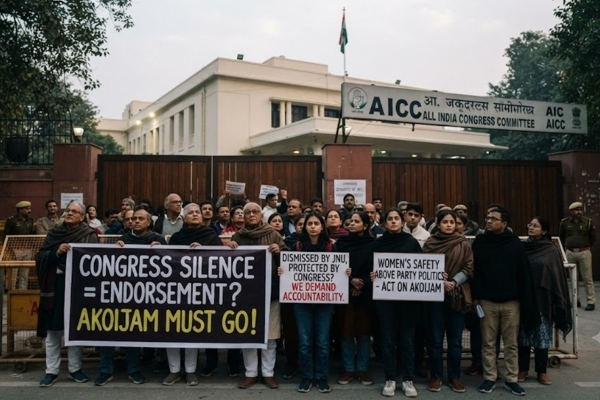
As the political vacuum left by the Congress leadership grew, the streets outside the party’s central headquarters became a focal point for intense public anger. Demonstrations erupted, driven notably by women’s organizations and political opponents who sought to pierce the opposition's wall of silence. Demonstrations were held at several locations from Delhi to Imphal, and from Himachal Pradesh to Karnataka.
Protesters marched toward the Congress headquarters, carrying placards and raising slogans demanding immediate accountability. Led by prominent figures and women’s wing leaders, the demonstrators directed their ire squarely at Congress President Mallikarjun Kharge and senior leader Rahul Gandhi. Speakers at the protests launched blistering attacks on the party’s selective morality, questioning how a political organization that routinely claims to "smash patriarchy" can turn a blind eye when its own Lok Sabha MP faces verified charges of sexual harassment from female scholars.
The core demands raised during these protests were unambiguous and direct: Immediate Expulsion from the primary membership of the party, Resignation from his seat as the Member of Parliament representing Inner Manipur, and the party should issue a formal, unconditional public apology to the 11 student complainants for attempting to shield an accused lawmaker through deliberate silence.

Historical Precedents and Intra-Party Dynamics
The controversy surrounding MP Angomcha Bimol Akoijam is not an isolated instance where the Indian National Congress has faced criticism for a delayed response or strategic silence regarding internal misconduct allegations. Reviewing past political episodes reveals a recurring pattern wherein institutional loyalty or political convenience has occasionally superseded swift accountability.
In April 2023, former Assam Youth Congress President Angkita Dutta publicly accused Indian Youth Congress (IYC) National President Srinivas BV of harassment, gender-based discrimination, and sustained sexist abuse over a period of months, alleging that senior leadership failed to act despite prior complaints.
While Dutta took the matter public and subsequently filed a formal police FIR, the central party leadership's initial reaction was marked by hesitation and procedural red tape. Rather than taking immediate executive action or suspending the high-profile youth leader pending an independent probe, the party issued a routine show-cause notice, drawing sharp criticism from political opponents who accused the leadership of sheltering a key organizational figure. Following the public fallout, the Congress party expelled Dutta for six years citing ‘anti-party activities.’
Critics and political analysts have frequently pointed out that when allegations surface against grassroots or mid-level party functionaries, local units often prioritize damage control and image management over victim-centric justice. Internal complaints committees within the Congress have historically lacked statutory transparency, leading to prolonged internal delays before any definitive disciplinary actions are publicized.
Conclusion: The Cost of Double Standards
The case of Angomcha Bimol Akoijam is not merely an isolated employment dispute within a central university; it is a critical litmus test for the moral authority of the Indian National Congress. By choosing political expediency and the preservation of a parliamentary seat over uncompromising ethical standards, the party has severely compromised its moral high ground.
The core friction lies in the stark dichotomy between the party's external rhetoric and its internal execution. Whenever accusations involve opponents, the Congress parliamentary and organizational wings typically demand immediate resignations and arrests within hours. However, when similar or severe allegations strike within its own rankssuch as in the cases of youth wing leaders or parliamentary representatives the leadership frequently defaults to a posture of prolonged silence, legal compartmentalization, or delayed reviews, fueling accusations of partisan double standards.
True political courage requires accountability without exemptions. If the Congress wishes to retain any credibility when it speaks for the safety, dignity, and rights of women, it can no longer afford to hide behind calculated silence. The protests demanding Akoijam’s resignation are a reminder that public conscience expects consistency. Until the leadership breaks its silence, takes decisive disciplinary action, and forces its MP to face the legal and moral consequences of his dismissal, the party's grand slogans against patriarchy will ring hollow echoing only as symbols of a profound double standard.
Anatomy of a Dismissal: The Charges Against Akoijam
The crisis broke into the open when Jawaharlal Nehru University issued an official order terminating the services of Dr. Angomcha Bimol Akoijam, who taught at the Centre for the Study of Social Systems. Signed by Vice-Chancellor Santishree D. Pandit, the termination followed a rigorous months-long investigation by the university’s Internal Committee (IC).
The inquiry was initiated after at least 11 female students came forward with grave and detailed complaints of sexual harassment. According to findings corroborated by the institutional panel, the allegations outlined a disturbing pattern of behavior: students were reportedly summoned to the professor’s campus residence under the guise of academic meetings or discussions, only to face attempted sexual harassment. Furthermore, complainants alleged that inappropriate and obscene remarks were made during class hours.
Operating under its service rules and Rule 11(ix) of the Central Civil Services (Classification, Control and Appeal) Rules, JNU acted on the IC’s recommendation, imposing the major penalty of immediate dismissal. Swiftly following the academic termination, the legal noose tightened when the Delhi Police registered an FIR against the Congress MP based on a complaint filed by JNU’s chief security officer.
Despite these severe institutional and criminal developments, Akoijam dismissed the allegations entirely, characterizing his termination as a political "witch hunt" and claiming he was denied a fair opportunity to respond. Yet, an internal university inquiry backed by testimonies from 11 distinct student complainants carries immense legal and moral weight weight that a national political party cannot simply sweep under the carpet.
The Deafening Silence of the Congress Leadership
For a party that has built much of its recent opposition narrative around holding leaders accountable frequently demanding immediate resignations and strict penal actions against ruling party figures accused of misconduct, including the recent alleged controversy around the SIR and allegations of ‘vote theft’ and demands for resignation of CEC Gyanesh Kumar its response to the Akoijam episode has been characterized by conspicuous evasion.
Days after the JNU dismissal and the filing of criminal charges, the top echelons of the Congress party including prominent voices who routinely champion women's safety have offered virtually no official commentary. There has been no demand for internal inquiry, no suspension from the parliamentary party, and no statement expressing solidarity with the 11 young women who navigated a grueling internal committee process to seek justice.
This silence marks a profound departure from the party’s professed standards. When similar allegations have surfaced against political opponents, the Congress has historically been the first to demand immediate resignations, arguing that individuals holding high public office must be held to a higher standard of probity. By adopting a policy of strategic ambiguity and quiet protectionism toward its own MP, the party leadership has invited charges of institutional hypocrisy. The implicit message sent by this silence is deeply damaging: that the party's commitment to fighting patriarchy and protecting victims is conditional, applicable only when political adversaries are in the dock, but negotiable when the accused wears a Congress badge, exposing its double standards.
Protests, Public Outcry, and Demands for Resignation
As the political vacuum left by the Congress leadership grew, the streets outside the party’s central headquarters became a focal point for intense public anger. Demonstrations erupted, driven notably by women’s organizations and political opponents who sought to pierce the opposition's wall of silence. Demonstrations were held at several locations from Delhi to Imphal, and from Himachal Pradesh to Karnataka.
Protesters marched toward the Congress headquarters, carrying placards and raising slogans demanding immediate accountability. Led by prominent figures and women’s wing leaders, the demonstrators directed their ire squarely at Congress President Mallikarjun Kharge and senior leader Rahul Gandhi. Speakers at the protests launched blistering attacks on the party’s selective morality, questioning how a political organization that routinely claims to "smash patriarchy" can turn a blind eye when its own Lok Sabha MP faces verified charges of sexual harassment from female scholars.
The core demands raised during these protests were unambiguous and direct: Immediate Expulsion from the primary membership of the party, Resignation from his seat as the Member of Parliament representing Inner Manipur, and the party should issue a formal, unconditional public apology to the 11 student complainants for attempting to shield an accused lawmaker through deliberate silence.
These protests transcended typical partisan friction; they struck at the heart of public trust in democratic institutions. When elected representatives who swear to uphold the Constitution and protect the vulnerable—are insulated by party machinery from facing the consequences of criminal and institutional findings, public faith in the rule of law takes a severe beating.
Historical Precedents and Intra-Party Dynamics
The controversy surrounding MP Angomcha Bimol Akoijam is not an isolated instance where the Indian National Congress has faced criticism for a delayed response or strategic silence regarding internal misconduct allegations. Reviewing past political episodes reveals a recurring pattern wherein institutional loyalty or political convenience has occasionally superseded swift accountability.
In April 2023, former Assam Youth Congress President Angkita Dutta publicly accused Indian Youth Congress (IYC) National President Srinivas BV of harassment, gender-based discrimination, and sustained sexist abuse over a period of months, alleging that senior leadership failed to act despite prior complaints.
While Dutta took the matter public and subsequently filed a formal police FIR, the central party leadership's initial reaction was marked by hesitation and procedural red tape. Rather than taking immediate executive action or suspending the high-profile youth leader pending an independent probe, the party issued a routine show-cause notice, drawing sharp criticism from political opponents who accused the leadership of sheltering a key organizational figure. Following the public fallout, the Congress party expelled Dutta for six years citing ‘anti-party activities.’
Critics and political analysts have frequently pointed out that when allegations surface against grassroots or mid-level party functionaries, local units often prioritize damage control and image management over victim-centric justice. Internal complaints committees within the Congress have historically lacked statutory transparency, leading to prolonged internal delays before any definitive disciplinary actions are publicized.
Conclusion: The Cost of Double Standards
The case of Angomcha Bimol Akoijam is not merely an isolated employment dispute within a central university; it is a critical litmus test for the moral authority of the Indian National Congress. By choosing political expediency and the preservation of a parliamentary seat over uncompromising ethical standards, the party has severely compromised its moral high ground.
The core friction lies in the stark dichotomy between the party's external rhetoric and its internal execution. Whenever accusations involve opponents, the Congress parliamentary and organizational wings typically demand immediate resignations and arrests within hours. However, when similar or severe allegations strike within its own rankssuch as in the cases of youth wing leaders or parliamentary representatives the leadership frequently defaults to a posture of prolonged silence, legal compartmentalization, or delayed reviews, fueling accusations of partisan double standards.
True political courage requires accountability without exemptions. If the Congress wishes to retain any credibility when it speaks for the safety, dignity, and rights of women, it can no longer afford to hide behind calculated silence. The protests demanding Akoijam’s resignation are a reminder that public conscience expects consistency. Until the leadership breaks its silence, takes decisive disciplinary action, and forces its MP to face the legal and moral consequences of his dismissal, the party's grand slogans against patriarchy will ring hollow echoing only as symbols of a profound double standard.