For decades, mainstream commentators and global media outlets have sold a carefully crafted, comfortably selective narrative: that anti-Hindu sentiment is nothing more than a paranoid construct. But as events unfold across North America and Europe, the uncomfortable reality can no longer be swept under the carpet of globalist rhetoric. Hinduphobia is not a figment of imagination it is an alarming, aggressively expanding reality across the Western world.
What we are witnessing today in the United States, Canada, Australia, and the United Kingdom is a coordinated convergence of hate. It ranges from ideological delegitimization in academic corridors to violent physical assaults on peaceful Sanatani communities.
The alarming reality of escalating anti-Hindu sentiment in the West was laid bare in October 2026 when law enforcement in Palatine, Illinois, arrested 19-year-old Alexandros Paporakis after uncovering an alleged plot to carry out a mass shooting targeting a Hindu temple in the Chicago area. Driven by radical white supremacist ideologies, Paporakis drafted a manifesto explicitly expressing intent to commit violence against individuals of South Asian and Indian heritage, only for a devastating tragedy to be narrowly averted when his rifle jammed during an attempted shooting. This harrowing incident serves as a stark, chilling reminder that Hindu places of worship and peaceful diaspora communities are increasingly being targeted by violent extremist hatred.
A plot two years in the makingAccording to prosecutors, Paporakis told a coworker he was planning “it” at the largest Hindu temple in Aurora, then told another coworker that Sunday “was going to be a special day.” Investigative records reportedly show he had been planning a violent assault for two years, zeroing in on the Aurora temple over a two-month period.
He was not unprepared. Reports say he had a tactical vest, an un-serialised short-barreled AR-style rifle, eight loaded magazines, a loaded extended magazine, and approximately 300 rounds of ammunition. The attack appears to have failed in part because the weapon malfunctioned: one report credits a jammed rifle with stopping the plot. That is luck, not security, and the same report credits an alert co-worker and responding officers with averting the tragedy.
Attacks and threats on Hindu institutions in the West did not begin this month. In 2019, a Hindu temple in Louisville, Kentucky was vandalized, with walls sprayed with graffiti, including several black crosses and anti-Hindu messages. A 17-year-old was charged, and a worshipper said the community was struck by fear as it waited for closure. Violence against South Asian houses of worship has a longer history too. In 2012, a former US soldier with white-power ties gunned down six people at a Sikh temple in Wisconsin. Sikhs are not Hindus, but the episode showed how South Asian communities can be targeted regardless of their specific faith.
What the data says, and what it doesn’t
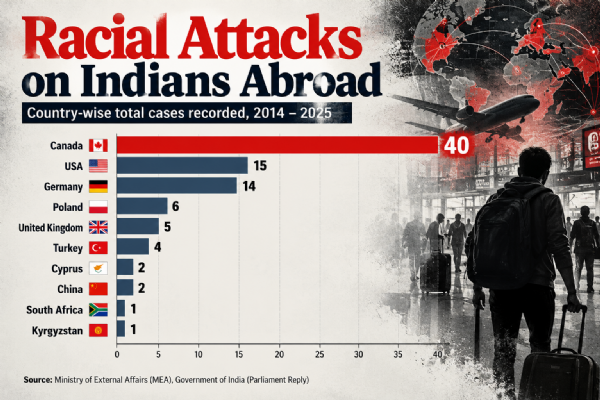
As per the data of the Ministry of External Affairs replies in Parliament shows a worrying trend in racial attacks on Indians abroad. Between 2014 and 2025, a total of 90 cases were reported, rising from 2 cases in 2019 to a peak of 22 in 2024. By country, Canada accounted for the most cases (40), followed by the United States (15) and Germany (14).
This evidence needs careful reading. The figures cover racial attacks on Indians generally. They do not break incidents down by religion, so they cannot by themselves prove that Hindus were targeted as Hindus. They also reflect cases the government recorded, which depends on reporting. They are a signal that something is changing, not a full accounting of anti-Hindu hate.
The Palatine case is different because the evidence here is direct: a named suspect, specific charges, a specific temple, and documented hateful material. Taken together, the data and the case point the same way: Indians and Hindus abroad face a real and growing risk, and it should be taken seriously rather than dismissed or exaggerated.
Yet, the response from Western civil authorities remains shockingly indifferent. When a Hindu Mandir is vandalized or a priest is threatened, police departments and media portals habitually downplay the crime under generic labels like "vandalism" or "anti-Asian bias," refusing to acknowledge the explicit theological and racial animus at play. This institutional denial creates a permissive ecosystem where lone-wolf extremists and radicalized groups feel emboldened to plan armed massacres.
The time for polite diplomatic appeals is over. Western democracies that preach human rights to the rest of the planet must look in the mirror and enforce law and order within their own borders. They must strictly curb illegal migration networks that harbor radical hostility, dismantle white supremacist cells, and legally classify Hinduphobia as a distinct, high-priority hate crime.
The Indian and Hindu diaspora in the United States and Canada represents one of the most economically successful, law-abiding, and civically engaged immigrant communities in North America. Despite making up a modest percentage of the overall population, their contribution through taxes, innovation, public service, and civic participation is disproportionately high.
In Canada, where over 828,000 Hindus reside primarily across key urban centers like Ontario, British Columbia, and Alberta, the community serves as a pillar of regional economies, local businesses, and public services. As voters, Hindu Americans and Hindu Canadians have transformed into increasingly active and decisive electoral blocs, commanding high voter turnout rates and shaping outcomes in critical swing districts. Yet, despite paying their full share of taxes, enriching their adopted homelands, and upholding peaceful democratic norms, this high-performing diaspora finds its sacred places of worship, families, and civil rights increasingly exposed to unchecked extremist violence and systemic indifference.
What makes the situation profoundly hypocritical is the glaring double standard maintained by Western foreign policy and oversight bodies like the US Commission on International Religious Freedom (USCIRF) and the UN Human Rights Council (UNHRC). These institutions routinely compile sweeping, highly critical dossiers grading religious freedoms and minority rights in non-Western democracies like India, yet they remain systematically silent when faced with systemic Hinduphobia, temple desecrations, and armed white supremacist terror plots within their own borders. How can Western bodies comfortably lecture foreign sovereign nations on minority protections when they fail to publish dedicated reports, issue policy warnings, or demand structural accountability for the rising, documented hate crimes targeting peaceful, tax-paying Hindu and South Asian diaspora communities right in their own backyards?