Ministry of Tribal Affairs Holds First Working Group Meeting to Preserve Tribal Languages
He emphasised that speakers must remain at the centre of language development and that no Indian language should be considered inferior or superior to another.
Total Views |


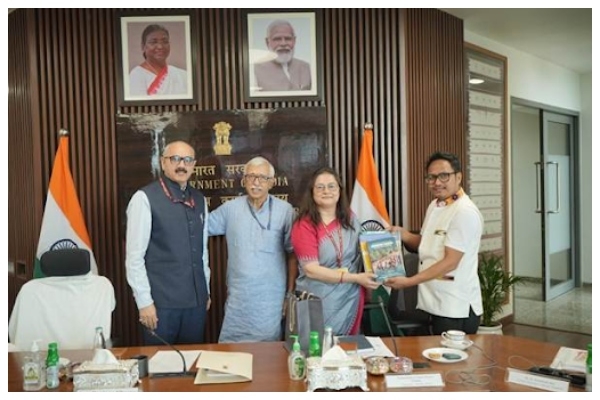
The Ministry of Tribal Affairs held the first meeting of its Working Group on Tribal Languages to strengthen efforts towards the documentation, preservation and promotion of tribal languages across India. The meeting was chaired by Ranjana Chopra, Secretary, Ministry of Tribal Affairs, and attended by linguists, academics, researchers and community language practitioners.
 Representatives of the National Education Society for Tribal Students (NESTS) highlighted the potential of more than 525 Eklavya Model Residential Schools, serving over 1.7 lakh students, to use Adi Vaani in classrooms.
The Ministry will circulate the meeting agenda and prepare a roadmap for further action. Chopra also stressed that language resources developed with tribal communities should continue to be owned by those communities.
The meeting marks a step towards coordinated efforts to preserve India's tribal linguistic heritage through research, technology, education and community-led initiatives.
The Working Group includes representatives from institutions such as the Central Institute of Indian Languages (CIIL), Indian Institutes of Technology (IITs) at Delhi, Dharwad and Kanpur, Tezpur University, Manipur University, Assam University, Sikkim University, Living Tongues Institute for Endangered Languages and Bhasha Samiti.
The initiative aims to bring existing research and language resources onto a common platform, encourage community participation and prevent duplication of documentation efforts.
Adi Vaani to Support Digital Preservation of Tribal Languages
During the meeting, Chopra highlighted the importance of language in improving the outreach and delivery of government welfare schemes among tribal communities. She said that Adi Vaani, initially developed as a translation tool for practitioners and administrators, could evolve into a comprehensive national repository containing language resources, dictionaries, primers and community stories.
The meeting reviewed the platform, developed by IIT Delhi in collaboration with the Ministry. Adi Vaani currently offers text-to-text translation in nine tribal languages, alongside speech, Optical Character Recognition (OCR) and video-subtitling features.
The platform also provides searchable access to more than 300 primers prepared by Tribal Research Institutes (TRIs). According to the Ministry, state TRIs have contributed approximately 13.9 lakh text sentences in ten languages and around 300 hours of speech data.
The platform has recorded more than 48,000 Android downloads and approximately 6,500 monthly users. IIT Delhi sought support from the Working Group to validate linguistic datasets, standardise spelling systems and develop specialised vocabulary for future pilot projects.
Seven Pillars for Language Development
Padma Shri awardee Chamu Krishna Shastry, Chairman of Bhasha Samiti, outlined seven pillars for developing Indian languages. These include proficiency among speakers in their mother tongue, the use of languages in education and administration, contemporary literature, continuous development of vocabulary, technological adoption, teaching-learning resources and institutional support.
He emphasised that speakers must remain at the centre of language development and that no Indian language should be considered inferior or superior to another. He also suggested collaboration among Bhasha Samiti, tribal universities, the Indian Council of Social Science Research and the IKS Division of the Ministry of Education.
Dr K. Sreenivasa Rao, former Secretary of Sahitya Akademi, proposed a searchable national database of tribal language writers, scholars and resources. He also recommended district-level community resource groups, digital archives and a two-year action plan with quarterly reviews.
India’s tribal languages and oral traditions carry generations of knowledge, identity and cultural memory- making their preservation essential for future generations.
— Ministry of Tribal Affairs, Govt. of India (@TribalAffairsIn) October 15, 2026
Through a new Ministry of Tribal Affairs initiative, the first Working Group meeting has outlined a roadmap for…
Technology, Research and Community Participation
CIIL Director Basavraj Kudagonti suggested prioritising languages in phases, establishing regional teams and creating a common repository for researchers and institutions. Former CIIL Director Shailendra Mohan proposed preparing an atlas of tribal languages and mother tongues across states.
The Council for Diversity and Innovation (CoDIN) proposed a network of digital archives supported by common metadata standards, with Adi Vaani serving as the national gateway. Researchers from Tezpur University, IIT Kanpur, Assam University and Sikkim University also offered expertise in speech technology, digital archiving, community-led documentation and the development of technical vocabulary.
Tribal Languages in Education
Chopra called for promoting mother-tongue-based multilingual education to address learning gaps during the early years. She asked members to share details of the languages they have studied and the resources available for integration into the platform in coordination with IIT Delhi.
The meeting marks a step towards coordinated efforts to preserve India's tribal linguistic heritage through research, technology, education and community-led initiatives.