Did you know Sonia Gandhi appointed Navin Chawla as Election Commissioner despite 12 allegations of partisan bias?
Congress is questioning the impartiality of Chief Election Commissioner Gyanesh Kumar today. But when Navin Chawla was appointed Election Commissioner in 2005, why did contemporary reports link his appointment to Sonia Gandhi? And why did the Congress-led UPA government reject the CEC’s recommendation to remove him despite 12 allegations of partisan conduct?
Total Views |


The Congress party is questioning Chief Election Commissioner Gyanesh Kumar’s impartiality and demanding accountability from the Election Commission. But a controversial episode from the UPA era raises questions about the party’s own record.
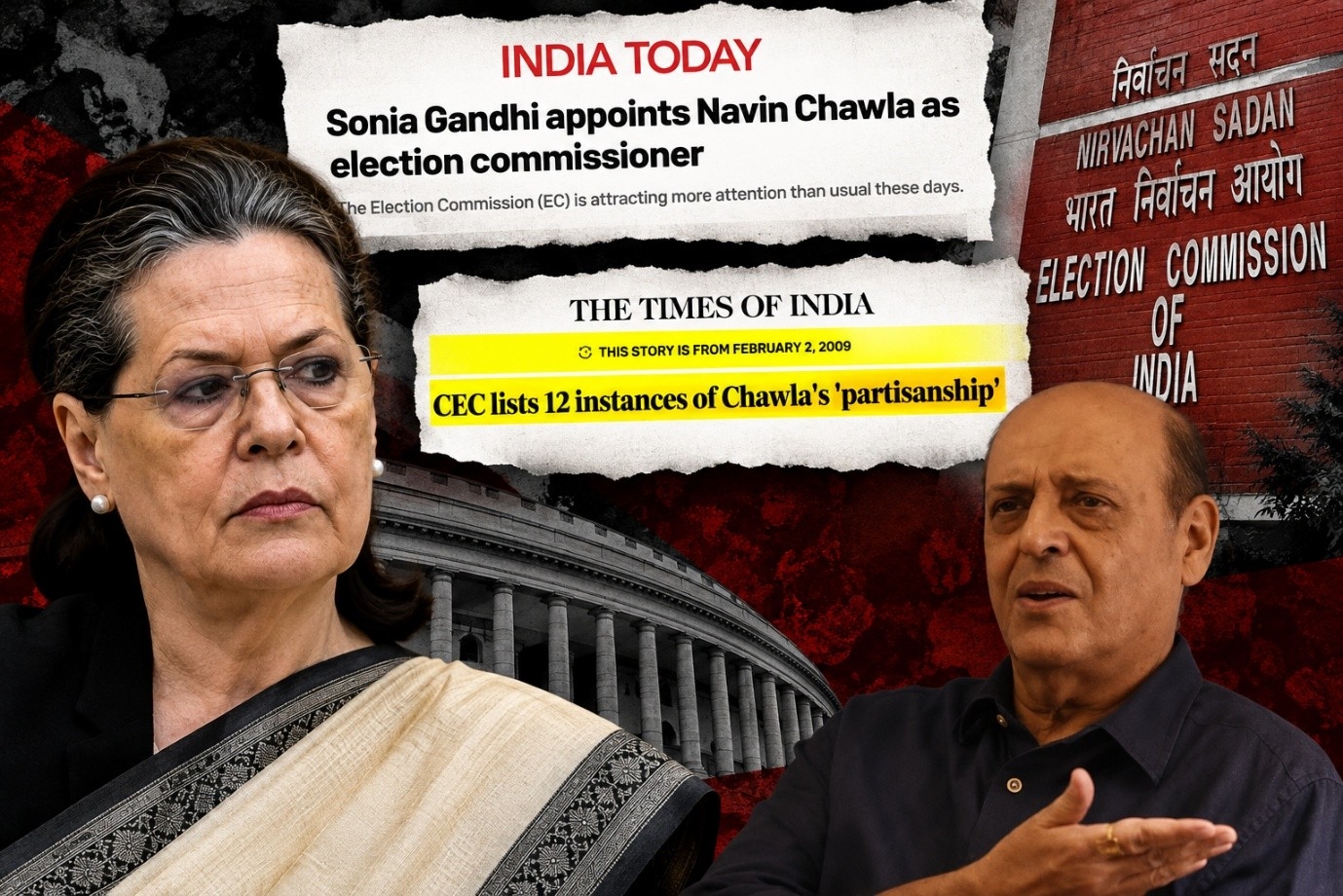
(An AI Generated image)
In May 2005, India Today published a report stating, “Sonia Gandhi appoints Navin Chawla as election commissioner.” The report said Chawla, described as close to the Congress president, had secured the Election Commission post despite expectations that he would become Home Secretary. It also suggested that his appointment could position him to head the poll body during the 2009 general election.
But there is an obvious constitutional question: Sonia Gandhi was the Congress president, not the Prime Minister, President or any other constitutional appointing authority. So what authority did she have to appoint an Election Commissioner?
Under the system in place in 2005, Election Commissioners were formally appointed by the President on the advice of the Prime Minister and the Union government. Sonia Gandhi did not possess the legal power to make that appointment herself.
The report raises a political question: Did Congress president influenced a decision formally made by the government?
Since when does a party president appoint the Election Commissioner?
— BJP West Bengal (@BJP4Bengal) October 15, 2026
Even after the CEC flagged 12 instances of partisan bias against Chawla, he wasn't removed. Why? Because the ruling UPA simply rejected the CEC's recommendation, shielded their favourite and promoted him to CEC… pic.twitter.com/KkR9Pz3mvn
Sonia Gandhi was Congress president and chairperson of the UPA, but neither position gave her the constitutional authority to appoint an Election Commissioner.
The formal appointment of Chawla was announced by the Union government in May 2005, when he was serving as Secretary in the Ministry of Information and Broadcasting. Contemporary reporting noted that he was appointed to fill the vacancy created by B.B. Tandon’s elevation to Chief Election Commissioner.
Twelve Allegations of Partisan Conduct
The controversy did not end with Chawla’s appointment. In January 2009, then Chief Election Commissioner N. Gopalaswami recommended his removal, citing 12 instances that he considered evidence of partisan conduct favouring the Congress.
The allegations concerned several sensitive matters, including the handling of assembly elections in Gujarat, Himachal Pradesh and Uttar Pradesh, a complaint concerning Sonia Gandhi’s acceptance of Belgium’s Order of Leopold, a BJP CD case and the Bhagalpur by-election.
Gopalaswami’s recommendation was serious, but the allegations were disputed. The Congress-led UPA government rejected the recommendation, arguing that the CEC lacked independent authority to seek Chawla’s removal in the circumstances and that the allegations did not establish the misconduct claimed.
That decision raises another question for Congress: If the independence of the Election Commission is paramount, why did its government reject the recommendation of the sitting CEC rather than act on the concerns he had raised?
Promotion before the 2009 elections
On April 21, 2009, Chawla became Chief Election Commissioner after Gopalaswami’s retirement. The government had rejected the recommendation against him, and Chawla went on to oversee most phases of the 2009 Lok Sabha elections, which returned the Congress-led UPA to power.
The sequence became a major point of criticism for the BJP and other opponents of the UPA. They questioned why the government had rejected the CEC’s recommendation and then allowed Chawla to take charge of the institution shortly before a general election.
The government disputed the allegations and defended its decision. But the timing remains central to the political controversy.
Why did the UPA stand by Chawla despite the CEC’s recommendation? Why was he elevated to the top post just before a national election? And would Congress accept the same sequence without demanding answers if it involved a government led by the BJP?
Congress’s current campaign raises questions
Congress now accuses CEC Gyanesh Kumar of bias over the Special Intensive Revision of electoral rolls and has questioned the Election Commission’s handling of the process. The Commission has defended the revision as a legitimate exercise to maintain accurate electoral rolls, while the opposition’s allegations must be assessed on their evidence.
The present controversy is not identical to the Chawla episode, and the allegations in both cases must be examined separately. But Congress’s current demands invite scrutiny of its own record.
When Congress was in power, its government rejected a CEC’s recommendation against Chawla over allegations of partisan conduct. Today, the party insists that the current CEC must be held accountable for alleged bias.
That raises a straightforward question: Does Congress apply the same standard of institutional independence when it is in power as it demands when it is in opposition?
If Congress expects the present government to answer questions about the Election Commission’s independence, it should also be prepared to answer questions about the decisions taken under its own rule.