Lesson to Loudmouth Raut and Wagle
Sanjay Raut has made political provocation a familiar feature of his public persona.
NewsBharati 17-Oct-2026 11:33:00 AM
Total Views |


The Supreme Court’s decision to issue show-cause notices to Shiv Sena (UBT) MP Sanjay Raut and journalist Nikhil Wagle over their remarks against Chief Justice of India Surya Kant is a timely reminder that public life cannot be reduced to a contest of insults, insinuations and political intimidation. Criticism of the judiciary is legitimate in a democracy. But reckless allegations against judges, personal abuse directed at the Chief Justice and attempts to undermine public confidence in constitutional institutions raise a much more serious question: where does democratic criticism end and irresponsible institutional denigration begin?

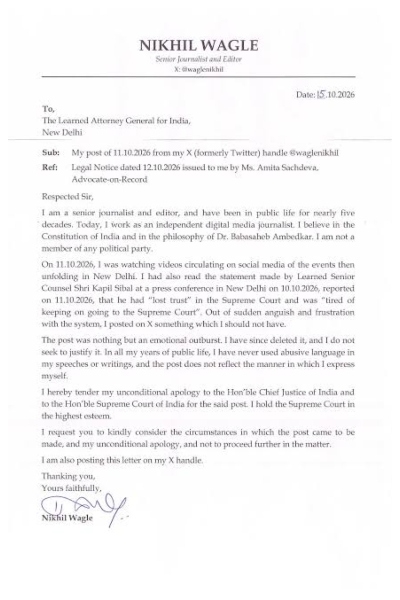
On October 16, the Supreme Court issued notices to Raut and Wagle in criminal contempt proceedings following a petition by the Supreme Court Bar Association. The proceedings concern Raut’s allegations about judges’ proximity to political leaders and Wagle’s abusive social-media post directed at the CJI. The Court has sought their responses; it has not yet determined their guilt. The distinction matters. Yet the conduct that brought the two men before the Court deserves serious public scrutiny. Both of them are known for their reckless, irresponsible, insensitive and immature statements for years. Both of them turned to be cowardly as they tendered unconditional apology hours after receiving the notice. The Supreme Court is yet to consider their apology, However, their so-called courage vanished within a single notice.
Sanjay Raut has made political provocation a familiar feature of his public persona. His style relies heavily on dramatic declarations, personal attacks and sweeping allegations. Such rhetoric may generate headlines and energise political supporters, but it also risks poisoning public discourse when it targets constitutional institutions without adequate factual verification.
Serious allegations demand serious evidence. The Attorney General, R. Venkataramani, said Raut’s claims were not based on facts. On the badminton photographs, he referred to a Delhi High Court order of June 19, 2026, which found that images circulated as photographs of a London event actually related to a programme held at Delhi’s Thyagaraj Stadium in November 2025. The Attorney General also said that Raut should have verified the facts before making such allegations.
This is the heart of the matter. An elected representative has every right to question a judicial decision, demand transparency and raise concerns about institutional conduct. But a Member of Parliament carries a corresponding responsibility to distinguish verified facts from insinuation. If a public figure uses misleading material to suggest that judges are politically compromised, the damage extends beyond the individual judge. It strikes at the public’s confidence in the institution responsible for interpreting the Constitution and protecting citizens’ rights.
Raut must understand that parliamentary status does not confer immunity from responsibility for public statements. Nor can political loudness substitute for evidence. His tendency to turn contentious issues into confrontational spectacles deserves to be checked not through political censorship, but through factual scrutiny, institutional accountability and the ordinary application of law.
Nikhil Wagle’s conduct presents a different but equally troubling problem. After the CJI declined to meet the opposition delegation, Wagle posted an abusive message directed at the Chief Justice on social media. He subsequently deleted the post and apologised.
The freedom of the press is indispensable to democracy. Journalists must be able to question judges, scrutinise judgments and expose misconduct wherever credible evidence exists. But press freedom does not transform personal abuse into public-interest journalism. An argument about judicial propriety requires facts, reasoning and evidence. An insult offers none of these.
An apology is relevant and must be considered fairly by the Court. It does not, however, erase the wider question of responsibility. Public figures with an audience have a duty to understand the consequences of their words, particularly when those words target institutions whose authority depends substantially on public confidence. The problem is not that the judiciary must be insulated from criticism. The problem is the growing tendency to confuse criticism with contempt, accountability with humiliation, and disagreement with an alleged licence to abuse.
The Supreme Court is not an extension of the government, nor is it an opponent of the Opposition. It is a constitutional institution whose authority derives from the Constitution and whose duty is to adjudicate disputes according to law. Its judgments can be questioned through reasoned legal arguments, appeals, review petitions and informed public discussion. Its functioning can be scrutinised. Judges are not beyond accountability.
This principle applies equally to the government and the Opposition. Neither should be allowed to browbeat the judiciary. The independence of the courts is not a privilege granted by the party in power; it is a constitutional safeguard for every citizen, including those who oppose that government.
The controversy involving Raut and Wagle must also be viewed against a broader political climate in which the credibility of constitutional institutions is repeatedly drawn into partisan battles. The Election Commission, the judiciary and other institutions have become subjects of intense political confrontation. Allegations of institutional bias are often circulated before the relevant facts have been established, while procedural decisions are presented as evidence of a larger political design.
The possibility that attacks on constitutional institutions are becoming mutually reinforcing deserves scrutiny. When political rhetoric, unverified allegations and abusive campaigns converge, their cumulative effect can be to weaken public confidence in the institutions that sustain constitutional democracy. Whether this reflects a coordinated strategy or a series of politically motivated interventions must be established through evidence; it should neither be presumed nor dismissed without examination.
The danger is that citizens may eventually be encouraged to regard every adverse judicial decision as politically motivated and every institutional procedure as illegitimate. Such a climate benefits no democracy. If the judiciary loses public credibility through persistent misinformation and personal attacks, the consequences will not be confined to the judges who are targeted. Ordinary citizens who depend on independent courts for the protection of their liberty, property and fundamental rights will also suffer.
Raut and Wagle should therefore recognise the seriousness of their conduct. Political theatrics and provocative language may command temporary attention, but they cannot be allowed to become substitutes for responsible public argument. Those who claim to defend democracy must also respect the institutions through which democratic rights are protected.
The Supreme Court must now consider the responses of both men and proceed according to law. The contempt jurisdiction must be exercised carefully, with due regard for freedom of expression and the legitimate scope of criticism. Neither political affiliation nor public prominence should determine the outcome. The same legal standards must apply to everyone.
Raut’s tendency to turn political disagreements into verbal confrontations must be challenged through facts and accountability. Wagle’s abusive post cannot be excused merely because it arose from political anger. Both men are entitled to defend themselves in the proceedings, but neither is entitled to treat public influence as a licence for irresponsibility.
The final word belongs to the Constitution, not to the loudest political voice or the most provocative social-media post. The Supreme Court must remain independent of political pressure, and its judges must be able to discharge their duties without intimidation. Those who attack the judiciary for political advantage must be reminded that weakening the authority of the courts is not the same as strengthening democracy. It is the rule of law—not the rule of the loudmouth that must prevail.
The apologies tendered by Sanjay Raut and Nikhil Wagle appear driven more by the fear of punishment than by genuine remorse. The issue, however, extends far beyond the judiciary. All constitutional institutions deserve respect, and attempts to undermine their credibility through reckless statements cannot be dismissed as mere political rhetoric. The Supreme Court now has an important opportunity to send a strong message against such tendencies. It must ensure that the dignity of constitutional institutions is not compromised by individuals who cross limits and retreat only when confronted with legal consequences. The Court should not allow this opportunity to go to waste.

Editor's Desk
Editor's Desk