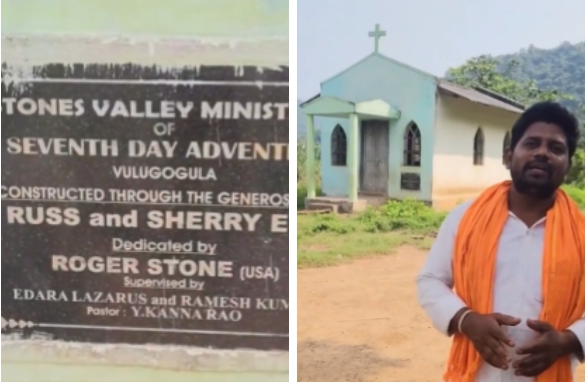
In a striking demonstration of their deep commitment to Hindu Dharma, approximately 40 tribal families in Telangana steadfastly rejected attempts by missionaries to convert them to Christianity. Despite a pastor constructing a church near their settlement, an act highlighting concerns over missionaries luring tribal communities and the potential misuse of FCRA funds, not a single family converted. Consequently, the pastor was forced to lock the church and abandon the area, showcasing the unwavering resilience of the tribal community in preserving their heritage.
According to the inscription at the site, the church was established by Stones Valley Ministries of the Seventh-day Adventist Church in Vulugogula. The construction was directly funded through contributions from US-based donors Russ and Sherry Eva and formally dedicated by Roger Stone, founder and director of the US-based Stone's Valley Foundation. The plaque also names Edara Lazarus and Ramesh Kumar as project supervisors, with Y. Kanna Rao serving as the resident pastor.
Established in 1999, Stone's Valley Foundation operates as an independent foreign mission network dedicated to church planting, running orphanages, and broadcasting Telugu-language evangelical programming across southern and central India. The involvement of foreign directors and overseas donors in constructing facilities within protected tribal belts highlights how international funds directly fuel localized proselytization networks.
In several tribal-majority regions, demographics have shifted sharply over recent decades, with local Christian populations rising substantially in some specific hamlets and villages reaching 40% to 50% or more. Observers and social organizations highlight that this rapid demographic change often stems from targeted proselytization in vulnerable rural pockets, where missionaries leverage educational, medical, and socio-economic support.
Against this backdrop, the firm resistance shown by these 40 tribal families stands out as a powerful and reassuring testament to cultural resilience. Yet, beyond serving as a positive development, the incident raises sharp, critical questions.
Tribal Land Rights: Who Approved the Construction?
Building a religious facility in a Fifth Schedule tribal area raises severe legal and regulatory questions regarding compliance with the Provisions of the Panchayats (Extension to the Scheduled Areas) Act (PESA), 1996. Under PESA, the local Gram Sabha holds statutory authority over land transfer, communal resources, and the protection of indigenous tribal identity. Constructing a church without the explicit prior consent and resolution of the local Gram Sabha directly undermines this constitutional safeguard designed to prevent the alienation of tribal land. Furthermore, because non-tribals and foreign-funded entities are legally restricted from acquiring or repurposing land in protected Scheduled Areas, such developments call into question how land titles were cleared, whether local self-governance was bypassed, and if state authorities failed to enforce tribal land preservation laws.
FCRA Funding and Foreign Contributions
The Foreign Contribution (Regulation) Act, 2010, regulates foreign donations received by eligible organisations in India. Organisations must comply with registration or prior-permission requirements, maintain prescribed accounts and use foreign contributions in accordance with the law.
The involvement of US-based benefactors (Russ and Sherry Eva) and foreign missionary leadership (Roger Stone) raises serious questions about how individual donations from overseas are funneled into physical real estate projects in rural India. Under FCRA regulations, foreign funds explicitly granted for charitable or social welfare purposes cannot be diverted into unauthorized proselytization or non-permitted activities.
The direct deployment of foreign capital into vulnerable, economically weaker tribal belts underscores how financial disparities are leveraged to establish infrastructural footprints in remote, Scheduled Areas.
Incidents like this directly highlight the core legislative intent behind the Ministry of Home Affairs' (MHA) ongoing strengthening of the Foreign Contribution (Regulation) Act (FCRA), including the Foreign Contribution (Regulation) Amendment Bill, 2026.