France in Flames: Unholy Alliance of Red and Green Burns
The students’ grievances cannot simply be dismissed.
NewsBharati 19-Oct-2026 15:29:16 PM
Total Views |


Europe’s crisis is no longer confined to migration, street protests or the electoral rise of the nationalist right. It is increasingly a struggle over national identity, social integration, the authority of democratic institutions and the capacity of the state to maintain a common civic order. France’s escalating unrest offers a particularly revealing example of how legitimate social grievances can become entangled with ideological confrontation.
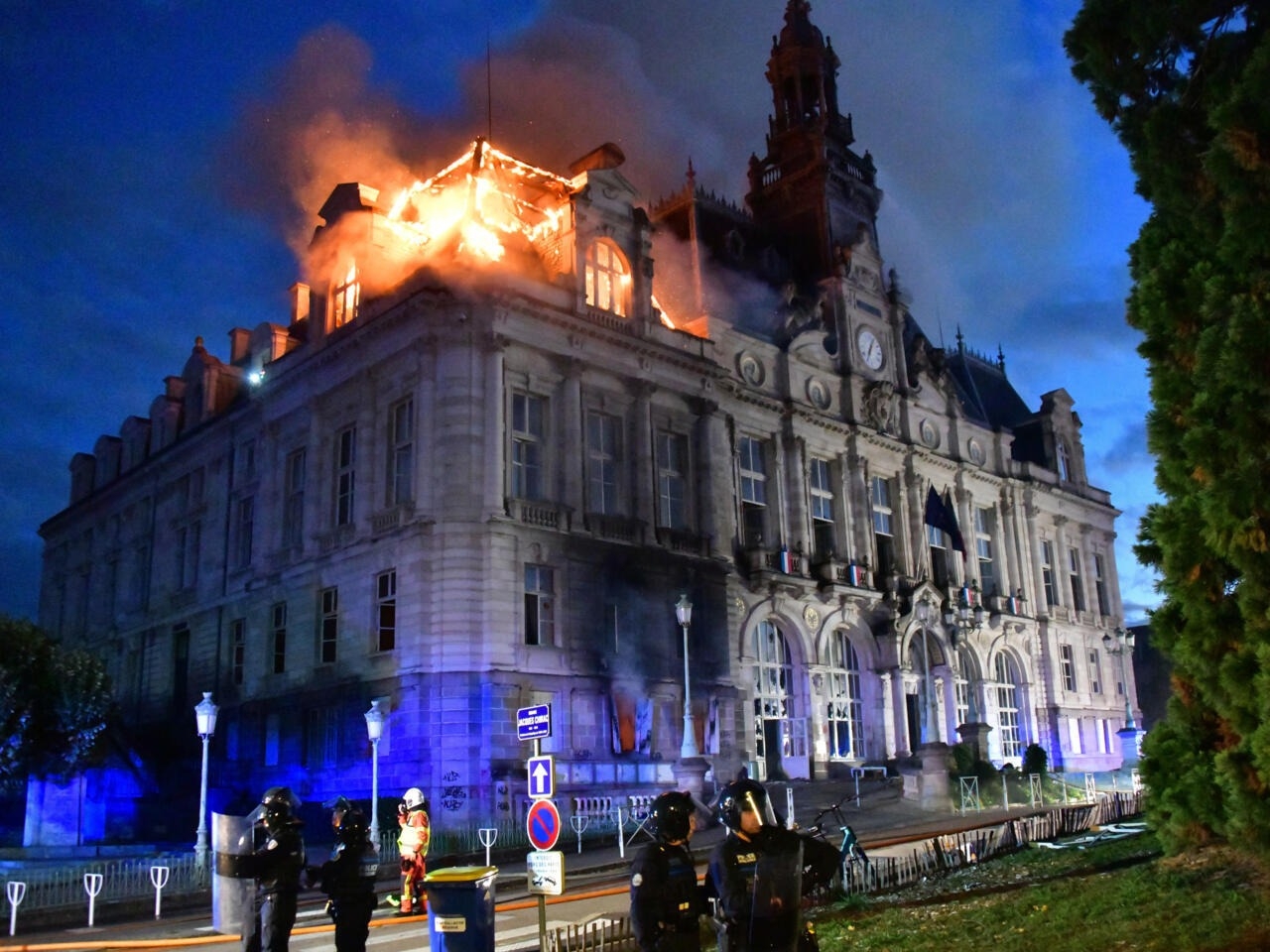
The French student protests began on September 21 with complaints about teacher shortages, overcrowded classrooms, deteriorating school infrastructure and uncertain educational prospects. Within days, demonstrations spread beyond the Paris region. By October, school blockades, arson, clashes with police and attacks on educational staff had transformed the movement into a serious public-order challenge. The unrest subsequently became part of a broader wave of demonstrations over public services and the cost of living.
The students’ grievances cannot simply be dismissed. The more consequential question is how genuine dissatisfaction becomes available for political exploitation, and why some protests develop into confrontations that undermine the very institutions expected to address their grievances.
The appropriate conclusion is neither to dismiss the protests as a conspiracy nor to ignore the possibility of ideological exploitation. It is to recognise that a genuine social movement can become a vehicle for wider political agendas, with the resulting violence obscuring the original demands. The French state must respond simultaneously to educational failures, protect peaceful demonstrators and hold those responsible for violence accountable.
But France’s difficulties extend beyond the immediate school crisis. For years, the country has confronted jihadist terrorism, Islamist radicalisation, disputes over secularism and questions about the integration of communities whose religious or political identities sometimes conflict with the Republic’s universalist principles. The challenge is political Islamism when it seeks to undermine equal citizenship, impose coercive religious authority or justify violence.
The radical left and Islamism are not the same phenomenon. They have different intellectual foundations, constituencies and ultimate objectives. Nevertheless, opposition to aspects of the existing political order can occasionally produce tactical convergence, particularly when both seek to mobilise anger against state institutions. Such convergence need not imply a formal alliance or central coordination. It can emerge through shared protests, overlapping political rhetoric or a common willingness to exploit institutional distrust.
This is the larger European challenge: different forms of radicalism can feed on the same weaknesses, including social exclusion, economic insecurity, identity conflict and declining public confidence in government. Their interaction deserves scrutiny without turning every social protest into evidence of a coordinated design.Sweden illustrates how the debate has moved from political rhetoric to official investigation. On June 30, the Swedish Government announced an inquiry into religious radicalisation, focusing on political Islam, its implications for integration and social exclusion, and the potential effects on democratic institutions. The inquiry will also examine infiltration and improper influence. This is significant because it recognises that integration cannot be measured merely by residence, employment or access to public services. It also concerns whether individuals and institutions operate within the same democratic framework.
Denmark offers a second example. Its security service, PET, assessed the terrorist threat as significant in its 2026 report, identifying militant Islamism as a major concern while also recognising right-wing, left-wing and anti-establishment extremism. The report highlighted the growing influence of international conflicts, state actors and online radicalisation. Denmark’s assessment demonstrates why the problem cannot be reduced to immigration policy alone: security threats can develop through domestic radicalisation, international networks and digital propaganda.
Britain faces its own combination of domestic tensions and foreign-linked security concerns. On October 12, Prime Minister Andy Burnham told Parliament that a suspected plot involving RAF Fairford was highly likely to have been coordinated in Iran and almost certainly directed by Iran’s Islamic Revolutionary Guard Corps. Several men had been arrested in connection with the investigation, although the authorities acknowledged that important details remained uncertain and the suspects were released on police bail. Iran denied involvement. The episode underlines the need to distinguish substantiated security assessments from proven criminal responsibility, while taking the potential use of domestic networks by foreign actors seriously.
The Netherlands demonstrates the danger of an escalating reaction from the opposite direction. On September 19, police confronted hundreds of far-right protesters at an anti-immigration rally in The Hague. Fireworks and other projectiles were thrown at officers; some demonstrators reportedly made Nazi salutes and shouted antisemitic slogans. The authorities dispersed the crowd and made arrests. This episode matters because anxiety over migration can be channelled into a politics of racial hostility and intimidation. A government that confronts Islamist extremism but tolerates violent far-right mobilisation would undermine the democratic principles it claims to defend.
Italy and Belgium, meanwhile, featured in the latest wave of demonstrations over economic pressures and public policy. On October 17, protests in Milan turned violent, with property damaged amid wider discontent over inflation and living costs. In Brussels, student demonstrations over education reforms and budget cuts also prompted a forceful police response, with 195 arrests reported. These events should not automatically be classified as Islamist or radical-left operations. Their significance lies elsewhere: economic frustration, declining confidence in public institutions and political polarisation are creating a volatile environment in which more radical groups may seek to gain influence.
Taken together, these eight countries France, Sweden, Denmark, Britain, the Netherlands, Greece, Italy and Belgium reveal neither a uniform crisis nor a single coordinated movement. They reveal different national problems that intersect around questions of security, integration, economic opportunity, migration and the legitimacy of state authority. Europe’s political landscape is increasingly shaped by three competing forces. The radical left mobilises around inequality, public services, migration, minority rights and opposition to established political institutions. Islamism, particularly in its radical and violent forms, challenges democratic society through religious-political doctrines that may reject secular authority, equal citizenship or pluralism. The nationalist right draws strength from demands for secure borders, national identity and stricter law enforcement.
The resulting cycle is dangerous. Poor integration can deepen social separation; separation can create opportunities for radicalisation; radicalisation can generate insecurity; insecurity can fuel nationalist backlash; and the backlash can intensify polarisation, weakening public trust in democratic institutions. Economic hardship and inadequate public services can accelerate this process, even when they are not its original cause.
Europe must therefore reject two comforting illusions. The first is that every social conflict can be explained by economic inequality and that ideological radicalisation is merely a distraction. The second is that migration or Islamism explains every instance of unrest and that legitimate grievances can consequently be ignored. Both approaches substitute ideology for serious analysis.
The answer is a state that combines firm law enforcement with institutional competence, effective integration, secure borders and equal citizenship. Peaceful protest must remain protected; violence, intimidation and coercive attempts to establish parallel authority must be confronted. Religious freedom must be respected, but it cannot provide immunity for extremism. Equally, opposition to immigration cannot legitimise racism, antisemitism or political violence.
For India, the European experience carries a clear lesson. Social cohesion cannot be taken for granted, and constitutional institutions cannot function effectively if governments apply democratic standards selectively. A diverse society requires a common civic framework in which different communities enjoy equal rights while remaining subject to the same laws. Europe’s central challenge is not simply to defeat the radical left or Islamism in isolation. It is to prevent competing extremisms from turning social grievances and identity conflicts into a sustained assault on democratic institutions. A democracy preserves its freedom not by tolerating every attempt to undermine its foundations, but by defending the same constitutional principles against every ideology that threatens them.

Editor's Desk
Editor's Desk