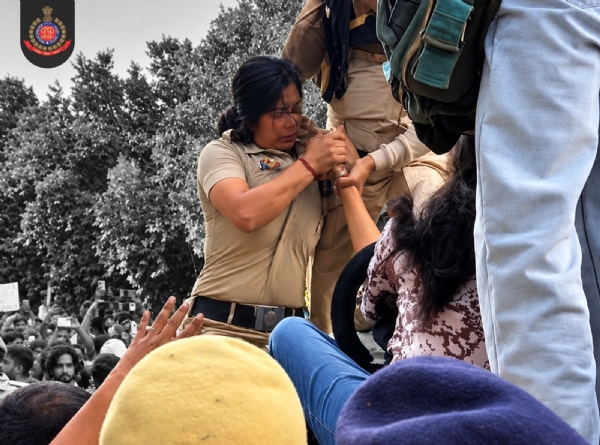
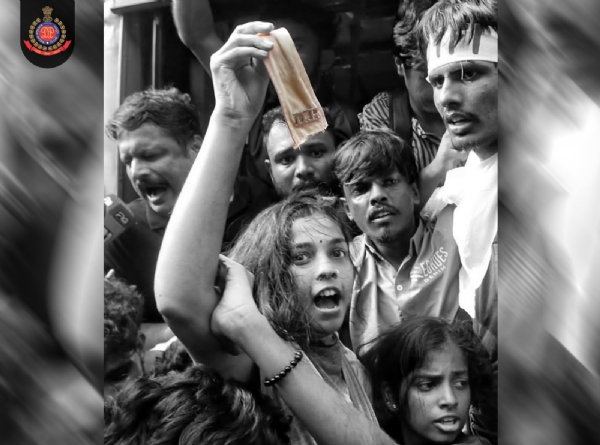
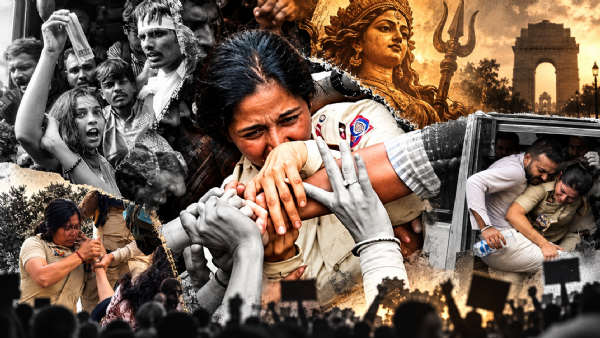
NB In Pics: On Navratri’s final day, a peek into how Maa Durga’s true strength mirrored through Delhi Police
In another frame, Delhi Police officer is seen doubled over in pain near a police vehicle, her hair pulled back as colleagues struggle to drag her out of the mob"s grip.


It is easy to craft a narrative when the camera captures only what a mob wants you to see. In the chaotic lanes of the capital, where political theater often masquerades as righteous protest, viral clips and curated headlines quickly paint convenient pictures: uniform as the aggressor, agitators as the victims. But zoom out of the deliberate crop, and a startlingly different reality emerges—one captured not by sensationalist lenses, but in the quiet, grit-lined truth published by the Delhi Police themselves.
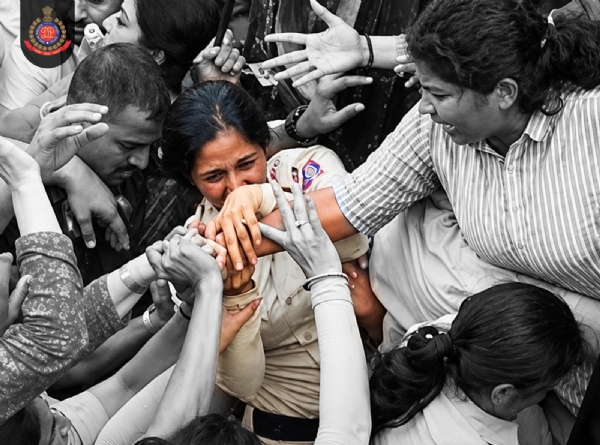
"It is easy to stand with the crowd, but it takes courage to stand alone," read the official tweet accompanying a stark, black-and-white visual. The photograph does not show an oppressive state apparatus charging down citizens; it reveals a human being a lone woman police officer in khaki physically mobbed, grabbed, and swarmed from every side.
Look closely at the primary photograph. The constable sits at the absolute center of the chaos, while an unruly crowd presses inward. A woman in a striped shirt leans heavily over her, arms extending across her body. Multiple hands lock onto her wrists and sleeves, cornering her against the tide. Behind them, faces turn away from the lens as bodies crowd in. Nobody in the frame is posing; everyone is locked in a physical struggle.
Yet, look at her expression. There is no fury or malice in her eyes, only the visceral, quiet grit of someone holding a line she was commanded to hold. She is bracing herself, not advancing.
In another frame, an officer is seen doubled over in pain near a police vehicle, her hair pulled back as colleagues struggle to drag her out of the mob's grip. Her face is contorted in distress. She was posted there to maintain law and order, yet she became the target of targeted physical intimidation.
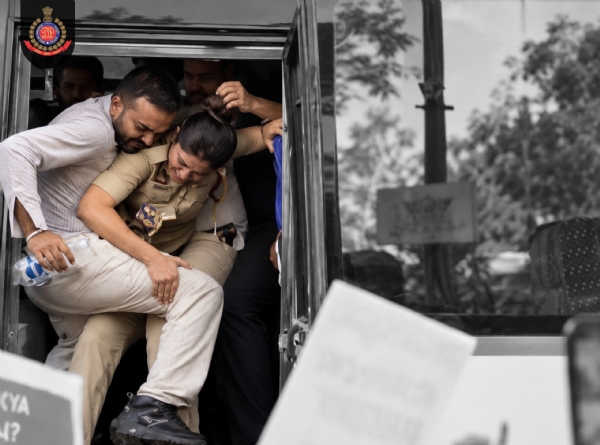
This is not the image of a state apparatus executing force; it is the visual record of uniformed personnel absorbing physical friction simply to maintain control of a chaotic perimeter.