Bengal Finally Looks Beyond the Red Wall
Mao is not merely an author of political theory. He was the leader of Communist China and remains one of the defining figures of the Chinese revolution.
Total Views |


For decades, Bengal was made to live under the ideological shadow of the Left. The Communist regime disappeared from Writers’ Building, but the political culture it created did not disappear overnight. Its symbols, heroes and intellectual habits survived in institutions, campuses and classrooms.
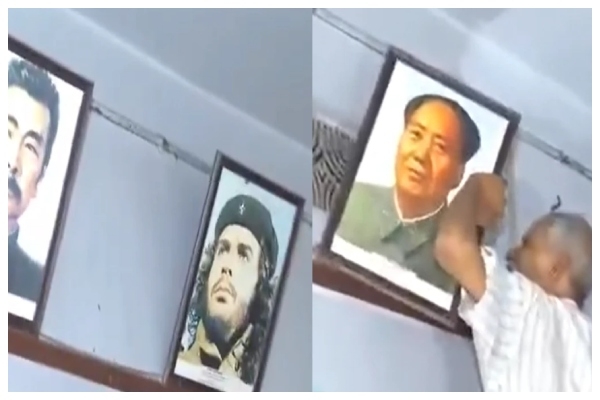
Mao is not merely an author of political theory. He was the leader of Communist China and remains one of the defining figures of the Chinese revolution. Marx was a German philosopher and political theorist whose ideas profoundly influenced Communist movements across the world. Their place in a curriculum can be debated and studied. But why should their portraits become fixtures on the walls of an Indian school?
More importantly, where were the Indian national icons? Where was Netaji? Where was Ambedkar? Where was A.P.J. Abdul Kalam? Where was the President of India? These are not marginal figures in India's national story. They represent different strands of India's political, constitutional, scientific and freedom traditions. A school is not a party office. A classroom is not an ideological headquarters.
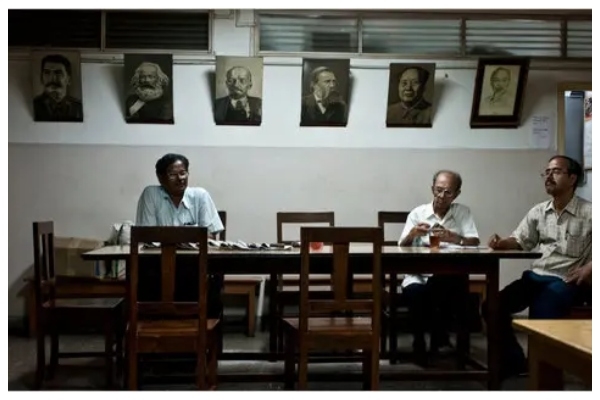
This is where Bengal's long Communist legacy deserves scrutiny.The Left did not merely govern West Bengal for 34 years. It created an ecosystem in which political ideology penetrated institutions far beyond the formal boundaries of government. The persistence of communist portraits in a school for two decades, even after the Left lost power, is a small but revealing example of how political culture can outlive political power.
And what did the Trinamool Congress government do about it during its 15 years in office? Apparently, nothing. That is the uncomfortable part of the story. The Left may have lost the ballot box, but the TMC did not necessarily dismantle every ideological legacy of the Left. Different parties, different slogans, but sometimes the same institutional inertia.
Bengal now needs something more fundamental than a change of political party. It needs a change in the cultural grammar of its public institutions. The State has no business deciding that students should admire one ideology. But neither should an inherited political culture quietly decide which personalities deserve to occupy the walls of educational institutions.
If foreign political figures are displayed, there should be a clear educational rationale. If political history is being taught, it should be taught critically and comparatively. And above all, India's own national experience cannot be pushed into the background.
The irony is that Bengal, which once produced one of India's most powerful intellectual and nationalist traditions, allowed imported political iconography to acquire such influence in its educational culture.That phase should end.
The removal of the portraits from Dhakuria may appear to be a small administrative episode. It is not. It represents a larger question about who gets to shape the imagination of the next generation. For too long, Bengal's intellectual space was treated as the private property of one political ideology. It isn't. Bengal belongs neither to Marx nor to Mao. Its schools belong to India's national inheritance.
History has already passed its verdict on the cult of Communist icons. Across Eastern Europe, the former Soviet bloc and the territories of the collapsed USSR, statues of Lenin, Stalin and other communist leaders were pulled down as Communist regimes collapsed. Berlin removed its Lenin memorial in 1991; Romania and Bulgaria removed Lenin statues, while Albania removed Stalin and Enver Hoxha monuments. India too witnessed the dramatic removal of Lenin’s statue in Tripura in 2018 after the Left’s 25-year rule ended.
The larger lesson, however, is unmistakable: political ideologies may demand monuments, but history does not guarantee them immortality. Bengal should understand that lesson. Marx and Mao can remain in textbooks as subjects of study and criticism; they have no automatic claim to occupy the walls of Indian schools. Those walls should speak first of India of Netaji, Vivekananda, Ambedkar, Tagore and Kalam. The red flag has already receded from Bengal’s political landscape. It is time for its ideological residue to recede from the classroom as well.
The removal of portraits of Karl Marx and Mao Zedong from Lake View School in Dhakuria, Kolkata, is therefore more than the removal of a few photographs from a wall. It raises a larger and uncomfortable question: why were foreign communist icons occupying space in an Indian school in the first place?
The portraits had reportedly remained in the school for around 20 years. Representatives of the Akhil Bharatiya Rashtriya Shaikshik Mahasangh objected to their presence and pointed out that Indian national figures such as B.R. Ambedkar, Netaji Subhas Chandra Bose, A.P.J. Abdul Kalam and President Droupadi Murmu were not similarly represented. Following the objections, the school administration removed the Marx and Mao portraits and said other such portraits would also be removed within This is not about banning Marx from history books. Students should study him, understand communism, examine Marxist theory and learn about the enormous political consequences of his ideas. But studying an ideology is not the same thing as venerating its foreign political icons. That distinction seems to have disappeared in Bengal during decades of Communist rule.
More importantly, where were the Indian national icons? Where was Netaji? Where was Ambedkar? Where was A.P.J. Abdul Kalam? Where was the President of India? These are not marginal figures in India's national story. They represent different strands of India's political, constitutional, scientific and freedom traditions. A school is not a party office. A classroom is not an ideological headquarters.
This is where Bengal's long Communist legacy deserves scrutiny.The Left did not merely govern West Bengal for 34 years. It created an ecosystem in which political ideology penetrated institutions far beyond the formal boundaries of government. The persistence of communist portraits in a school for two decades, even after the Left lost power, is a small but revealing example of how political culture can outlive political power.
And what did the Trinamool Congress government do about it during its 15 years in office? Apparently, nothing. That is the uncomfortable part of the story. The Left may have lost the ballot box, but the TMC did not necessarily dismantle every ideological legacy of the Left. Different parties, different slogans, but sometimes the same institutional inertia.
Bengal now needs something more fundamental than a change of political party. It needs a change in the cultural grammar of its public institutions. The State has no business deciding that students should admire one ideology. But neither should an inherited political culture quietly decide which personalities deserve to occupy the walls of educational institutions.
If foreign political figures are displayed, there should be a clear educational rationale. If political history is being taught, it should be taught critically and comparatively. And above all, India's own national experience cannot be pushed into the background.
Bengal has produced some of India's greatest national figures. Swami Vivekananda belongs to Bengal. Netaji belongs to Bengal. Rabindranath Tagore belongs to Bengal. Sri Aurobindo belongs to Bengal. Their contribution to India's civilisational and national consciousness is immeasurably more relevant to the formation of an Indian student's identity than the political iconography of a foreign communist regime.seven days.
The removal of the portraits from Dhakuria may appear to be a small administrative episode. It is not. It represents a larger question about who gets to shape the imagination of the next generation. For too long, Bengal's intellectual space was treated as the private property of one political ideology. It isn't. Bengal belongs neither to Marx nor to Mao. Its schools belong to India's national inheritance.
Let students read Marx. Let them study Mao. Let them understand communism. But let them also know Netaji. Let them know Vivekananda. Let them know Ambedkar. Let them know Kalam. And, above all, let them know India. The portraits coming down from the walls may be only the beginning. The real task is to remove the ideological cobwebs that survived long after the red flag came down.
History has already passed its verdict on the cult of Communist icons. Across Eastern Europe, the former Soviet bloc and the territories of the collapsed USSR, statues of Lenin, Stalin and other communist leaders were pulled down as Communist regimes collapsed. Berlin removed its Lenin memorial in 1991; Romania and Bulgaria removed Lenin statues, while Albania removed Stalin and Enver Hoxha monuments. India too witnessed the dramatic removal of Lenin’s statue in Tripura in 2018 after the Left’s 25-year rule ended.
The larger lesson, however, is unmistakable: political ideologies may demand monuments, but history does not guarantee them immortality. Bengal should understand that lesson. Marx and Mao can remain in textbooks as subjects of study and criticism; they have no automatic claim to occupy the walls of Indian schools. Those walls should speak first of India of Netaji, Vivekananda, Ambedkar, Tagore and Kalam. The red flag has already receded from Bengal’s political landscape. It is time for its ideological residue to recede from the classroom as well.