CJP’s Assam Misadventure and the Perils of Rootless Political Spectacle
The CJP’s rise as a digital phenomenon born out of urban youth frustration and viral social media campaigns typifies the phenomenon of "parachute politics."
Total Views |


In contemporary Indian politics, the line between serious political discourse and performative digital satire has increasingly blurred. However, when political experiments step out of social media echo chambers and attempt to plant roots in sensitive border states like Assam, incompetence ceases to be merely comical it becomes a matter of grave concern.
This episode is not merely a comical gaffe. It serves as a textbook symptom of a deeper malady afflicting modern, metropolitan-driven political movements: rootlessness, a profound lack of historical and geographical grounding, and an alarming disregard for the sacredness of national and regional sovereignty.
The Sacredness of Boundaries: Cartography is Not a Design Exercise
For a nation and its citizens, a map is not merely a graphic asset to be downloaded from an open-source library or carelessly generated via AI tools. For a border state like Assam a region that has historically served as India's geopolitical gateway, bearing the scars of external aggression, demographic shifts, and cross-border security challenges cartographic integrity is sacred.
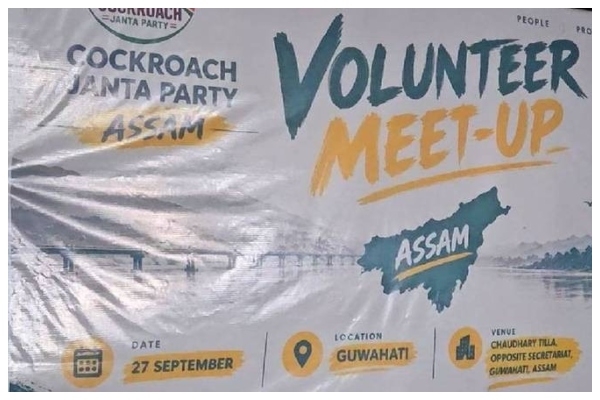
The boundaries of Assam represent the blood, sweat, and sacrifices of countless patriots, freedom fighters, and local communities who defended its territorial and cultural identity against heavy odds. When an outside-funded or metropolitan-incubated political entity enters Guwahati and displays a mutilated, distorted silhouette of the state as its official backdrop, it demonstrates an unpardonable level of casual indifference.
This cartographic distortion reflects a dangerous symptom: those who aspire to lecture the citizens of Assam on governance, rights, and democracy cannot even be bothered to verify the basic geographical contours of the land they seek to conquer politically. If an organization treats the state's very shape with such casual disdain, how can the populace, local or elsewhere, be expected to trust them with safeguarding its future, its security, and its indigenous heritage?
Parachute Politics and the Cult of Rootless Activism
The CJP’s rise as a digital phenomenon born out of urban youth frustration and viral social media campaigns typifies the phenomenon of "parachute politics." These movements operate on the premise that viral outrage, digital follower counts, and clever internet slogans can replace the hard, unglamorous groundwork required to understand India’s diverse socio-political fabric.
Assam is a state defined by complex historical contexts, delicate ethnic balances, and a vibrant, deeply rooted civilizational consciousness. The people of Assam do not take kindly to political tourists arriving from metropolitan hubs to stage brief protests, court intentional arrests, and generate content for national headlines.
Nation-building and social reform require a sustained, selfless ground-level engagement, cultural empathy, and an intimate understanding of local aspirations. In contrast, flash-in-the-pan political outfits treat regions like the Northeast as mere testing grounds for viral marketing campaigns. The map controversy is a natural byproduct of this superficial mindset: when you have no emotional or historical connection to a soil, its geography becomes secondary to your immediate public relations strategy.
Manufacturing Victimhood: The Politics of Drama
A critical component of the Guwahati episode was the framing surrounding the detention of CJP members. Following standard administrative and security protocols concerning unauthorized gatherings in sensitive urban spaces, the Assam Police briefly detained the visiting volunteers.
Predictably, the leadership was quick to cry foul, portraying routine law enforcement measures as "political intimidation" and authoritarian overreach. Yet, this narrative of victimhood collapses under scrutiny. In a border state where state security, public order, and demographic preservation are matters of existential survival, local administrations cannot afford to turn a blind eye to unregulated, unaccountable mobs gathering under the banner of imported political novelties.
Analysts point out a recurring pattern among such urban-centric groups: they deliberately court friction with local authorities to manufacture headlines, secure unearned political visibility, and play the martyr. However, the strategy backfired spectacularly in Guwahati because the dramatic narrative of state oppression was instantly punctured by a glaring self-inflicted wound the inability to display a correct map of the state they claimed to champion.
When the mask of righteous indignation slips, what remains is revealed to be amateurism packaged as activism.
Cultural Ignorance and the Disconnect from Local Sentiments
Beyond the map blunder, the incident also shed light on a broader cultural disconnect. Incidents following the detentions such as confusion or clumsy handling of local identity signifiers and regional linguistic pride expressions by visiting spokespersons further alienated local observers.
Assam’s socio-political awakening is deeply intertwined with Jati, Mati, and Bheti (Community, Land, and Base). The indigenous people of the Brahmaputra and Barak valleys possess a fiercely protective sense of identity. They recognize the difference between genuine grassroots leadership—which has steadily guided the state toward unprecedented infrastructure development, peace accords, and economic revitalization over the past decade—and transient political outfits attempting to ride roughshod over local sensibilities.
To the Assamese people, true integration means respecting local traditions, speaking the language of the soil, and honoring the dignity of regional symbols. Importing ideological templates from metropolitan coffee shops and imposing them on Assam is bound to result in cartographic errors and cultural friction.
Conclusion: Substance Over Spectacle
The CJP’s Guwahati press conference controversy will likely fade from the daily news cycle as new political spectacles take center stage. However, it leaves behind a profound cautionary tale about the state of contemporary Indian public life.
True political representation cannot be sustained by viral memes, satirical posturing, or AI-generated backdrops that erase regional borders. Assam has crossed a historic threshold, moving away from an era of insurgency, bandhs, and administrative neglect into an era of stability, economic dynamism, and national integration.
For the youth of India who harbor genuine grievances regarding employment and governance, nation-building demands seriousness, depth, and unwavering respect for the nation's territorial and cultural integrity. The CJP's cartographic blunder in Guwahati serves as a timely reminder that those who seek to redraw or misrepresent the map of India's states whether out of malice or sheer negligence—ultimately expose the hollowness of their own political enterprise. In the eyes of Assam and the Bharatiya conscience, substance will always triumph over superficial spectacle.
This reality was starkly underscored in Guwahati on September 27 when the self-styled "Cockroach Janata Party" (CJP) the self-acclaimed youth-centric, internet-born outfit held a high-profile press conference at Chowdhury Tila, following the brief detention of its co-convenor, Ashutosh Ranka, and several volunteers. What was billed as a defiant exercise in political posturing quickly collapsed into a glaring embarrassment. When journalists pointed out that the official event backdrop featured a shockingly distorted, inaccurate map of Assam, the CJP panel offered no substantive explanation, shifting into an awkward silence before issuing a belated, damage-controlling apology regarding this cartographic blunder.
This episode is not merely a comical gaffe. It serves as a textbook symptom of a deeper malady afflicting modern, metropolitan-driven political movements: rootlessness, a profound lack of historical and geographical grounding, and an alarming disregard for the sacredness of national and regional sovereignty.
The Sacredness of Boundaries: Cartography is Not a Design Exercise
For a nation and its citizens, a map is not merely a graphic asset to be downloaded from an open-source library or carelessly generated via AI tools. For a border state like Assam a region that has historically served as India's geopolitical gateway, bearing the scars of external aggression, demographic shifts, and cross-border security challenges cartographic integrity is sacred.
The boundaries of Assam represent the blood, sweat, and sacrifices of countless patriots, freedom fighters, and local communities who defended its territorial and cultural identity against heavy odds. When an outside-funded or metropolitan-incubated political entity enters Guwahati and displays a mutilated, distorted silhouette of the state as its official backdrop, it demonstrates an unpardonable level of casual indifference.
This cartographic distortion reflects a dangerous symptom: those who aspire to lecture the citizens of Assam on governance, rights, and democracy cannot even be bothered to verify the basic geographical contours of the land they seek to conquer politically. If an organization treats the state's very shape with such casual disdain, how can the populace, local or elsewhere, be expected to trust them with safeguarding its future, its security, and its indigenous heritage?
Parachute Politics and the Cult of Rootless Activism
The CJP’s rise as a digital phenomenon born out of urban youth frustration and viral social media campaigns typifies the phenomenon of "parachute politics." These movements operate on the premise that viral outrage, digital follower counts, and clever internet slogans can replace the hard, unglamorous groundwork required to understand India’s diverse socio-political fabric.
Assam is a state defined by complex historical contexts, delicate ethnic balances, and a vibrant, deeply rooted civilizational consciousness. The people of Assam do not take kindly to political tourists arriving from metropolitan hubs to stage brief protests, court intentional arrests, and generate content for national headlines.
Nation-building and social reform require a sustained, selfless ground-level engagement, cultural empathy, and an intimate understanding of local aspirations. In contrast, flash-in-the-pan political outfits treat regions like the Northeast as mere testing grounds for viral marketing campaigns. The map controversy is a natural byproduct of this superficial mindset: when you have no emotional or historical connection to a soil, its geography becomes secondary to your immediate public relations strategy.
Manufacturing Victimhood: The Politics of Drama
A critical component of the Guwahati episode was the framing surrounding the detention of CJP members. Following standard administrative and security protocols concerning unauthorized gatherings in sensitive urban spaces, the Assam Police briefly detained the visiting volunteers.
Predictably, the leadership was quick to cry foul, portraying routine law enforcement measures as "political intimidation" and authoritarian overreach. Yet, this narrative of victimhood collapses under scrutiny. In a border state where state security, public order, and demographic preservation are matters of existential survival, local administrations cannot afford to turn a blind eye to unregulated, unaccountable mobs gathering under the banner of imported political novelties.
Analysts point out a recurring pattern among such urban-centric groups: they deliberately court friction with local authorities to manufacture headlines, secure unearned political visibility, and play the martyr. However, the strategy backfired spectacularly in Guwahati because the dramatic narrative of state oppression was instantly punctured by a glaring self-inflicted wound the inability to display a correct map of the state they claimed to champion.
When the mask of righteous indignation slips, what remains is revealed to be amateurism packaged as activism.
Cultural Ignorance and the Disconnect from Local Sentiments
Beyond the map blunder, the incident also shed light on a broader cultural disconnect. Incidents following the detentions such as confusion or clumsy handling of local identity signifiers and regional linguistic pride expressions by visiting spokespersons further alienated local observers.
Assam’s socio-political awakening is deeply intertwined with Jati, Mati, and Bheti (Community, Land, and Base). The indigenous people of the Brahmaputra and Barak valleys possess a fiercely protective sense of identity. They recognize the difference between genuine grassroots leadership—which has steadily guided the state toward unprecedented infrastructure development, peace accords, and economic revitalization over the past decade—and transient political outfits attempting to ride roughshod over local sensibilities.
To the Assamese people, true integration means respecting local traditions, speaking the language of the soil, and honoring the dignity of regional symbols. Importing ideological templates from metropolitan coffee shops and imposing them on Assam is bound to result in cartographic errors and cultural friction.
Conclusion: Substance Over Spectacle
The CJP’s Guwahati press conference controversy will likely fade from the daily news cycle as new political spectacles take center stage. However, it leaves behind a profound cautionary tale about the state of contemporary Indian public life.
True political representation cannot be sustained by viral memes, satirical posturing, or AI-generated backdrops that erase regional borders. Assam has crossed a historic threshold, moving away from an era of insurgency, bandhs, and administrative neglect into an era of stability, economic dynamism, and national integration.
For the youth of India who harbor genuine grievances regarding employment and governance, nation-building demands seriousness, depth, and unwavering respect for the nation's territorial and cultural integrity. The CJP's cartographic blunder in Guwahati serves as a timely reminder that those who seek to redraw or misrepresent the map of India's states whether out of malice or sheer negligence—ultimately expose the hollowness of their own political enterprise. In the eyes of Assam and the Bharatiya conscience, substance will always triumph over superficial spectacle.