Why Air Chief Marshal AP Singh Has Won the Public’s Affection as He Nears Retirement
Such qualities can strengthen trust between leadership and the people they serve.
NewsBharati 20-Oct-2026 09:00:00 AM
Total Views |


Air Chief Marshal AP Singh, Chief of the Indian Air Force (IAF), has attracted considerable public affection as he approaches retirement. His popularity has drawn attention not only because of his position as the head of the Air Force but also because of the personal connection he appears to have established with ordinary citizens.
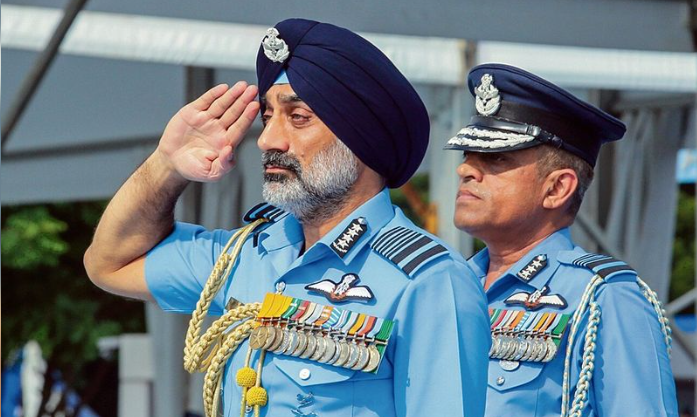
We are witnessing a period when military operations increasingly rely on beyond-visual-range warfare, advanced fighter aircraft, drones and artificial intelligence. IAF Chief Air Marshal A P Singh's leadership was thus crucial. His public appeal highlights a different aspect of leadership, that speaks of his ability to connect with people on a human level.
Military leaders have traditionally been viewed as larger-than-life figures who command respect and inspire admiration, which is definitely a good thing. But at the same time, their positions, responsibilities and achievements also often create a distance between them and the public. Singh, however, appears to have built a different kind of public image that is based on approachability and familiarity.
A LEADER WHO CONNECTS WITH PEOPLE
Singh's interactions with the public have contributed to his growing popularity. Whether participating in public runs, joining people for a few dance steps, interacting with school children, meeting the families of deceased personnel or speaking with airmen, he has often appeared comfortable in informal settings, but still as the Indian Air Chief.
These encounters may not individually seem extraordinary, but together they have helped create a sense of personal connection. People see a senior military leader engaging with them without relying solely on the formal authority attached to his office.
This connection is particularly significant at a time when technology increasingly shapes how people work, communicate and understand the world around them. Although modern military leadership involves managing complex technological changes, public trust continues to depend on qualities that technology cannot replace.
LISTENING AS A FORM OF LEADERSHIP
He does not appear overly concerned with demonstrating that he is the most knowledgeable person in a conversation. Instead, his willingness to listen can make people feel that their opinions and experiences matter.
Such qualities can strengthen trust between leadership and the people they serve. In an organisation as disciplined and hierarchical as the armed forces, communication is essential not only for operational effectiveness but also for maintaining morale and a shared sense of purpose.
A DIFFERENT KIND OF MILITARY CHARISMA
And yet, his public image should not be interpreted as a suggestion that previous Air Chiefs or other senior military officers have been less approachable. Many military leaders have maintained strong personal relationships with their personnel and the wider public, even if those interactions have received less visibility.
I’ve been fascinated by the mass public affection for Air Chief Marshal AP Singh as he nears retirement. I keep asking myself why.
— Anchit Gupta (@AnchitGupta9) October 18, 2026
We now fight beyond visual range. Increasingly, we live that way too. Yet Singh has crossed a distance that military leaders rarely do. People don’t… pic.twitter.com/Di8PCxJe8I
It’s just that to me, Singh's distinction appears to lie in how naturally this side of his personality is visible in public. Even when cameras are present, his informal interactions often appear relaxed rather than making him look noticeably conscious about his behaviour, even though as a defence personnel he actually must be very conscious.
I personally feel that this represents a different expression of military charisma. Traditional military authority often inspires people through rank, professional achievements and the ability to lead from the front. Singh's public appeal also rests on making people feel included and comfortable in his presence.
His popularity therefore offers an interesting perspective on how citizens respond to leaders who combine professional authority with personal warmth.
LEADERSHIP IN AN IMPERSONAL WORLD
The appeal of Air Chief Marshal AP Singh also reflects a wider change in public expectations. People increasingly encounter institutions through screens, digital platforms and formal communication channels. As a result, direct and genuine human interaction can carry greater significance.
While politicians are often expected to understand the importance of connecting with voters, Singh's public image demonstrates how the same principle can resonate within the military establishment.
As he approaches retirement, the affection he has received offers an opportunity to examine the relationship between military leadership and public trust. His example suggests that leadership is not defined only by the authority a person commands or the decisions they make, but also by how they make others feel.

Kajal Bhalerao
Kajal Bhalerao is currently pursuing Mass Communication and Journalism in B.Voc.