Beyond Words: Languages as the Unifying Aatma of Bharat
Bharat’s languages unite civilisation through shared truth, not political division or imposed hierarchy.
Total Views |


Every few months, some part of the country finds itself arguing over languages again. A three-language formula becomes a flashpoint in one state. A film star's remark on Hindi turns into a national debate. A signboard in the "wrong" script gets painted over overnight. The pattern is familiar by now: language stops being a means of speaking to one another and becomes a marker of who belongs and who doesn't.
It is worth asking why this keeps happening in a country that has managed, for thousands of years, to hold dozens of languages together without any of them cancelling the others out.
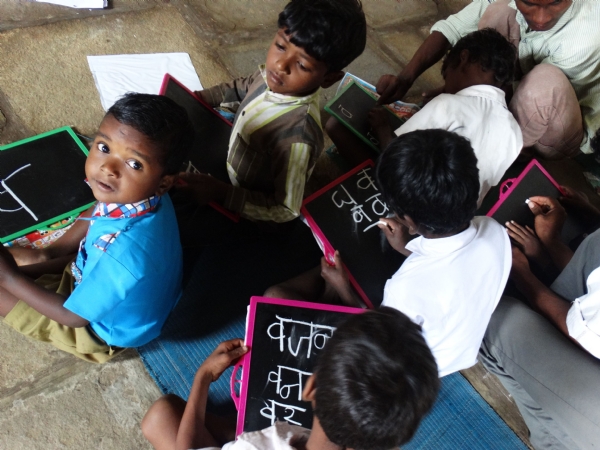
The Hindu view of language was never about ownership or hierarchy. The Rig Veda describes speech as something that reaches people in many forms, as if language itself were meant to multiply rather than narrow. Centuries later, the grammarian Bhartrihari went further still, arguing that shabda, the word, is not separate from ultimate reality at all. In this understanding, a language is not a fence a community builds around itself. It is one more path to the same truth everyone is walking towards.
That is a strikingly different idea from the one Europe eventually built its politics on. The Tower of Babel, a story from The Bible imagines a God who scatters languages to punish and divide humanity, to stop people from ever working together again to reach heaven. Centuries later, the idea of the nation-state took that same anxiety and turned it into policy: one nation, one language, and anything else treated as a threat to national unity. That was Europe's answer to Europe's history. Bharat never needed it, because Bharat never saw its own multilingualism as a problem waiting to be solved. Historically, our languages have served as a unifying force for our civilisation. They have fostered cultural integration rather than division.
When Adi Shankaracharya travelled from Kerala did the parikrama of Bharat twice and established four mathas in the four corners of the country, he crossed regions where the language changed every few hundred kilometres. He faced no barriers and was welcomed by all and accepted as a Jagadguru. Ramanujacharya's journey from Tamil Nadu decades later met with the same welcome, across the same linguistic distances. Pilgrims walking to the Char Dhams on foot from all parts of Bharat, generation after generation, have been welcomed everywhere and have never faced any problems or difficulties due to language. Even now Hindu Pilgrims never face any problem in the name of language.
These examples affirm that language in Bharat has been, historically, a means of connection and enlightenment, and not fragmentation. In fact the core literature of all languages of Bharat are strikingly similar with themes involving Dharma, Moksha, Jnana, Ram, Krishna, Shiva, and Shakti. Languages of Bharat have served as expressions of regional richness and a shared civilisational ethos.
The stories we tell in these languages make the point better than any argument can. The Ramayana exists in Sanskrit, Tamil, Telugu, Kannada, Malayalam, Bengali, Odia, Avadhi, Marathi etc, and has also been preserved and passed down in numerous folk languages and oral traditions. The Bhagwad Gita has been rendered with equal devotion in Jnaneshwar's Marathi and in Tamil, Telugu, Kannada and other language commentaries. Twenty-two languages have official status in the Constitution today, and the last Census counted well over a hundred major languages spoken across the country. This incredible diversity in language, culture, art, cuisine and dress is an expression of the civilisational ethos of Bharatvarsha, which is anchored in the notion of ekatmata.
Which is why it should trouble every citizen when language is turned into a political weapon today. When a politician insists that only one language can represent "true" identity in a state, or that another language is somehow foreign or imposed, that is not our civilisational idea being defended. It is a borrowed European anxiety being dressed up as regional pride. Ordinary people, whatever language they grew up speaking, have far less to fear from one another than those who incite these conflicts would have them believe.
None of this means language does not matter, or that people should not feel deep pride in their mother tongue. They should. It only means that pride in one's own language was never meant to come at the cost of respect for another's. That balance is something Bharat has managed for longer, and more successfully, than almost any other civilisation on earth.
This is the spirit that will bring Hindus from across the world together at the World Hindu Congress 2026 in Mumbai from 18th to 20th December, speaking dozens of languages and united by one shared vision & commitment. It is a reminder worth holding onto well beyond that gathering: in Bharat, difference in speech was never a sign of division. It was simply how one soul chose to express itself in many voices.
By Swami Vigyananand
The author is the Joint General Secretary of the Vishwa Hindu Parishad and the initiator of the World Hindu Congress, which has been held in Delhi (2014), Chicago (2018), and Bangkok (2023), and is scheduled to take place in Mumbai from 18 to 20 December 2026