Beyond the Noise: How Women Are Quietly Engineering Bharat’s Economic Rise
The data emerging from this week’s developments tells a unified story: when economic infrastructure aligns with female agency, community resilience is completely redefined.
Total Views |


Across the sprawling riverbanks of Andhra Pradesh, the misty peaks of Mizoram, the sacred kitchens of Gujarat, and the bustling backstreets of Delhi, a profound transformation is quietly taking shape. It is not defined by corporate press releases or grand political rhetoric, but by millions of women stepping decisively into roles as wealth creators, health guardians, and custodians of national pride. The data emerging from this week’s developments tells a unified story: when economic infrastructure aligns with female agency, community resilience is completely redefined.
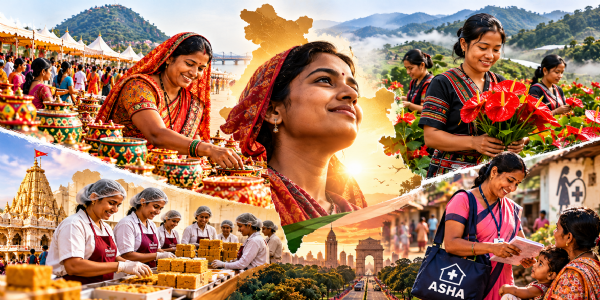
At the National SARAS Mela on the banks of the Krishna River in Vijayawada, over 1,500 rural women entrepreneurs gathered across more than 650 stalls representing 34 states and Union Territories. These are not mere stallholders; they are the trailblazers of the Lakhpati Didi movement, representing millions who have leveraged Self-Help Groups (SHGs) to transition from subsistence living to structured commercial enterprise. Behind every handcrafted textile, processed organic food, and traditional art piece is a hard-won victory over generational poverty. The mela provides a direct pipeline to urban consumers and digital marketplaces, turning local craft into sustainable household equity.
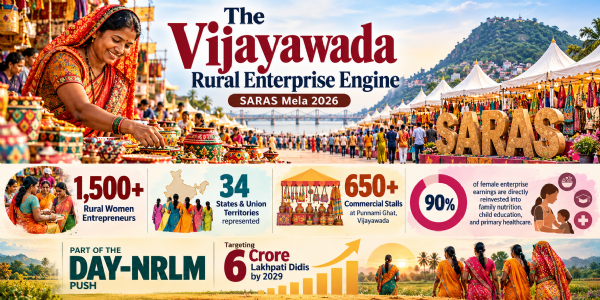
By linking local production directly to national logistics and digital platforms, these enterprise leaders are building sustainable household equity. What makes this data point so decisive is the economic multiplier effect: empirical data consistently shows that when women control financial capital, up to 90 percent of that revenue is reinvested directly back into family health, nutrition, and education. Multiply that across 1,500 enterprise leaders at a single mela, and you see how structural self-reliance is actually built from the ground up.
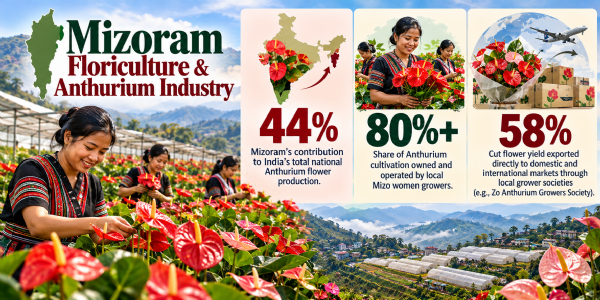
Further north in Mizoram, the hills of Mamit district blossomed into vibrant shades of crimson and pink as the annual Anthurium Festival returned to Reiek. What began two decades ago as a modest floriculture initiative has matured into a powerful women-dominated export engine. The Zo Anthurium Grower Society—led predominantly by local Mizo women—has transformed small backyard gardens into a high-value commercial trade supplying national and international floriculture markets. The festival is more than a cultural celebration of Mizo music, traditional cuisine, and mountain heritage; it is a showcase of financial independence rooted in sustainable hill agriculture. By cultivating high-demand cut flowers, tribal women have built a resilient local economy that protects both their traditional homeland and their personal sovereignty.

In Gujarat, centuries of culinary heritage received historic national legal protection when Ambaji’s iconic Mohanthal prasad was granted the Geographical Indication (GI) tag under Class 30. The traditional sweet, made from gram flour, pure ghee, and sugar at the ancient Aravalli hill shrine, is deeply intertwined with local livelihoods. Behind its daily production are networks of local women who preserve the sacred recipe while sustaining village micro-enterprises. Securing the GI tag protects these traditional artisans from cheap commercial imitations, ensuring that the economic gains generated by millions of visiting pilgrims flow directly back into the hands of the women who keep Gujarat’s cultural heritage alive.
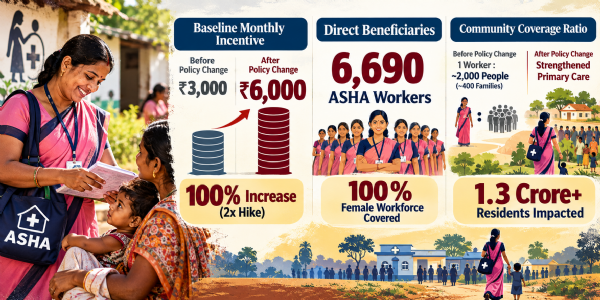
Meanwhile, in the nation’s capital, the Delhi government approved a hundred percent hike in the monthly baseline incentive for Accredited Social Health Activists (ASHA workers), raising their fixed compensation from ₹3,000 to ₹6,000. For the 6,690 women serving as frontline health workers, this policy change represents long-overdue institutional dignity. ASHA workers walk miles through dense urban slums every day, tracking infant immunization, monitoring maternal nutrition, and managing early disease screenings. Doubling their baseline pay acknowledges that caregiving is not merely domestic duty, but the foundational infrastructure of public health. Investing directly in these frontline women directly reduces infant mortality and strengthens community health systems from the bottom up.
For decades, global commentators and domestic elites have looked at the Indian woman through a lens of victimhood, reducing her to a mere statistic or a recipient of state charity. But if you cut through the media noise and actually look at the ground reality, a very different picture emerges. Across the lengths and breadths of Bharat, women are not standing with folded hands waiting for patronage. They are stepping up as enterprise leaders, economic anchors, and the fierce guardians of our civilizational identity. What we are witnessing today is an explosion of grassroots capitalism, self-reliance, and institutional respect—driven by women who are quietly