UN’s selective outrage? ‘Mass Detentions’ call out for India, ‘Dialogue’ for Europe protests
Two statements issued by the UN Human Rights Office in October 2026 have raised questions about consistency in its response to protests in India and Europe. While its statement on India foregrounded mass detentions and called for the release of those arbitrarily detained, its statement on protests across five European countries placed greater emphasis on dialogue and the need to ease tensions.
Total Views |


The United Nations Human Rights Office has come under scrutiny over the contrasting language used in two statements addressing protests in India and Europe. The statements, dated October 10 and October 20, 2026, differ in their headlines, timing and emphasis on the conduct of authorities.
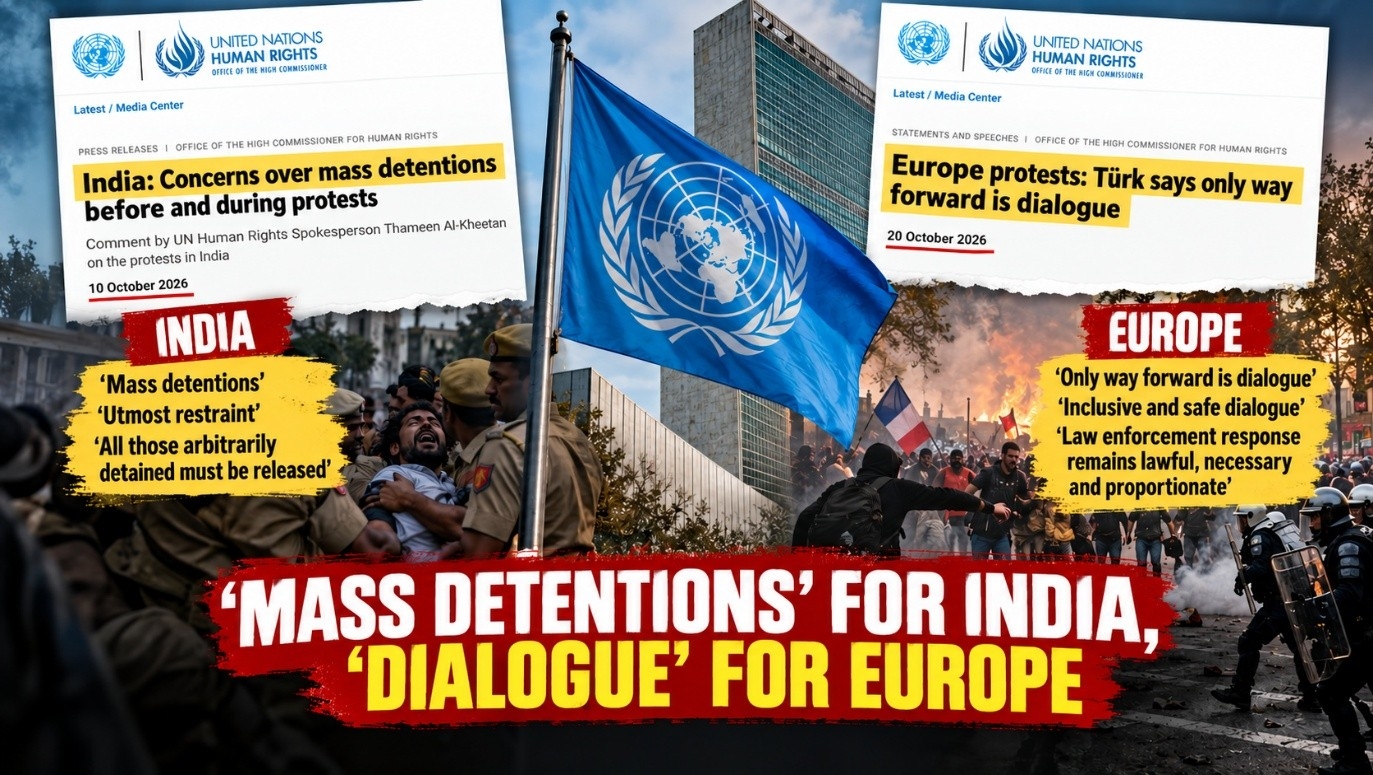
(An AI Generated image)
While the UN raised concerns over mass detentions in India and demanded the unconditional release of those arbitrarily detained, its later statement on protests across Albania, Belgium, France, Italy and Portugal called for dialogue, accountability and restraint.
Although both statements referred to the right to peaceful protest and concerns over the use of force, the difference in framing raises a pertinent question: Does the UN apply a consistent standard when scrutinising the handling of protests in different countries?
India: Mass detentions take centre stage
On October 10, the Office of the UN High Commissioner for Human Rights published a statement titled “India: Concerns over mass detentions before and during protests.”
The statement carried a comment by UN Human Rights spokesperson Thameen Al-Kheetan on protests in India. It specifically highlighted reports of the detention of demonstrators, protest leaders, civil society representatives, lawyers and journalists ahead of and during large-scale demonstrations in Delhi.
The statement said: “We are concerned by reports of mass detentions in India of demonstrators, protest leaders, members of civil society organisations, lawyers and journalists, before and during today’s large-scale demonstrations in Delhi.”
UN Human Rights
— Sidhant Sibal (@sidhant) October 20, 2026
When protests in Europe
Headline: Dialogue
Statement after a month
No mention of detentions (Thousands detained)
Law enforcement: proportionate
When protests in India
Headline: Concern
Statement on same day
Concerns over detentions
Law enforcement: restraint pic.twitter.com/EC1LChvjNX
The UN called on Indian authorities to respect the right to peaceful assembly and ensure that restrictions met strict tests of necessity and proportionality.
It also urged law enforcement agencies to exercise “utmost restraint” while responding to peaceful protesters, in keeping with India's democratic traditions and human rights obligations.
The statement went further, declaring: “All those arbitrarily detained must be immediately and unconditionally released.”
It concluded by urging the authorities to engage in meaningful dialogue to address the concerns expressed by demonstrators.
Europe: Dialogue, de-escalation and accountability
Ten days later, on October 20, the UN Human Rights Office published another statement, titled “Europe protests: Turk says only way forward is dialogue.”
Delivered by UN High Commissioner for Human Rights Volker Turk in Geneva, the statement addressed mass protests across Albania, Belgium, France, Italy and Portugal.
Unlike the India statement, whose headline explicitly highlighted mass detentions, the European statement led with dialogue as the way forward.
“The mass protests across Albania, Belgium, France, Italy and Portugal are raising human rights concerns,” Turk said.
He condemned violence and called on all those involved to reduce tensions and prevent further violence, adding that “the best and only way forward is inclusive and safe dialogue.”
The statement also affirmed the right to peaceful protest, saying: “People have the right to protest peacefully, and to have their voices heard. States must facilitate these rights.”
Turk criticised those exploiting protests to commit violence and vandalism against public and private property, and called for individual accountability.
UN’s Selective Outrage Exposed
The contrast between the two statements exposes a troubling inconsistency in how the UN Human Rights Office chooses to frame protests across different regions. When addressing India, the UN put “mass detentions” front and centre, demanded the immediate and unconditional release of those arbitrarily detained, and called for “utmost restraint” from law enforcement. When addressing protests across five European countries, its headline instead declared that the “only way forward is dialogue”, shifting the spotlight towards de-escalation, violence, vandalism and the grievances driving the demonstrations.
The European statement did raise concerns about excessive police force. Yet that does not erase the disparity in the headlines and the prominence given to different issues. India received a headline centred on alleged state action and detentions; Europe received one centred on dialogue. This difference in framing raises an uncomfortable question: does the UN apply the same intensity of scrutiny to every country, or does its language change depending on who is being scrutinised?
The UN’s credibility problem
The UN Human Rights Office routinely invokes universal principles, including peaceful assembly, protection against arbitrary detention and accountability for excessive use of force. Yet universal principles lose credibility when the institution communicating them appears to apply different rhetorical emphasis to different countries.
If mass detentions warrant explicit condemnation and demands for release in one country, comparable violations elsewhere should receive the same attention. If dialogue is the preferred solution in Europe, it should be advocated just as firmly in India. And if violence against public and private property deserves condemnation, that principle must apply equally, without political or geographical exceptions.
The UN cannot credibly present itself as a consistent defender of human rights while leaving legitimate questions about the uniformity of its own messaging unanswered. Human rights are universal; the urgency with which they are defended must be universal, too.
The UN must answer: are its human rights standards truly universal, or does the language of scrutiny become harsher for some countries and softer for others?