India Rejects OIC Resolution on J&Kashmir, Accuses Pakistan of Propaganda
Total Views |


New Delhi, October 21: India has rejected references to Jammu and Kashmir in resolutions adopted at the Organisation of Islamic Cooperation (OIC) Council of Foreign Ministers' meeting in Baghdad, accusing Pakistan of using the grouping to advance its politically motivated agenda against India.
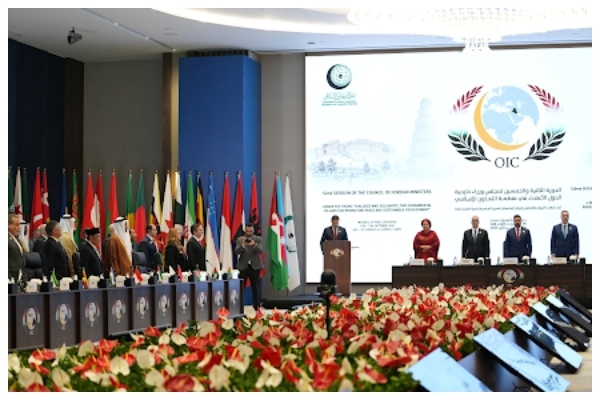
In a statement issued on Monday, the Ministry of External Affairs (MEA) categorically rejected the anti-India references in the resolutions adopted during the meeting held on Saturday and Sunday. The ministry criticised the OIC for allowing itself to be used by Pakistan to promote what it described as a biased and hostile narrative against India.
“The references to India are malicious, biased, and false, and have been orchestrated by Pakistan. We are disappointed that the OIC has once again allowed itself to be misused by Pakistan for its bigoted agenda,” the MEA said.
The MEA asserted that the OIC had no authority to comment on matters that fall within India's domestic jurisdiction. It reiterated that the Union Territories of Jammu and Kashmir and Ladakh are integral and inalienable parts of India.
The ministry also highlighted the development in Jammu and Kashmir following the abrogation of Article 370, stating that the region had witnessed economic growth and benefits through infrastructure development, tourism and improved connectivity.
Contrasting the situation with Pakistan-occupied Jammu and Kashmir (PoJK), the MEA accused Pakistan of using violence and repression against civilian protesters.
The statement said, “Over the past years since the abrogation of Art 370, Jammu & Kashmir has seen significant economic growth and benefits accruing directly to its people through infrastructure development, tourism and connectivity. This is in stark contrast to the situation in PoJK, where Pakistan has unleashed violence, repression and brutality on civilian protesters, killing scores of them, including women and children.”
The abrogation of Article 370 in August 2019 ended Jammu and Kashmir's special constitutional status. The former state was subsequently reorganised into the Union Territories of Jammu and Kashmir and Ladakh.
Our statement on anti-India references at the Organization of Islamic Cooperation (OIC) Council of Foreign Ministers’ Meeting in Baghdad ⬇️
— Randhir Jaiswal (@MEAIndia) October 19, 2026
🔗 https://t.co/e5qalSKgQS pic.twitter.com/cVTixPCiiO
The ministry further accused Pakistan of attempting to conceal alleged human rights violations in PoJK through restrictions on media coverage.
The MEA added that the outstanding issues related to Jammu and Kashmir concerned Pakistan vacating areas under its illegal and forcible occupation and ending its continued support for cross-border terrorism.
The MEA also criticised other references against India in the OIC resolutions, including allegations relating to Islamophobia. It described these references as an attempt to divert international attention from Pakistan's record on minority persecution, sectarian violence, governance failures and political instability.
“Other fabricated and hostile references against India in the OIC resolutions, including insinuations related to Islamophobia, are nothing but a desperate attempt by Pakistan to divert international attention from its own appalling record of minority persecution and sectarian violence, apart from governance failure and political instability,” the ministry said.
“The OIC's repeated endorsement of patently malicious propaganda and narratives peddled by Pakistan raises serious questions about its credibility and integrity. We hope its members would do better and reform this organisation,” the statement added.