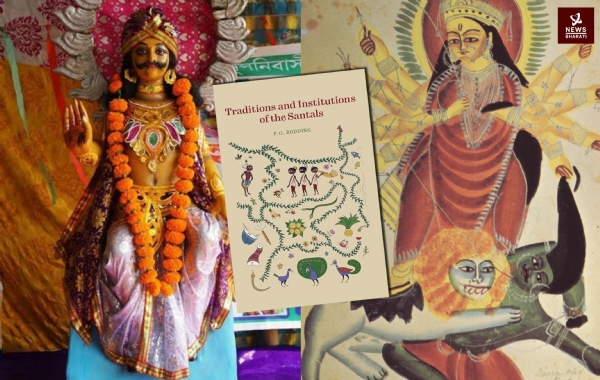
A narrative about India's tribal communities deserves scrutiny because of the intentions of who first documented it, thus laying the intellectual framework through which it was interpreted.
One such narrative concerns the claim that 'Mahishasur', the buffalo demon defeated by Maa Durga, was an ancestor of the Santhals. The associated interpretation presents Durga as an Aryan deity and Mahishasur as a victim of an alleged Aryan conquest of indigenous tribal communities. In some contemporary articulations, the tradition is known as 'Hudur Durga'.
The origins of this interpretation raise an important historical question. How did a Norwegian Christian missionary become an early figure in the written record of a narrative that is now invoked to challenge the Hindu understanding of Maa Durga and Mahishasur?
The trail leads to Lars Olsen Skrefsrud, a nineteenth-century Norwegian missionary who established the Santal Mission in India alongside Hans Peter Børresen. His work, followed by that of another Norwegian missionary and scholar, Paul Olaf Bodding, forms an important part of the history of how Santhal traditions were documented and interpreted.
Lars Olsen Skrefsrud: From Norway to the Santhal Mission
Lars Olsen Skrefsrud was born in Norway in 1840 and became one of the early European missionaries associated with the organised Christian mission among the Santhals of eastern India.
His personal history is significant. Biographical accounts record that Skrefsrud was convicted of theft in 1858 and imprisoned in Oslo. During his imprisonment, he became a Christian and developed a religious commitment that eventually led him towards missionary work.
In 1862, he applied for admission to a mission school in Stavanger but was rejected because of his criminal conviction. He subsequently went to Berlin, where he applied to the missionary training institution associated with Johannes Evangelista Gossner. He pursued language study and prepared for a career in evangelism.
These details matter because they establish that Skrefsrud's engagement with India was not simply that of a detached observer documenting an unfamiliar society. He was a trained Christian missionary whose vocation was explicitly religious.
Skrefsrud then travelled to India with Hans Peter Børresen, and together they established the Santal Mission in 1867. Their work combined preaching and the translation of religious material with engagement in the social and linguistic life of the Santhal community.
Missionaries frequently learned local languages, recorded oral traditions and produced grammars, dictionaries and ethnographic accounts. Such work could preserve valuable cultural knowledge. But at the same time, some important and obvious questions need to be asked. How did the missionaries' religious convictions shape what they recorded, how they interpreted it and which elements they considered important?
These questions become especially relevant when missionary writings are subsequently invoked to establish the historical origins of a community's religious identity.
Skrefsrud's Book and the Mahishasur Question
The
X thread identifies Skrefsrud's '
Hor Koren Mare Hapramkoak Reak Katha', published in 1887, as an early source associated with the claim that 'Mahishasur' was an ancestor of the Santhals.
Skrefsrud's account connected Maa Durga with an Aryan identity and Mahishasur with the ancestors of tribal communities. The narrative is significant because it offers a radically distorting interpretation of the familiar Hindu account of the goddess's victory over Mahishasur.
'Mahishasur' is an asura defeated by the goddess Durga, whose victory is celebrated through festivals such as Durga Puja and Navaratri. In the alternative interpretation popularised by Dimagi Naxals, that is also described in the thread, the same episode is reframed as a conflict between an invading or dominant Aryan group and indigenous people, with Mahishasur recast as a victim or ancestral figure.
The implications are considerable. A story traditionally understood through the framework of the triumph of divine power over destructive forces becomes a political narrative of conquest, dispossession and resistance. Religious symbolism is reinterpreted through the categories of ethnicity, ancestry and historical conflict.
This transformation deserves rigorous investigation. Was the account a faithful record of a pre-existing Santhal oral tradition? Was it shaped by the missionary's own interpretive framework? Or did the written account combine local traditions with the assumptions of nineteenth-century European ethnography?
These are not interchangeable possibilities. Establishing which interpretation is best supported requires examining the original text, its terminology, the context in which it was produced and independent evidence of the tradition's existence.
The Missionary Lens: Why the Author's Background Matters
Skrefsrud's background as a Christian missionary cannot simply be dismissed as irrelevant biographical information. It is an essential context for reading his work critically.
Nineteenth-century European missionaries often approached Indian religions through theological assumptions that differed fundamentally from those of the communities they studied. Some sought to understand local beliefs; others interpreted them through Christian categories, assessed them against Christian theology or used knowledge of local languages and customs to facilitate evangelisation.
Missionary scholarship was not uniform, and it would be inaccurate to assume that every observation made by a missionary was fabricated or that all such work had the same purpose. Nevertheless, the religious and institutional context of a source must be examined before treating it as an impartial account of indigenous history.
The same standard should apply when missionary-era descriptions are used in contemporary ideological debates. If a text written by a European missionary is cited as proof that a Hindu deity represents an invading people and that a demon in Hindu mythology represents an indigenous community's ancestors, people should ask what evidence supports that interpretation.
Who supplied the underlying tradition? How was it translated? Did the author distinguish between an informant's account and his own interpretation? Do earlier records corroborate the claim? And how did later writers develop or alter the narrative?
These questions do not diminish Santhal traditions. They protect them from being reduced to a single interpretation, particularly one that may be detached from the community's own diverse understandings.
Paul Olaf Bodding: The Next Stage of Documentation
The missionary and scholar Paul Olaf Bodding, who lived from 1865 to 1938, continued and expanded the documentation of Santhal language, folklore and traditions in the early twentieth century.
Like Skrefsrud, Bodding was Norwegian and worked within the Christian missionary tradition. His contributions included substantial linguistic and folkloric scholarship, making him an important figure in the written preservation and study of Santhal cultural material.
The
X thread describes Bodding as having expanded upon Skrefsrud's work. This connection matters because the way an oral tradition enters the written record can influence how later scholars, political movements and community representatives encounter it.
When a narrative is recorded by one researcher and subsequently collected, translated, classified or repeated by others, it can acquire the appearance of an established historical account. Yet repetition across publications is not necessarily independent corroboration. Researchers must determine whether later accounts draw on separate oral sources or depend substantially on earlier missionary texts.
This is particularly important when the subject is a claim about collective ancestry. An assertion that Mahishasur was an ancestor of the Santhals is not a minor detail about folklore. It is a claim about the historical identity of a community and the meaning of a major Hindu tradition.
Its evidentiary basis should therefore be examined with the same rigour applied to other contested historical claims.
From Ethnography to Contemporary Identity Politics
The modern political significance of the 'Mahishasur' narrative lies in its potential to turn a religious story into a framework for interpreting social identity and historical power.
The alternative account described in the thread presents the conflict between Durga and Mahishasur as an expression of an alleged Aryan conquest of indigenous peoples. In this interpretation, the goddess is associated with an external or dominant group, while Mahishasur becomes a symbol of indigenous resistance.
Such interpretations are consequential because they can encourage people to view Hindu religious traditions through a binary of conqueror and conquered, rather than through the religious, philosophical and cultural contexts in which those traditions developed.
The issue is not whether Santhal communities have distinctive traditions, whether tribal histories deserve greater recognition, or whether historical conflicts should be investigated. They definitely do, that's not even a question. The issue is whether one contested interpretation, especially one whose written history is linked to colonial-era missionary scholarship, should be presented as the definitive account of an entire community's ancestry.
'Santhal identity' cannot be reduced to a single story, and no missionary, historian or contemporary political organisation should be treated as the final authority on what every Santhal person believes. Nor should the historical identity of a Hindu deity be determined merely by assigning modern ethnic categories to figures in mythology. Such claims require evidence and that evidence should be certainly asked for.
Question that needs to be asked
The account associated with Skrefsrud provides a starting point for investigating the relationship between Christian missionary activity, nineteenth-century ethnography and later interpretations of tribal traditions.
It does not conclusively establish that Christian missionaries invented the 'Mahishasur-ancestor' narrative, that the tradition did not exist before 1871, or that it was deliberately created as part of a coordinated campaign against Hinduism. Certainly, more evidence is required to come to that conclusion. But this argument is substantial enough to initiate an inquiry into this subject, calling for an examination of the original book, its relevant passages, earlier oral and written evidence, and the subsequent history of the 'Hudur Durga' interpretation.
However, the larger question that the case proposes, remains entirely legitimate. When a narrative challenges the historical and religious understanding of a civilisation, should its origins, authorship and evidentiary foundations not be scrutinised? Of course, they should. India's tribal traditions deserve to be studied in their own right, through their languages, oral histories, community knowledge and historical contexts. They should neither be dismissed because they challenge mainstream interpretations nor be instrumentalised to serve a predetermined ideological narrative.
The same principle applies to missionary scholarship. Its contributions to language preservation and ethnography deserve acknowledgement, but its assumptions, purposes and interpretations remain open to critical examination. And that, perhaps, is the bigger catch in this discussion about how tribal legends and Hindu history have been interpreted.
The story of 'Mahishasur' and the Santhals is therefore more than a dispute over history. It is a reminder that the written record of India's past was shaped by people with particular intellectual, political and religious commitments, and that understanding those commitments is indispensable to understanding the record itself.
Before accepting a sweeping claim about the ancestors of a community or the meaning of the sacred traditions of one of the world's oldest civilizations, it is important to ask a basic historical question. Who first recorded the claim, what exactly did they write, and what independent evidence supports it?
And this is the job of the academia, that has been largely dominated by Dimagi Naxals over decades. No doubt, the divisive narrative has percolated so heavily among the community.
--