RSS chief warns of foreign ‘regime change’ designs, calls for social unity and discerning use of technology
Dr. Mohan Bhagwat speaks of "Hindu spirit as inclusive nationalism" during the post-centennial Vijayadashami Utsav
Total Views |


Rashtriya Swayamsevak Sangh (RSS) chief Dr. Mohan Bhagwat, during Vijayadashami Utsav at Reshimbagh in Nagpur on Tuesday, issued a sharp warning against the West-backed efforts to destabilise countries and install proxies in positions of influence. Speaking at the concluding programme of the RSS centenary year in Nagpur, he said that such designs would never succeed in a strong, united India.
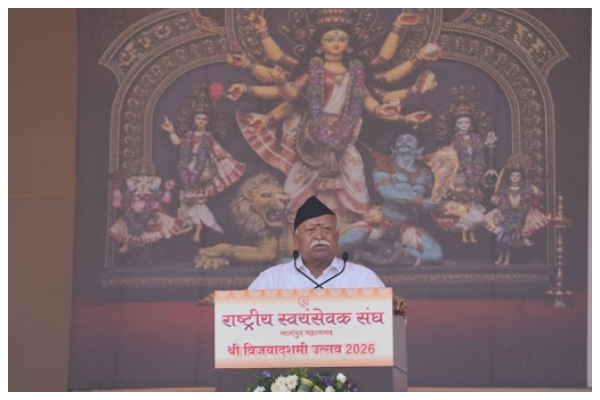
Dr. Bhagwat referred to the developments in France, Albania, Bangladesh and Nepal, and said that some forces wanted to destabilise the world for their own selfish interests. But, in India, talk of 'regime change' would not succeed. The West wants India but not a strong one. He argued that India’s leadership, national pride and social awakening had strengthened the country’s global position, making it a 'decisive and most formidable' power. Hence, some forces were seeking to weaken it.
Sanjay Gupta, Editor-in-Chief of Dainik Jagran, was the chief guest on this occasion. Deepak Tamshettiwar, Vidarbha Prant Sanghchalak; Shridhar Gadge, Vidarbha Prant Sah Sanghchalak, and Rajesh Loya, Mahanagar Sanghchalak were present on the dais.
Jagdeep Dhankhar, former Vice-President of India; and Yaniv Revach, Israel's Consul General in Mid-West India, were the special invitees for the programme.
Maharashtra Chief Minister Devendra Fadnavis, Union Minister Nitin Gadkari; State Revenue Minister Chandrashekhar Bawankule, Shantakka, Pramukh Sanchalika of Rashtra Sevika Samiti; Ajay Sancheti, former MP, and other dignitaries were present prominently.
Dr. Bhagwat acknowledged that a large society inevitably has problems and that agitations can arise from shortcomings in governance. Agitations were part of democracy. But he insisted that agitations should aim at solutions, remain within constitutional and legal bounds, and avoid creating hostility, bitterness or social division.
He cautioned that agitations could become political tools when driven by antagonism toward individuals, groups or ideologies. Such divisive movements, he said, deepen differences, foster victimhood, erode faith in national institutions, and create disorder -- conditions that the global powers wishing to keep India subdued can exploit.
The RSS chief called for vigilance against divisive propaganda, quoting a Marathi song sung by Asha Bhosle and composed by P Sawalaram that warns of evil forces deepening discrimination and striking at unsuspecting people 'from the dark'. He urged citizens to remain focused on the goal of India’s rise as a global leader.
On the centenary year of the RSS, the Sarsanghchalak presented an extensive account of the organisation's centenary outreach. He said the 'Sampark Abhiyan' had reached 10,19,88,511 households across 4,61,527 villages and 41,076 urban localities.
He added that meetings of 'enlightened citizens' were held in 1,117 districts and attended by 4,26,497 people; 'Sadbhavana' meetings took place in 5,036 'Khands'; Hindu Sammelans were organised in 34,187 'Mandals'; and youth gatherings drew 39,25,225 participants.
Dr. Bhagwat also said RSS workers had visited other countries to present a correct understanding of India, Hindutva and the Sangh. He claimed growing global curiosity about India reflected a search for answers to problems created by materialism, individualism, environmental stress, social fragmentation and weakening family values.
The RSS chief's speech placed the centenary outreach within the organisation's 'Panch Parivartan' framework: Samarasata (social harmony), Kutumb Prabodhan (family enlightenment), Paryavaran (environmental care), Swa-Bodh (selfhood) and Swadeshi, and Nagari Kartavya (civic duties). He described these not as one-year campaigns but as a continuing effort to change conduct, form habits and build character.
He said the initiative to awaken Swa-Bodh, a deeper consciousness of selfhood and national identity, and adopt Swadeshi in daily life was especially important. In his view, India’s diversity of faiths, languages, regions, castes and customs could become a source of unity only when people regarded one another with belonging and goodwill.
Invoking the Constitution’s phrase “We, the People of India,” Bhagwat said the Directive Principles guide the strengthening of emotional unity. He argued that India’s Sanatan tradition recognised diversity as natural while affirming an underlying unity of existence.
Dr. Bhagwat welcomed scientific and technological progress but warned against treating technology as an end in itself. He said, development pursued only through a consumerist lens could impose severe social and ecological costs. He pointed to the recent disaster in Nepal and, without naming China, suggested that one-sided development across the Himalayan region may have contributed to it.
He said atomic knowledge could produce either clean energy or weapons of mass destruction, while artificial intelligence could be misused to deceive people and spread falsehoods, including through deepfakes. India, he argued, must offer the world a model of development that combines knowledge with ethics, restraint and practical discipline.
On digital media, Dr. Bhagwat said declining transmission of values from families, schools and society had left young people exposed to unfiltered information. Today, information is available to everyone but the Vivek (pragmatism) of how to use it is becoming rare. He noted that some countries had imposed regulations after experiencing adverse effects, and said Indian society was increasingly demanding similar scrutiny of OTT platforms. He called on the government to consider the issue seriously.
He also described drug addiction as a 'serious national problem' and announced that RSS volunteers would work with anti-drug organisations and citizens to build a nationwide movement against it .
The Sarsanghchalak repeatedly framed the RSS’s idea of Hindu society as inclusive. He said the 'Hindu view' was not defined by a particular mode of worship, food habit, caste, language, region or political ideology, but by spirituality, humanity and universal brotherhood.
Devotion to Bharat Mata, pride in shared ancestry and commitment to India’s civilisational values were compatible with diversity and modernity, he added. A strong and organised Hindu society, he argued, would strengthen national unity and respect for all faiths.
Dr. Bhagwat cited Flydubai aircraft pilot Captain Smit Machchar as an example of this spirit, saying his courage in protecting others reflected the Hindu ethos of goodwill, service, and considering the world as one family.
Rejecting the idea that government alone can solve social problems, the RSS chief said that community initiative and dialogue were equally essential. He cited an RSS-supported study of 1,296 rural schools across 210 districts in 21 regions, which found that where villagers participated and volunteers assisted, student attendance, learning levels and parental involvement improved.
He said such work covering education, infrastructure, sports, cultural activities and value-based programmes was part of a broader effort to build self-respect, self-reliance and civic participation.
Dr. Mohan Bhagwat recalled the anti-partition movement in Bengal, saying 'Vande Mataram' had helped unite people against Lord Curzon's attempt to divide the province. He said the national song should be sung "in its entirety, with pride and in a loud, clear voice".
His core message was that India must resist external and internal attempts to divide it, cultivate discernment in the digital age, and pursue ethical development, and build unity through everyday conduct. "That society alone which remains firmly rooted in mutual affection, discipline, and unwavering commitment to its national goal achieves unity and attains invincible strength," he concluded.
Earlier, the RSS chief paid tributes to Sant Shiromani Ravidas Maharaj on the saint's 650th birth anniversary, Swami Shraddhanand on 100 years since his martyrdom, and also Swami Lakshmananand Saraswati Maharaj from Odisha in his birth centenary year. He also remembered the late Rajnarayan Basu from Bengal, the inspirer and pioneer of the 'Hindu Mela', on Basu's bicentennial birth anniversary.
Dr. Bhagwat said forces seeking global dominance were attempting to create instability among nations and place their own agents in power to serve selfish interests. "They devise plans and work towards finding ways to dismantle Bharat, Hindu society, and Sangh," he said, adding that some political leaders, driven by 'petty political interests' and a lack of discernment, were assisting such efforts.
Dr. Bhagwat referred to the developments in France, Albania, Bangladesh and Nepal, and said that some forces wanted to destabilise the world for their own selfish interests. But, in India, talk of 'regime change' would not succeed. The West wants India but not a strong one. He argued that India’s leadership, national pride and social awakening had strengthened the country’s global position, making it a 'decisive and most formidable' power. Hence, some forces were seeking to weaken it.
Sanjay Gupta, Editor-in-Chief of Dainik Jagran, was the chief guest on this occasion. Deepak Tamshettiwar, Vidarbha Prant Sanghchalak; Shridhar Gadge, Vidarbha Prant Sah Sanghchalak, and Rajesh Loya, Mahanagar Sanghchalak were present on the dais.
Jagdeep Dhankhar, former Vice-President of India; and Yaniv Revach, Israel's Consul General in Mid-West India, were the special invitees for the programme.
Maharashtra Chief Minister Devendra Fadnavis, Union Minister Nitin Gadkari; State Revenue Minister Chandrashekhar Bawankule, Shantakka, Pramukh Sanchalika of Rashtra Sevika Samiti; Ajay Sancheti, former MP, and other dignitaries were present prominently.
'Agitations must seek solutions, not become political tools'
He cautioned that agitations could become political tools when driven by antagonism toward individuals, groups or ideologies. Such divisive movements, he said, deepen differences, foster victimhood, erode faith in national institutions, and create disorder -- conditions that the global powers wishing to keep India subdued can exploit.
The RSS chief called for vigilance against divisive propaganda, quoting a Marathi song sung by Asha Bhosle and composed by P Sawalaram that warns of evil forces deepening discrimination and striking at unsuspecting people 'from the dark'. He urged citizens to remain focused on the goal of India’s rise as a global leader.
On RSS centenary outreach
He added that meetings of 'enlightened citizens' were held in 1,117 districts and attended by 4,26,497 people; 'Sadbhavana' meetings took place in 5,036 'Khands'; Hindu Sammelans were organised in 34,187 'Mandals'; and youth gatherings drew 39,25,225 participants.
Dr. Bhagwat also said RSS workers had visited other countries to present a correct understanding of India, Hindutva and the Sangh. He claimed growing global curiosity about India reflected a search for answers to problems created by materialism, individualism, environmental stress, social fragmentation and weakening family values.
On 'Panch Parivartan'
He said the initiative to awaken Swa-Bodh, a deeper consciousness of selfhood and national identity, and adopt Swadeshi in daily life was especially important. In his view, India’s diversity of faiths, languages, regions, castes and customs could become a source of unity only when people regarded one another with belonging and goodwill.
Invoking the Constitution’s phrase “We, the People of India,” Bhagwat said the Directive Principles guide the strengthening of emotional unity. He argued that India’s Sanatan tradition recognised diversity as natural while affirming an underlying unity of existence.
On Technology, OTT and Drug Addiction
He said atomic knowledge could produce either clean energy or weapons of mass destruction, while artificial intelligence could be misused to deceive people and spread falsehoods, including through deepfakes. India, he argued, must offer the world a model of development that combines knowledge with ethics, restraint and practical discipline.
On digital media, Dr. Bhagwat said declining transmission of values from families, schools and society had left young people exposed to unfiltered information. Today, information is available to everyone but the Vivek (pragmatism) of how to use it is becoming rare. He noted that some countries had imposed regulations after experiencing adverse effects, and said Indian society was increasingly demanding similar scrutiny of OTT platforms. He called on the government to consider the issue seriously.
He also described drug addiction as a 'serious national problem' and announced that RSS volunteers would work with anti-drug organisations and citizens to build a nationwide movement against it .
'Hindu spirit as inclusive nationalism'
Devotion to Bharat Mata, pride in shared ancestry and commitment to India’s civilisational values were compatible with diversity and modernity, he added. A strong and organised Hindu society, he argued, would strengthen national unity and respect for all faiths.
Dr. Bhagwat cited Flydubai aircraft pilot Captain Smit Machchar as an example of this spirit, saying his courage in protecting others reflected the Hindu ethos of goodwill, service, and considering the world as one family.
'Change has to be community-led'
He said such work covering education, infrastructure, sports, cultural activities and value-based programmes was part of a broader effort to build self-respect, self-reliance and civic participation.
'Vande Mataram united people when British partitioned Bengal'
His core message was that India must resist external and internal attempts to divide it, cultivate discernment in the digital age, and pursue ethical development, and build unity through everyday conduct. "That society alone which remains firmly rooted in mutual affection, discipline, and unwavering commitment to its national goal achieves unity and attains invincible strength," he concluded.
Earlier, the RSS chief paid tributes to Sant Shiromani Ravidas Maharaj on the saint's 650th birth anniversary, Swami Shraddhanand on 100 years since his martyrdom, and also Swami Lakshmananand Saraswati Maharaj from Odisha in his birth centenary year. He also remembered the late Rajnarayan Basu from Bengal, the inspirer and pioneer of the 'Hindu Mela', on Basu's bicentennial birth anniversary.