The Divine Architect's Heirs: From Neglect to Renaissance
Honoring the divine Architect Vishwakarma restores lost dignity to skilled artisans who built Bharat"s temples.
Total Views |


We worship Bhagwan Vishwakarma as the divine architect who built Dwarka, Amravati, and Indraprastha, fashioned the weapons of the gods, and shaped the very form of creation. Yet we have grown careless with both the craft and the craftsman—neglecting the pottery, weaving, metalwork, and sculpture that have kept that sacred act of creation alive for thousands of years. Every temple spire, every wedding mandap, every murti installed with such devotion, exists because someone's grandfather taught their father a skill that no modern university ever certified and no economic policy ever quite valued. We claim this as our heritage. We rarely acknowledge it as a debt we owe their families.
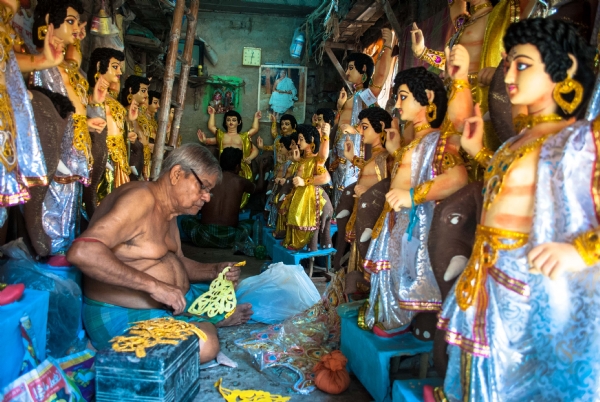
Image Source: Wikimedia Commons
That debt is finally getting a hearing. This September 17, when Vishwakarma Jayanti is observed in workshops and industries across the country, it arrives at a time of renewed focus on our artisan communities. When the World Hindu Congress gathers in Mumbai this December, under the theme "Samanam Vratam Saha Cittam" - Shared Commitment, Collective Resolve, Vishwakarmas will stand for the first time as one of its four central pillars, alongside Bhasha, Samaj and Dharma. In the centenary year of the Rashtriya Swayamsevak Sangh, a global assembly of Hindu thinkers, entrepreneurs and policymakers will place the artisans at the same table as achievers in other fields.
To understand why, one has to go back to what these skills and crafts have actually meant to Hindu life. Even the Yajurveda praises the work of carpenters, potters, smiths, and weavers as sacred, treating skilled craft as an essential part of dharma. Names that sound like mere trade categories today, Sonar, Kumbhkar, Lohar, Sutar, Rangrez, Kansara, are the living lineages that built the Chola and Chalukya temples and iron pillar of Delhi, wove the silks of Kanchipuram, Varanasi, Patan and Sualkuchi, and continue, quietly, to make our festivals and life-cycle rituals possible. A wedding without the goldsmith, the tailor and the drummer is not really a Hindu wedding. This is not mere folklore. It is our social architecture, and historically, it was always revered as sacred.
Which makes its slow unravelling harder to accept. Chroniclers of the medieval period like historian KS Lal recorded how punishing revenue demands under centuries of oppressive Islamic rule, taxation that at times consumed over half of what a family produced, drove entire villages of artisans to abandon their trades and flee into the forests. British colonial policy then delivered a second blow, strategically dismantling local industries that had sustained communities for generations, while extracting Bharat’s raw materials and flooding its markets with cheap goods. Independent Bharat, for all its promise, has allowed a third, quieter erosion: policy neglect, a failure to integrate technology with traditional skills, and an influx of cheap imports have made ancestral trades so unviable that children of artisan families now routinely walk away from what their forefathers perfected. What began centuries ago as economic hardship has become something more troubling, a slow erasure of memory, identity and self-respect.
There are signs the tide may be turning. The PM Vishwakarma Yojana has registered close to 30 lakh artisans across 18 trades, extending collateral-free loans, toolkits and training stipends unthinkable for this workforce a generation ago. Exhibitions such as the recent Vishwakarma Haat in Delhi, where craftsmen from every state sold directly to buyers instead of through layers of middlemen, show what happens when the state treats artisans as economic actors rather than a welfare footnote. These are genuine steps. But a toolkit grant, however useful, cannot by itself convince a young man from a family of coppersmiths that his inheritance is worth continuing. Government schemes can put money in an artisan's hands. Only society can put respect back into their craftsmanship.
This is the gap the World Hindu Congress is stepping into by giving Vishwakarmas their own plenary session this year. Hindu resurgence cannot be achieved while the hands that carve our temples, bind our texts and infuse life into our celebrations are left to fend for themselves. Bringing entrepreneurs, policymakers and artisan communities into the same room to discuss market access, skill transmission and fair credit is more than sound economics - it is an effort to restore dignity to the hands that built Bharat’s cultural heritage.
Recognising and reviving these skills, which are one of the pillars of our economy, is a civilisational obligation we owe to ourselves. The authenticity of our rituals, the richness of our festivals and the social harmony we take such pride in all rest on the quiet, uninterrupted hard work and creativity of the Vishwakarmas. If Hindu society is serious about renewal, it must begin with a simple act of remembering: the divine architect's greatest creation was not a city or a weapon, but the idea that skilled human hands, patiently trained and rightly honoured, are themselves a form of worship. Restoring dignity to those hands is unfinished work for all of us, not for artisans alone.
By Swami Vigyananand, Joint General Secretary, Vishva Hindu Parishad and Initiator, World Hindu Congress
By Swami Vigyananand, Joint General Secretary, Vishva Hindu Parishad and Initiator, World Hindu Congress