The Questions That Refuse to Remain Silent
Book Review of Muslim Women Through the Prism of Muslim Scholars by Dr. Shruti Anerao
Total Views |


— Shailja Tewari
Some books begin with an answer, while others begin with a question. Before trying to understand any society, however, there is a more basic question: how do we understand a society from within, through its own experiences, ideas and ways of thinking and expression? This is, in simple terms, the question of an academic perspective.
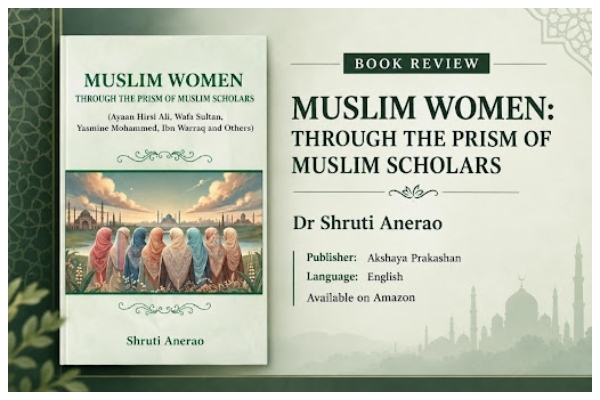
This question becomes particularly interesting when people from within a society begin to speak about its difficult or uncomfortable realities. Muslim Women: Through the Prism of Muslim Scholars by Dr. Shruti Anerao brings together precisely such voices. Drawing upon autobiographies, scholarly works and writings by women activists and critics, the book examines the condition of women in Islamic societies and gradually moves towards larger questions of freedom, religious interpretations and need of social reform.
What surprises us most was the range of voices the book brings out together and juxtaposes and analyzes the common experiences of women from different strata from different countries.
The Question of Reform
The Introduction immediately sets an important framework. Dr. Anerao does not treat religion as something completely fixed or unchanging. Her discussion of Christianity, Judaism, Buddhism, Zoroastrianism and Hindu traditions shows how religious traditions have responded to change in various circumstances under which they got transformed over a period of time.
When Patriarchy Becomes Personal
Chapter 2 brings these abstract questions into lived experiences in case of Tehmina Durrani's My Feudal Lord. Durrani's account makes patriarchy tangible not simply as a theoretical concept but through restriction, surveillance, dependence and violence. Her story also shows that wealth, political influence or social status do not necessarily translate into freedom for women. What makes her narrative significant is the movement from victimhood towards agency. She begins to question a relationship that had once seemed inevitable. Her refusal to accept the established terms of her marriage becomes an act of self-recognition.
Through Jean Sassoon’s Princess Trilogy, the discussion expands towards restrictions to women's mobility, education, marriage and autonomy in Saudi society. Here, an important distinction emerges between religious interpretation, culture and inherited social practice. When an evil social practice is defended in the name of religion, who has the authority to prevent a question that are posed by the victims?
Chapters 3 and 4 take this question further through Wafa Sultan in her A God Who Hates and Dr. Majid Rafizadeh’s A God Who Hates Women, Sultan's questioning is shaped by her experience of witnessing the killing of her professor in Syria. What begins as personal trauma develops into questions about religion, violence and society. Rafizadeh's A God Who Hates Women similarly connects personal experience with larger questions of gender and social conditioning. His observations of vicissitudes in life of her mother.
When Questioning Becomes Rebellion
Chapter 5, is focusing on Ayaan Hirsi Ali's Infidel, it marks a more radical movement, from suffering and questioning towards open intellectual dissent. Her experiences of female genital mutilation, restrictions on women, domestic violence and religious instruction become the basis for deeper questions about religious faith and treatment to women in Muslim society. One of the most striking aspects of her story is the conflict between belief and stark realities of life. Her questions become increasingly direct: if God is just, why are women treated unequally? If a religion is a religion of truth, why should questioning its interpretations be discouraged?
Freedom Has Many Faces
Chapter 6 brings together Malala Yousafzai, Yasmin Mohammed and Taslima Nasrin. Their circumstances are very different, but their experiences converge around the meaning of freedom. For Malala, education becomes the central symbol of freedom for which she fought. Under the Taliban, simply going to school becomes an act of courage. Yasmin Mohammed's Unveiled shifts the discussion into the family, exploring childhood abuse, rigid expectations and resistance resulting in fatal consequences.Taslima Nasrin adds another dimension through her struggle for the freedom to write, speak and disagree.
From Personal Stories to Text and Institutions
The book then moves from personal narratives towards textual and intellectual critique through Ibn Warraq's Why I Am Not a Muslim. The focus shifts to scripture, interpretation and law, particularly questions surrounding marriage, divorce, inheritance, testimony, veiling and gender roles. This shift is important because it asks how religious interpretations become institutional practices. The comparison with Swami Vivekananda's reflections on women's status in India also widens the discussion beyond a single tradition.
Reform, But of What Kind?
What Stayed With Me
For me, this book became more than a discussion of Muslim women. It became an invitation to think about how a society examines itself and how a tradition responds when voices from within begin to question it. The book is genuinely an eye-opener for me. At several points, I found myself stopping to reconsider assumptions I had taken for granted. The same question can look very different when approached through the personal experience of Muslim women from different geographical and social backgrounds.