Abdullah’s Dangerous Pakistan Narrative
Abdullah cannot have it both ways - criticise New Delhi for its intentions while assuming that Islamabad’s intentions deserve a more charitable interpretation
NewsBharati 26-Oct-2026 12:33:48 PM
Total Views |


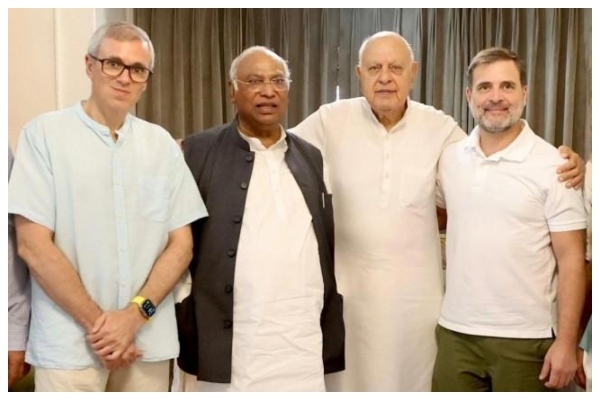
Farooq Abdullah owes the people of the country a clear explanation for his latest remarks portraying Pakistan as a protector of Kashmiris. But before that he needs to be condemned strongly and in no uncertain words. Speaking at a National Conference workers’ convention in Baramulla on October 24, the former Jammu and Kashmir Chief Minister suggested that Pakistan’s efforts to keep the Kashmir issue alive internationally were helping save Kashmiris, while questioning the intentions of the government in New Delhi
The question is not whether Abdullah has the right to criticise the Centre. The question is whether criticism of an elected government should lead to a portrayal of Pakistan as the defender of Kashmiri interests. These are two different propositions, and Abdullah must explain the reasoning behind his statement.
Pakistan’s role in Kashmir cannot be assessed merely by counting the international forums where it raises the issue. Its historical record must also be considered. In October 1947, tribal raiders backed by Pakistan invaded Jammu and Kashmir. The invasion brought violence and suffering to the region. Abdullah himself has previously condemned the atrocities committed by the raiders and paid tribute to Maqbool Sherwani, whose resistance helped impede their advance towards Baramulla.
That historical episode makes the present controversy particularly striking. How does a leader who acknowledges the atrocities associated with the 1947 invasion now describe Pakistan’s international campaign as something that helps save Kashmiris? Does raising a territorial dispute before international forums automatically make a country a well-wisher of the people concerned?
For decades, India has accused Pakistan of supporting cross-border terrorism in Jammu and Kashmir. Militancy has claimed civilian and security-force lives, disrupted ordinary life and left families bearing the consequences of violence. Pakistan disputes aspects of India’s accusations, but the history of militancy and the resulting suffering cannot simply be excluded from any serious assessment of Islamabad’s role.
If Pakistan is protecting Kashmiris, Abdullah must explain how that claim can be reconciled with this record. Protecting Kashmiris or Keeping the Dispute Alive? Abdullah’s own argument deserves closer scrutiny. According to his remarks, Pakistan’s continued assertion that Kashmir’s future remains unresolved is helping protect the people of Jammu and Kashmir. But keeping a territorial dispute alive internationally is not the same as protecting the people who live in the disputed region.
What tangible protection does Pakistan provide to Kashmiris? Does Abdullah mean protection from terrorism, economic hardship, political uncertainty or alleged injustices by the Indian government? Or does he believe that international pressure on India is itself a sufficient guarantee of Kashmiri interests? These questions are not rhetorical distractions. They go to the heart of his statement.
Pakistan’s position on Kashmir is not detached from its own territorial and strategic interests. Its diplomatic campaign must be judged in that context. Internationalising an issue may serve a country’s foreign-policy objectives without necessarily improving the lives of the people invoked in its arguments.
Abdullah cannot have it both ways - criticise New Delhi for its intentions while assuming that Islamabad’s intentions deserve a more charitable interpretation. What About the People Across the Line of Control? If Abdullah wants to evaluate the welfare of Kashmiris, his assessment should extend beyond the Indian side of the Line of Control. The people living in Pakistan-occupied Jammu and Kashmir also have political, economic and civil concerns. Their circumstances deserve scrutiny on their own merits. Why should Pakistan’s treatment of these populations be excluded from an assessment of its claim to represent Kashmiri interests?
There is a legitimate debate to be had about the political status of Jammu and Kashmir, statehood, civil liberties, economic development and the relationship between the Union government and the region. However, criticism of the Centre does not require portraying Pakistan as a protector. Nor does defending the rights of Kashmiris require accepting Islamabad’s narrative.
Abdullah also reiterated that his party did not regard itself as an enemy of India and affirmed Jammu and Kashmir’s accession to India. That clarification is relevant, but it does not eliminate the need to explain his description of Pakistan’s role. A political leader’s position must be assessed in its entirety. Affirming Indian identity while suggesting that Pakistan is helping save Kashmiris creates an obvious tension that deserves clarification. Abdullah must explain what he intended to convey, what evidence supports his assessment and whether he recognises the distinction between legitimate international diplomacy and Pakistan’s pursuit of its own claims over Kashmir.
The principal responsibility rests with Farooq Abdullah. He made the statement, and he must explain it. He should clarify whether he was referring only to Pakistan’s diplomatic efforts or endorsing a broader claim that Pakistan protects Kashmiri interests. He should also explain how his assessment accounts for the region’s history of violence and Pakistan’s role in the conflict.
The response of his political allies is a separate but important question. The Congress, which has an alliance with the National Conference in Jammu and Kashmir, must make its own position clear. On October 25, the Jammu and Kashmir Congress distanced itself from Abdullah’s remarks and maintained that Pakistan had no right to interfere in India’s internal affairs. That response is a useful clarification, but the wider INDIA alliance must also be clear about its position. Do its constituent parties agree with Abdullah’s assessment of Pakistan’s role, or do they reject it? Political alliances need not share identical views on every issue, but a statement of this significance warrants an unambiguous response.
The issue should not be reduced to partisan name-calling or demands for punitive action unsupported by a legal determination. The stronger democratic response is to insist on evidence, consistency and accountability.
The country is entitled to question Abdullah for his assessment of Pakistan. Who, precisely, is Pakistan protecting and how? Farooq Abdullah owes the nation an answer.
This is not an ordinary political criticism of the Union government. It raises a fundamental question - how can Pakistan’s international campaign on Kashmir be presented as a source of protection without confronting the country’s record of conflict, militancy and cross-border terrorism? Abdullah is an experienced politician who has occupied the highest elected office in Jammu and Kashmir. His words therefore carry political weight and demand more than a casual clarification.
The question is not whether Abdullah has the right to criticise the Centre. The question is whether criticism of an elected government should lead to a portrayal of Pakistan as the defender of Kashmiri interests. These are two different propositions, and Abdullah must explain the reasoning behind his statement.
Pakistan’s role in Kashmir cannot be assessed merely by counting the international forums where it raises the issue. Its historical record must also be considered. In October 1947, tribal raiders backed by Pakistan invaded Jammu and Kashmir. The invasion brought violence and suffering to the region. Abdullah himself has previously condemned the atrocities committed by the raiders and paid tribute to Maqbool Sherwani, whose resistance helped impede their advance towards Baramulla.
That historical episode makes the present controversy particularly striking. How does a leader who acknowledges the atrocities associated with the 1947 invasion now describe Pakistan’s international campaign as something that helps save Kashmiris? Does raising a territorial dispute before international forums automatically make a country a well-wisher of the people concerned?
For decades, India has accused Pakistan of supporting cross-border terrorism in Jammu and Kashmir. Militancy has claimed civilian and security-force lives, disrupted ordinary life and left families bearing the consequences of violence. Pakistan disputes aspects of India’s accusations, but the history of militancy and the resulting suffering cannot simply be excluded from any serious assessment of Islamabad’s role.
If Pakistan is protecting Kashmiris, Abdullah must explain how that claim can be reconciled with this record. Protecting Kashmiris or Keeping the Dispute Alive? Abdullah’s own argument deserves closer scrutiny. According to his remarks, Pakistan’s continued assertion that Kashmir’s future remains unresolved is helping protect the people of Jammu and Kashmir. But keeping a territorial dispute alive internationally is not the same as protecting the people who live in the disputed region.
What tangible protection does Pakistan provide to Kashmiris? Does Abdullah mean protection from terrorism, economic hardship, political uncertainty or alleged injustices by the Indian government? Or does he believe that international pressure on India is itself a sufficient guarantee of Kashmiri interests? These questions are not rhetorical distractions. They go to the heart of his statement.
Pakistan’s position on Kashmir is not detached from its own territorial and strategic interests. Its diplomatic campaign must be judged in that context. Internationalising an issue may serve a country’s foreign-policy objectives without necessarily improving the lives of the people invoked in its arguments.
Abdullah cannot have it both ways - criticise New Delhi for its intentions while assuming that Islamabad’s intentions deserve a more charitable interpretation. What About the People Across the Line of Control? If Abdullah wants to evaluate the welfare of Kashmiris, his assessment should extend beyond the Indian side of the Line of Control. The people living in Pakistan-occupied Jammu and Kashmir also have political, economic and civil concerns. Their circumstances deserve scrutiny on their own merits. Why should Pakistan’s treatment of these populations be excluded from an assessment of its claim to represent Kashmiri interests?
The rights of citizens must be protected regardless of which government administers their territory. But the same standard must apply to Pakistan. A country cannot establish its credentials as a protector merely by criticising another country. Its own record, policies and treatment of the people concerned must also be examined. Abdullah’s statement leaves this essential question unanswered. Is he evaluating Pakistan by the standards of governance and public welfare, or by its willingness to challenge India internationally?
There is a legitimate debate to be had about the political status of Jammu and Kashmir, statehood, civil liberties, economic development and the relationship between the Union government and the region. However, criticism of the Centre does not require portraying Pakistan as a protector. Nor does defending the rights of Kashmiris require accepting Islamabad’s narrative.
Abdullah also reiterated that his party did not regard itself as an enemy of India and affirmed Jammu and Kashmir’s accession to India. That clarification is relevant, but it does not eliminate the need to explain his description of Pakistan’s role. A political leader’s position must be assessed in its entirety. Affirming Indian identity while suggesting that Pakistan is helping save Kashmiris creates an obvious tension that deserves clarification. Abdullah must explain what he intended to convey, what evidence supports his assessment and whether he recognises the distinction between legitimate international diplomacy and Pakistan’s pursuit of its own claims over Kashmir.
The principal responsibility rests with Farooq Abdullah. He made the statement, and he must explain it. He should clarify whether he was referring only to Pakistan’s diplomatic efforts or endorsing a broader claim that Pakistan protects Kashmiri interests. He should also explain how his assessment accounts for the region’s history of violence and Pakistan’s role in the conflict.
The response of his political allies is a separate but important question. The Congress, which has an alliance with the National Conference in Jammu and Kashmir, must make its own position clear. On October 25, the Jammu and Kashmir Congress distanced itself from Abdullah’s remarks and maintained that Pakistan had no right to interfere in India’s internal affairs. That response is a useful clarification, but the wider INDIA alliance must also be clear about its position. Do its constituent parties agree with Abdullah’s assessment of Pakistan’s role, or do they reject it? Political alliances need not share identical views on every issue, but a statement of this significance warrants an unambiguous response.
The issue should not be reduced to partisan name-calling or demands for punitive action unsupported by a legal determination. The stronger democratic response is to insist on evidence, consistency and accountability.
Farooq Abdullah has spent decades in public life and has served as Chief Minister of Jammu and Kashmir. He understands the region’s complicated history and the consequences of political instability. His experience makes a precise explanation all the more necessary. The burden of explanation, in this case, rests on the person who made the claim.

Editor's Desk
Editor's Desk