After 36 years of struggle, Maa Durga’s worship returns to Bengal’s Rani Pukur
The immersion tradition at Basantia"s Rani Pukur faced difficulties after protests in 1990.
Total Views |


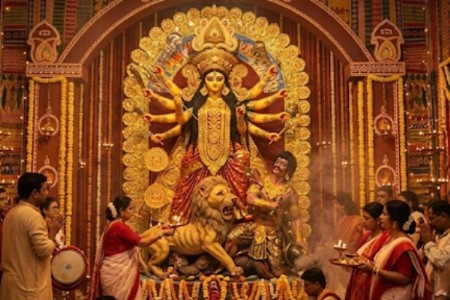
Thirty-six years is a long time for a religious tradition to remain interrupted. At Basantia’s Rani Pukur in West Bengal’s Paschim Medinipur district, the reported immersion of Maa Durga’s idol on October 25, 2026, has been described by local sources as the revival of a tradition that Hindu residents had struggled to continue.
About 1,000 Bengali Hindu youths reportedly joined the procession, turning the occasion into a significant community gathering. More than the immersion itself, the event has drawn attention to the reported difficulties surrounding the worship and observance of the tradition over the decades.
 The full history of the interruption, its impact on pujan and the role of successive administrations require confirmation through local organisers, police records, court documents and official statements. The episode nevertheless brings into focus a fundamental question: how can communities sustain their religious traditions while ensuring that public observances proceed peacefully and the rights of all are respected?
About 1,000 Bengali Hindu youths reportedly joined the procession, turning the occasion into a significant community gathering. More than the immersion itself, the event has drawn attention to the reported difficulties surrounding the worship and observance of the tradition over the decades.
The account traces the interruption to objections in 1990 and alleges that subsequent efforts to resume the practice faced restrictions. The precise history of the 36-year gap, however, requires independent verification.
A tradition amid disputes
Basantia’s Rani Pukur has been associated with disputes over Durga idol immersion. According to local accounts, objections in 1990 disrupted the traditional observance, with subsequent attempts reportedly encountering difficulties during successive Left Front and Trinamool Congress governments.
The Left Front, led by the CPI(M), governed West Bengal from 1977 to 2011. The Trinamool Congress, led by Mamata Banerjee, took power in 2011, followed by the BJP forming the state government for the first time in 2026. However, the claim that successive administrations consistently denied permission for the observance has not been independently established.
The distinction between worship and immersion matters. For devotees, the religious observance extends beyond the final procession to the pond; pujan is central to the tradition. Yet the available account does not establish whether worship itself was prevented throughout the reported interruption or whether the dispute specifically concerned the immersion procession.
A legal record offers some context. In October 1999, proceedings before the Calcutta High Court concerning a Durga Puja committee in the region involved permission for an immersion procession to Rani Pukur along a specified route. The dispute concerned route restrictions, not a complete prohibition on immersion. It remains unclear whether that case is related to the specific tradition discussed here.
A dispute over Durga idol immersion
The immersion tradition at Basantia's Rani Pukur faced difficulties after protests in 1990. The account attributes the interruption to objections from members of the Muslim community and claims that permission remained difficult to obtain during subsequent Left Front and Trinamool Congress governments.
These claims have not been independently established through official records. The distinction is important because restrictions on religious processions can arise from disputes over routes, public order and administrative decisions, and the circumstances may differ from one year to another.
A historical legal record also provides relevant context. In a case before the Calcutta High Court concerning a Durga Puja committee in the region, authorities granted permission in October 1999 for an immersion procession to Rani Pukur along a specified route. The dispute concerned restrictions on the route rather than a complete prohibition on immersion. The record does not establish whether that procession was connected to the specific tradition now being discussed.
After 36 years, Maa Durga’s idol immersion returns to Rani Pukur, Basantia, West Midnapore. 🚩
— BJP Sashi Kumar Subramony 🇮🇳 (@BjpSashi) October 26, 2026
Halted in 1990 after protests by local Muslims and denied by previous regimes, the procession finally took place, led by 1,000+ Hindu youths—a long-awaited moment for the community. 🙏🏻 pic.twitter.com/tL772ba91L
A thousand youths join the procession
According to the account of the October 25 event, approximately 1,000 Bengali Hindu youths participated in the procession carrying Maa Durga’s idol to Rani Pukur. Local sources have presented the event as the resumption of a religious practice after decades of interruption.
The organisers, the permissions granted, the route followed and the arrangements for the immersion have not been independently confirmed.
Religious rights and administrative responsibility
The episode raises questions about religious freedom, access to places of worship and the administration of public religious events. Articles 25 and 26 of the Constitution protect religious freedom, subject to constitutional limitations, including public order.
The 1999 proceedings concerning the Rani Pukur immersion route illustrate the need to balance religious rights with legitimate law-and-order considerations. Restrictions must be assessed in their specific context rather than treated as evidence of a blanket prohibition on worship.
A reported milestone
For the participating community, the October 25 procession represents more than a ceremonial conclusion to Durga Puja. If the reported 36-year interruption is established, the event would mark the resumption of a tradition whose continuity local residents say had been difficult to maintain.