'ISIS' inscribed on Brahmarakshas Murti in Kerala; Police inaction sparks devotee outrage
Despite police visiting the site and conducting a preliminary examination, reports indicate that no formal case was registered following the initial complaint.
Total Views |


In yet another shocking instance highlighting the growing vulnerability of Hindu places of worship under the watch of the secular establishment, the ancient Mohanapuram Mahadeva Venugopala Swami Temple in Pothencode, Thiruvananthapuram district, was brazenly desecrated.
The name of the dreaded Islamic terrorist organization, “ISIS,” was found inscribed on the pedestal of the sacred Brahmarakshas murti not just once, but on two consecutive nights.
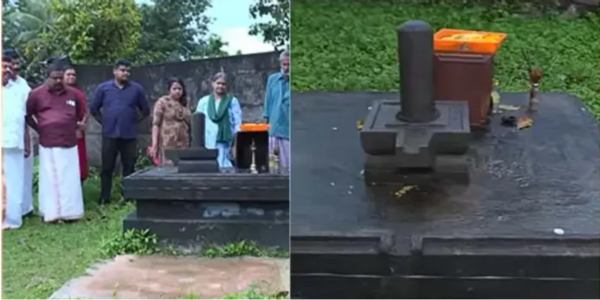
The brazen act has sent shockwaves through the Hindu community, exposing both the audacity of anti-social elements and the criminal laxity of the local law enforcement machinery.
A Chronology of Desecration and Police Indifference
The incident occurred on two consecutive occasions, on 23 and 24 October 2026, at the Mohanapuram Mahadeva Venugopala Swami Temple in Pothencode. It was found that the word “ISIS” was found written on the pedestal of a Brahmarakshas murti.
The temple archaka discovered the writing on the morning of 23 October while arriving to perform the daily pooja and informed the temple committee. Subsequently, the temple lodged a complaint with the Pothencode police.
Despite police visiting the site and conducting a preliminary examination, reports indicate that no formal case was registered following the initial complaint. This decision has since become a point of criticism among devotees and community members who argue that stronger action should have been taken at the outset.
The same act was repeated during the night of 24 October and discovered on the morning of 25 October, prompting the temple committee and devotees to approach the police again. Police personnel subsequently returned to the site with forensic experts to collect evidence, but heavy rainfall reportedly hampered the investigation.
The temple, managed by the Tiruvitamcoor Devaswom Board, had also experienced a theft of jewellery and other items about two years earlier, and the perpetrators were not identified. The repeated writing of “ISIS” on a sacred Hindu murti prompted devotees to demand a thorough investigation into the incident and the identification and arrest of those responsible.
Hindu Aikyavedi chief patron K.P. Sasikala Teacher and Vishwa Hindu Parishad state general secretary Adv. Anil Vilayil condemned the incident, describing it as an attempt to hurt Hindu religious sentiments and create communal tensions. Local residents and devotees also planned protests, including Japa Yathras, to demand action from the authorities. As of 26 October 2026, no arrests had been reported.
Plight of Hindus in KERALAM is evident from this Shiv Ling.
— Yuvraj Gokul (@yuvrajsays) October 27, 2026
ISIS was written on divine Shiv Ling using some iron piece. Also 786 was written on plinth and later made some random drawings on it.
This MahaDev-Maha Vishnu Temple is located in a Hindu minority region in my… pic.twitter.com/0diPOjSCjJ
Following the second complaint, police personnel returned to the temple along with forensic experts to gather evidence from the scene. Investigators reportedly attempted scientific examination of the vandalized area in hopes of identifying potential suspects and establishing the sequence of events.
However, efforts to collect forensic evidence were reportedly hampered by adverse weather conditions. Continuous rainfall in the area allegedly affected the preservation of physical traces that could have assisted investigators, creating additional challenges for the inquiry.
The weather-related difficulties have heightened concerns among devotees, many of whom fear that crucial evidence may have been compromised before it could be properly documented and analyzed.
As of October 26, 2026, investigators were continuing efforts to identify those responsible for the alleged desecration. No arrests were reported in the source article, and authorities were still examining available evidence despite the challenges posed by weather conditions.
The repetition of the act strengthened the concern that the incident was not simply an impulsive act of vandalism. The writing appeared on two consecutive occasions, demonstrating that the temple's sacred space was subjected to repeated interference. Such repetition proved that the perpetrator deliberately targeted the sacred space for desecration. Such actions are rooted in religious hatred towards Hindus and their places of worship.
The desecration of a sacred Hindu murti, the inscription of “ISIS” on its pedestal and the repetition of the act constituted religiously targeted hostility towards Hindu sacred symbols. The act went beyond ordinary vandalism by introducing the identity of an Islamic extremist organisation into a Hindu place of worship, undermining its sanctity and hurting Hindu religious sentiments.
Over the last few decades, the Keralam has been witnessing creeping Islamisation and rapid demographic shift, warning that mainstream political appeasement has allowed radical Islamist elements to gain an unshakeable foothold in the state. The brazen attack on the Mohanapuram Mahadeva Venugopala Swami Temple in Pothencode directly reflects this deep-seated, institutionalised hostility toward the Hindu community. By deliberately inscribing the name of "ISIS" on the pedestal of a sacred Brahmarakshas murti on two consecutive nights, the perpetrators were not engaging in mere property damage, but executing a calculated act of religious terror aimed at asserting extremist Islamist dominance over a consecrated Hindu space.
When law enforcement treats the defacement of a sacred deity with the mark of a global jihadist organisation as a routine matter, it demonstrates how deeply radicalisation and systemic appeasement have compromised the security and religious rights of Hindus in Kerala.