Respect for Institutions Cannot Be Fear-Driven
The same standard must apply irrespective of political affiliation.
NewsBharati 28-Oct-2026 12:08:29 PM
Total Views |


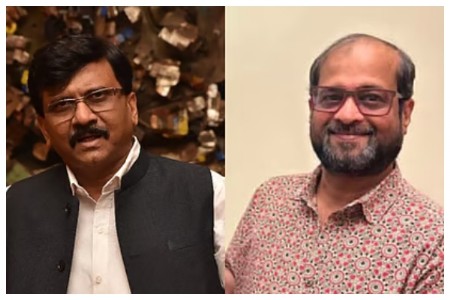
Respect for constitutional authorities and institutions is not a matter of political convenience. It is a fundamental requirement of a functioning democracy and an indicator of social maturity. Whether in public life or personal conduct, the way individuals speak about institutions reveals their understanding of constitutional values, civic responsibility and the limits of legitimate dissent. Recent developments involving the Kerala Pradesh Congress Committee (KPCC), journalist Nikhil Wagle and Shiv Sena (UBT) MP Sanjay Raut raise an important question - why does respect for constitutional institutions so often become visible only when the prospect of legal consequences appears?
The Kerala Congress episode is particularly revealing. On October 12, its official X account demanded the resignation of Chief Justice of India Surya Kant and suggested that the party could find a replacement for him. Following a legal notice from the Supreme Court Bar Association, KPCC president Sunny Joseph tendered an unconditional apology. The party described the post as unauthorised, said the person responsible had been removed and reaffirmed its respect for the Constitution and judicial independence.
The episode followed the controversy involving Wagle and Raut. Wagle had published an abusive post targeting the CJI after the latter declined to meet an opposition delegation and suggested that the matter could be brought before the court through a petition. Wagle subsequently deleted the post and tendered an unconditional apology. Raut, meanwhile, faced scrutiny over remarks alleging that judges attended political programmes and social engagements involving political leaders. The Supreme Court issued contempt notices to both following proceedings initiated by the Supreme Court Bar Association.
These are distinct cases, and their legal positions should not be conflated. Yet they raise a common question about public conduct, institutional dignity and accountability.
India's constitution guarantees freedom of speech and expression. That freedom allows citizens, journalists, political parties and public representatives to criticise judicial decisions, question government policies and expose institutional shortcomings. Constitutional authorities are not beyond scrutiny. Indeed, informed criticism is essential to democracy.
But criticism and contemptuous personal attacks are not interchangeable. Disagreement with a decision does not justify abusive language against the person who delivers it. Nor can unverified allegations against judges be treated as established facts simply because they serve a political argument.
The distinction is fundamental. A mature society does not demand unquestioning obedience to authority; it expects people to exercise their freedoms responsibly. Respect for institutions means recognising their constitutional role even when their decisions are inconvenient or disagreeable.
This principle extends beyond courtrooms and political platforms. The everyday language used by citizens, the conduct of public representatives and the standards maintained in private conversations all contribute to the social environment in which constitutional democracy operates. Respect cannot be confined to formal occasions or ceremonial declarations. It must become part of civic behaviour.
Political leaders have a particular responsibility in this regard. Their words carry influence far beyond their immediate audiences. When they portray constitutional authorities as legitimate only when those authorities agree with them, they encourage a culture of conditional respect. Such conduct risks weakening public confidence in institutions whose credibility depends on their ability to function without political intimidation.
The second issue is the tendency to view constitutional institutions through the narrow lens of political advantage. The immediate controversy arose from the CJI's refusal to meet an opposition delegation. The opposition was entitled to raise concerns about the Election Commission and electoral processes. It could approach the Court through the appropriate legal procedures, challenge decisions and place evidence before the competent authorities. But disagreement with the CJI's response could not, by itself, justify personal abuse or allegations unsupported by verified facts.
The same standard must apply irrespective of political affiliation. No party should demand institutional independence when an institution's position suits its interests and question its legitimacy when it does not. Constitutional principles cannot be selectively invoked.
Political competition is inherent in democracy. Political hostility, however, should not become a licence to undermine every institution that fails to accommodate a party's demands. The judiciary, Election Commission and other constitutional bodies perform distinct functions under the constitutional framework. Their actions can be questioned through lawful and reasoned processes, but attempts to exert pressure through personal attacks raise a different concern.
There is also a wider consequence. Repeated attacks on institutions can encourage citizens to regard every adverse decision as evidence of political conspiracy. Such a climate makes reasoned debate more difficult and public trust more fragile. Those who occupy positions of influence should understand that democratic disagreement requires restraint precisely when passions run high.
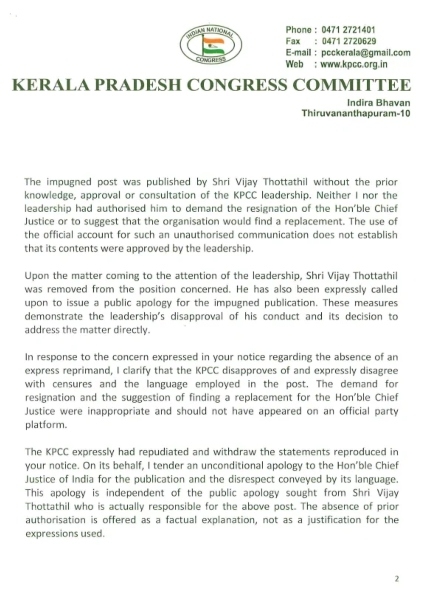
The most important question concerns the apologies and explanations that followed these controversies. In the Kerala Congress case, the apology came after a legal notice. In Wagle's case, the abusive post was deleted and an unconditional apology was tendered after contempt proceedings were initiated. Raut submitted an explanation after the Supreme Court issued notice and publicly reiterated his respect for the Court.
It would be impossible to establish the private motives behind each individual's response merely from the sequence of events. Nevertheless, the timing invites a legitimate question - would the same expressions of regret have followed if there had been no prospect of legal consequences?
An apology can acknowledge a genuine mistake. It can also be an attempt to resolve an immediate legal difficulty. The two possibilities are not necessarily mutually exclusive. What matters in the longer term is whether the apology is accompanied by a change in conduct.
If a public figure recognises that language was inappropriate, the recognition should endure beyond the immediate controversy. If a political party acknowledges failures in its social-media oversight, it should establish safeguards that prevent similar incidents. If a journalist or elected representative accepts the importance of institutional dignity, that understanding should guide future statements as well. Otherwise, an apology risks becoming a procedural response rather than an expression of responsibility.
The distinction matters because law alone cannot cultivate a democratic temperament. Legal proceedings may compel individuals to answer for their conduct and may deter certain forms of behaviour. But they cannot, by themselves, instil the instinct to exercise restraint before publishing an abusive post or making an unverified allegation.
A healthy democracy should not have to depend on legal notices and contempt proceedings to remind influential people of their responsibilities. The law must remain available when required, but respect should precede enforcement.
The same standard should govern political parties, journalists, elected representatives and ordinary citizens. Constitutional offices carry responsibilities that transcend the individuals who occupy them. Respecting those offices does not mean endorsing every decision; it means recognising the institutional framework that protects everyone's rights, including the rights of those who criticise it.
Ultimately, the measure of social maturity is not how quickly people apologise when confronted with the possibility of punishment. It is whether they understand their responsibilities before crossing the line.
India's constitutional culture will deepen when institutional respect becomes habitual rather than compulsory, when political calculations yield to civic responsibility, and when public figures exercise restraint without waiting for a court to remind them of its importance.
The real test of constitutional respect is not what people say when the law demands an explanation, but how they conduct themselves when they believe no consequences will follow.

Editor's Desk
Editor's Desk